Vogl Dan T, Atrash Shebli, Holstein Sarah A, Nadeem Omar, Benson Don, Chaudry Maria, Biran Noa, Suryanarayan Kaveri, Li Cheryl, Liu Yuyin, Collins Sabrina, Parot Xavier, Kaufman Jonathan L
Division of Hematology and Oncology, Abramson Cancer Center, Perelman School of Medicine, University of Pennsylvania, Philadelphia, PA.
Atrium Health Levine Cancer Institute, Wake Forest University School of Medicine, Charlotte, NC.
Blood. 2025 Feb 27;145(9):944-955. doi: 10.1182/blood.2024026124.
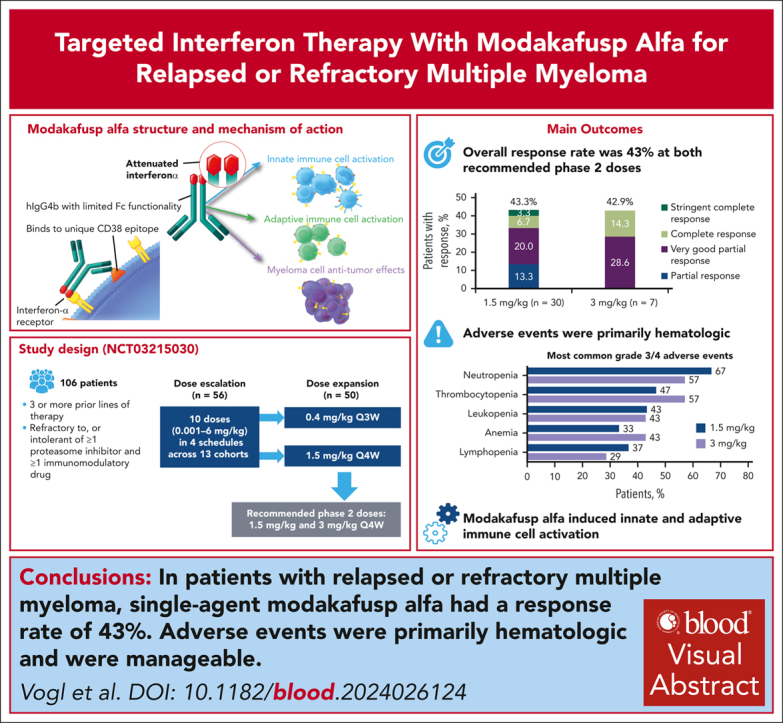
Interferon alfa has activity against multiple myeloma (MM). Modakafusp alfa is an immunocytokine comprising 2 attenuated interferon alfa-2b molecules and an anti-CD38 immunoglobulin G4 antibody, targeting delivery of interferon alfa to CD38-expressing (CD38+) immune and myeloma cells. This phase 1/2 trial enrolled patients with relapsed/refractory multiple myeloma with ≥3 prior lines of treatment and refractory to, or intolerant of, ≥1 proteasome inhibitor and ≥1 immunomodulatory drug. During dose escalation, modakafusp alfa was administered at 10 doses in 4 schedules across 13 cohorts. The primary end point was safety for dose escalation, and overall response rate (ORR) for dose expansion. We enrolled 106 patients who had received a median of 6.5 lines of prior therapy; 84% of patients had myeloma previously refractory to an anti-CD38 antibody. The most feasible dosing schedule was every 4 weeks (Q4W), at which the maximum tolerated dose was 3 mg/kg. Among 30 patients treated at 1.5 mg/kg Q4W, the ORR was 43.3%, with a median duration of response of 15.1 months (95% confidence interval [CI], 7.1-26.1); median progression-free survival was 5.7 months (95% CI, 1.2-14). Grade ≥3 adverse events (AEs) occurred in 28 (93.3%) patients, the most common were neutropenia (66.7%) and thrombocytopenia (46.7%); infections were reported in 8 (26.7%) patients (including grade 3 in 4 [16.7%]). Modakafusp alfa therapy induced upregulation of the type 1 interferon gene signature score, increased CD38 receptor density in CD38+ cells, and innate and adaptive immune cell activation. Modakafusp alfa resulted in antitumor activity and immune activation in patients with MM. AEs were primarily hematologic. This trial was registered at www.clinicaltrials.gov as #NCT03215030.
干扰素α对多发性骨髓瘤(MM)具有活性。莫达卡福斯α是一种免疫细胞因子,由2个减毒的干扰素α-2b分子和1个抗CD38免疫球蛋白G4抗体组成,旨在将干扰素α靶向递送至表达CD38(CD38+)的免疫细胞和骨髓瘤细胞。这项1/2期试验纳入了复发/难治性多发性骨髓瘤患者,这些患者既往接受过≥3线治疗,并且对≥1种蛋白酶体抑制剂和≥1种免疫调节药物耐药或不耐受。在剂量递增阶段,莫达卡福斯α以4种给药方案分10个剂量在13个队列中给药。主要终点是剂量递增阶段的安全性以及剂量扩展阶段的总缓解率(ORR)。我们纳入了106例患者,这些患者既往接受治疗的中位数为6.5线;84%的患者既往对一种抗CD38抗体难治。最可行的给药方案是每4周一次(Q4W),在此方案下最大耐受剂量为3mg/kg。在30例接受1.5mg/kg Q4W治疗的患者中,ORR为43.3%,中位缓解持续时间为15.1个月(95%置信区间[CI],7.1 - 26.1);中位无进展生存期为5.7个月(95%CI,1.2 - 14)。28例(93.3%)患者发生≥3级不良事件(AE),最常见的是中性粒细胞减少(66.7%)和血小板减少(46.7%);8例(26.7%)患者报告有感染(包括4例[16.7%]3级感染)。莫达卡福斯α治疗可诱导1型干扰素基因特征评分上调,增加CD38+细胞中的CD38受体密度,并激活固有免疫细胞和适应性免疫细胞。莫达卡福斯α在MM患者中产生了抗肿瘤活性和免疫激活作用。AE主要为血液学不良反应。本试验已在www.clinicaltrials.gov上注册,注册号为#NCT03215030。