Leśniewski Mateusz, Iłowska Emilia, Sawicka Justyna, Li Zihan, Tang Chun, Liwo Adam
Faculty of Chemistry, University of Gdańsk, Fahrenheit Union of Universities in Gdańsk, Wita Stwosza 63, 80-308 Gdańsk, Poland.
Laboratory of Molecular and Cellular Nephrology, Department of Molecular Biotechnology, Faculty of Chemistry, Mossakowski Medical Research Institute, Polish Academy of Sciences, ul. Adolfa Pawińskiego 5, 02-106 Warsaw, Poland.
J Phys Chem B. 2024 Dec 19;128(50):12403-12415. doi: 10.1021/acs.jpcb.4c06305. Epub 2024 Dec 4.
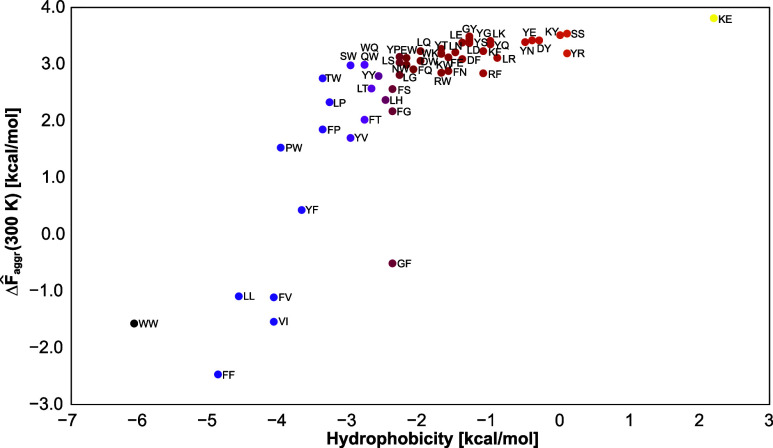
The association of 55 dipeptides extracted from aggregation-prone regions of selected proteins was studied by means of multiplexed replica-exchange molecular dynamics simulations with the coarse-grained UNRES model of polypeptide chains. Each simulation was carried out with 320 dipeptide molecules in a periodic box at 0.24 mol/dm concentration, in the 260-370 K temperature range. The temperature profiles of the degree of association, distributions of dipeptide cluster size, and structures of clusters were examined. It has been found that the dipeptides composed of strongly nonpolar (aromatic or aliphatic) residues associate nearly completely at all temperatures to form tight clusters, while those composed of charged or polar residues exhibited no or residual association. The dipeptides composed of nonpolar and small polar residues and those composed of less hydrophobic residues formed single clusters, gradually dissolving with increasing temperature, while those composed of phenylalanine or tryptophan and polar or charged residues formed multiple irregular clusters with room to accommodate water inside, suggesting the formation of liquid droplets or gels. The logarithms of the average degree of association and the free energy of aggregation per monomer were found to correlate with the dipeptide hydrophobicity.
通过使用多肽链的粗粒度 UNRES 模型进行多重复制交换分子动力学模拟,研究了从选定蛋白质的易聚集区域提取的 55 种二肽的缔合情况。每次模拟在 0.24 mol/dm 浓度的周期性盒子中,于 260 - 370 K 的温度范围内对 320 个二肽分子进行。研究了缔合度的温度分布、二肽簇大小的分布以及簇的结构。结果发现,由强非极性(芳香族或脂肪族)残基组成的二肽在所有温度下几乎完全缔合形成紧密簇,而由带电或极性残基组成的二肽则无缔合或仅有残余缔合。由非极性和小极性残基组成的二肽以及由疏水性较弱的残基组成的二肽形成单个簇,随着温度升高逐渐溶解,而由苯丙氨酸或色氨酸与极性或带电残基组成的二肽形成多个不规则簇,内部有容纳水的空间,表明形成了液滴或凝胶。发现平均缔合度的对数和每个单体的聚集自由能与二肽疏水性相关。