Zhao Kang, Guo Quan, Zhao Zhenzhou, Tang Haiyu, You Ran, Peng Liang, Rao Lixin, Li Muwei
Department of Cardiology, Fuwai Central China Cardiovascular Hospital, Zhengzhou, Henan, China.
Department of Cardiology, Henan Provincial People's Hospital, People's Hospital of Zhengzhou University, Zhengzhou, Henan, China.
BMC Cardiovasc Disord. 2024 Dec 4;24(1):697. doi: 10.1186/s12872-024-04386-w.
This study aims to evaluate the long-term outcomes of patients with large coronary arteries (LCA, reference vessel diameter more than 3.0 mm) de novo lesions treated by drug-coated balloon (DCB) versus second-generation drug-eluting stent (sDES) in real-world clinical practice.
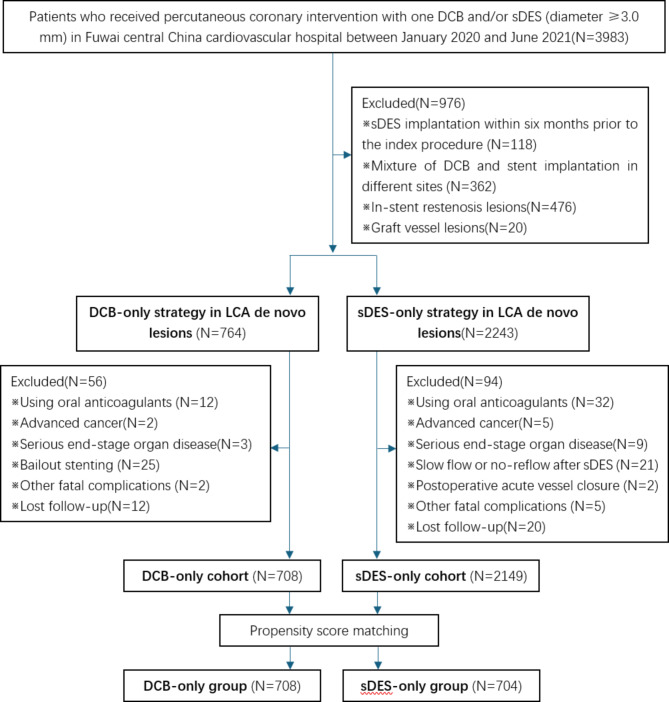
Between January 2020 and June 2021, 2857 consecutive patients with equal number of LCA de novo lesions, including 708 lesions treated with paclitaxel DCB-only (DCB-only cohort) and 2149 lesions with sDES-only (sDES-only cohort), were enrolled in this retrospective study. The primary outcome was the clinically driven target lesion revascularization (CD-TLR) rate at two years. After propensity score matching, 708 patients treated with DCB-only and another 704 patients with sDES-only were successfully matched to study adjusted associations between treatment strategy and outcomes.
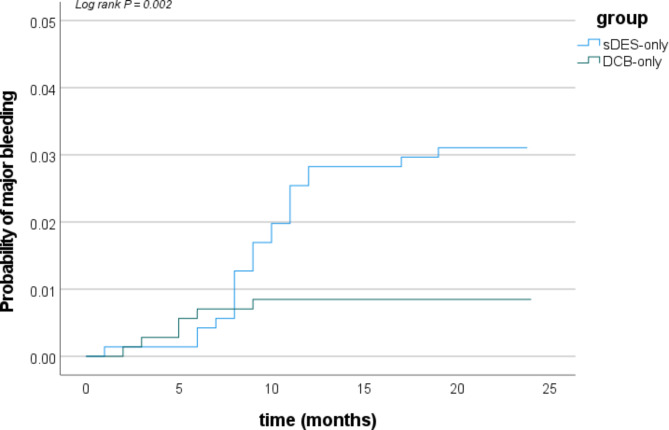
CD-TLR rate was higher in the DCB-only group than sDES-only group (DCB: 5.5%, sDES: 3.1%, P = 0.028). However, lower major bleeding rate was observed in the DCB-only group compared to sDES-only group (0.8% vs. 3.0%, P = 0.003), which benefited from its short duration of antiplatelet therapy. Multivariate logistic regression analysis revealed that hypercholesteremia [odds ratio (OR), 2.516], diabetes (OR, 2.773), severe calcified lesions (OR, 5.184) and residual stenosis>30% (OR, 8.676) were risk predictors (P<0.01) of CD-TLR for DCB-only strategy; meanwhile, diabetes (OR, 3.255) and severe calcified lesions (OR, 2.152) were risk predictors (P<0.01) of CD-TLR for sDES strategy.
DCB-only strategy is feasible for LCA de novo lesions in patients with high bleeding risk, but not suitable in other patients, who should first choose intended stenting strategy especially with unmanageable hypercholesteremia, severe calcified lesions or non-ideal residual stenosis after preprocessing.
本研究旨在评估在真实世界临床实践中,药物涂层球囊(DCB)与第二代药物洗脱支架(sDES)治疗初发大冠状动脉(LCA,参考血管直径大于3.0毫米)病变患者的长期结局。
在2020年1月至2021年6月期间,本回顾性研究纳入了2857例连续的LCA初发病变患者,病变数量相等,其中708例病变仅接受紫杉醇DCB治疗(仅DCB队列),2149例病变仅接受sDES治疗(仅sDES队列)。主要结局是两年时临床驱动的靶病变血运重建(CD-TLR)率。经过倾向评分匹配后,708例仅接受DCB治疗的患者和另外704例仅接受sDES治疗的患者成功匹配,以研究治疗策略与结局之间的调整后关联。
仅DCB组的CD-TLR率高于仅sDES组(DCB:5.5%,sDES:3.1%,P = 0.028)。然而,仅DCB组的严重出血率低于仅sDES组(0.8%对3.0%,P = 0.003),这得益于其较短的抗血小板治疗持续时间。多因素逻辑回归分析显示,高胆固醇血症[比值比(OR),2.516]、糖尿病(OR,2.773)、严重钙化病变(OR,5.184)和残余狭窄>30%(OR,8.676)是仅DCB策略CD-TLR的风险预测因素(P<0.01);同时,糖尿病(OR,3.255)和严重钙化病变(OR,2.152)是sDES策略CD-TLR的风险预测因素(P<0.01)。
仅DCB策略对于出血风险高的LCA初发病变患者是可行的,但不适用于其他患者,其他患者应首选预期的支架置入策略,尤其是对于高胆固醇血症难以控制、严重钙化病变或预处理后残余狭窄不理想的患者。