Takano Keisuke, Uchiyama Satoko, Nagase Shintaro, Tsuchimoto Yuka, Nakanishi Toshihiro, Nakata Yosuke, Pérez-Urquizo Joel, Madéo Julien, Dani Keshav M, Miyamaru Fumiaki
Department of Physics, Faculty of Science, Shinshu University, Nagano 390-8621, Japan.
Department of Electronic Science and Engineering, Kyoto University, Kyoto 615-8510, Japan.
Nanophotonics. 2024 May 20;13(17):3077-3089. doi: 10.1515/nanoph-2024-0010. eCollection 2024 Jul.
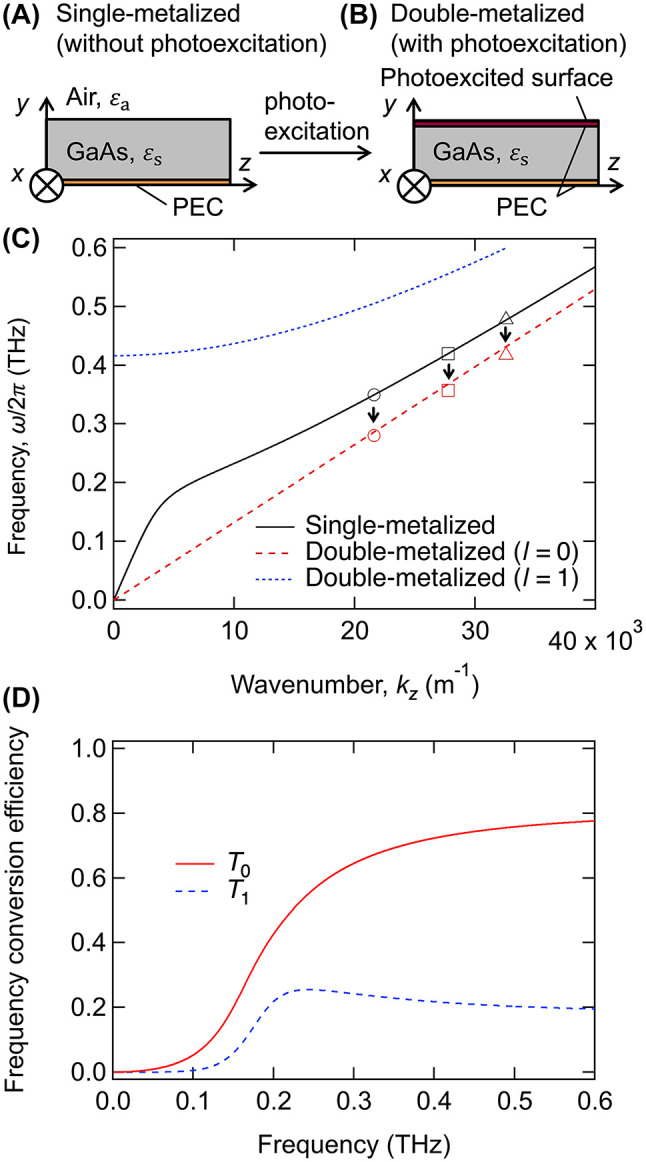
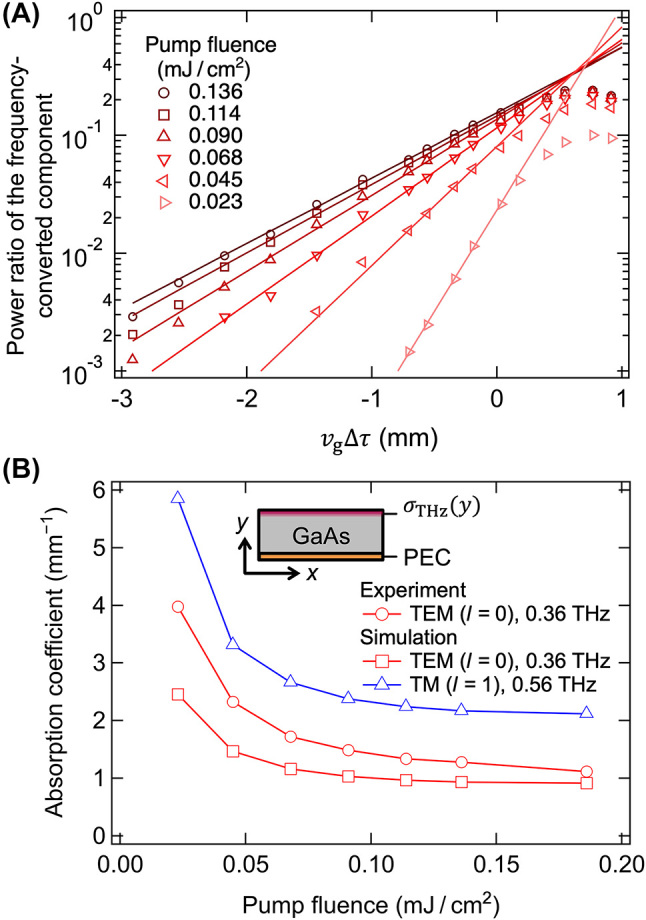
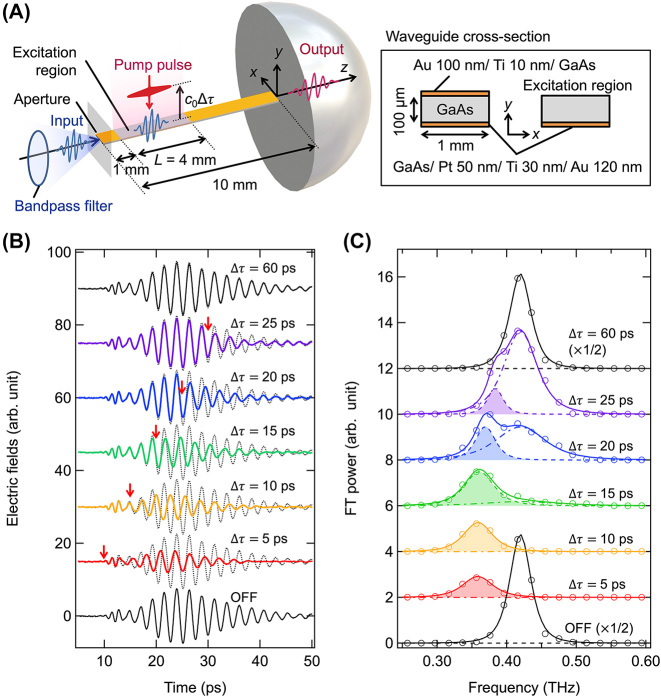
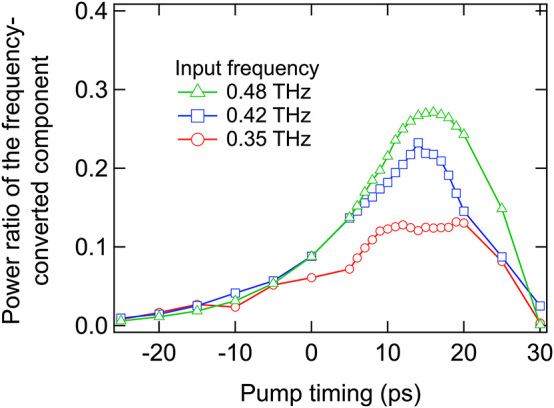
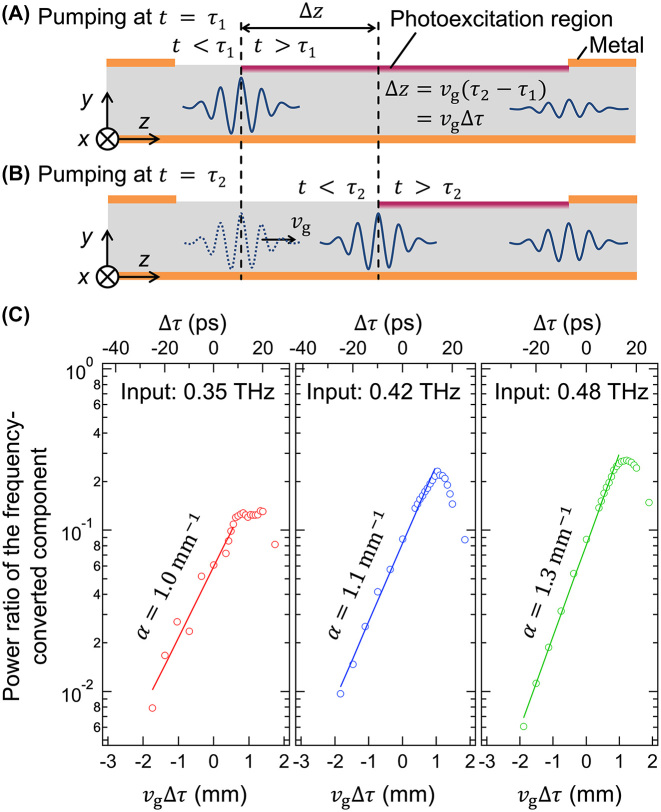
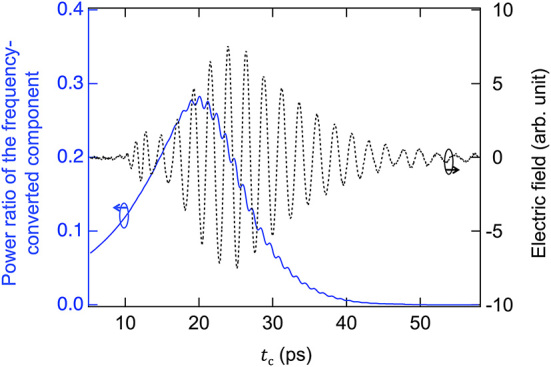
In this study, the frequency down-conversion of terahertz waves is analytically and experimentally demonstrated at the temporal boundaries within a GaAs waveguide. The temporal boundary is established by photoexciting the top surface of the waveguide, thereby instantaneously increasing its electrical conductivity. This photoexcited waveguide supports a transverse electromagnetic (TEM) mode with a frequency lower than those of the transverse magnetic (TM) modes present in the original waveguide. At the temporal boundary, the incident TM mode couples with the TEM mode, resulting in frequency down-conversion. Subtracting the propagation loss from the frequency-converted components indicates that the frequency conversion occurs with an efficiency consistent with the analytical predictions. The propagation loss is primarily due to ohmic loss, caused by the finite electrical conductivity of the photoexcited region. Given that the frequency of transverse electric modes is up-converted at the temporal boundary, our findings suggest that the direction of frequency conversion (upward or downward) can be controlled by manipulating the incident polarization. The polarization-dependent frequency conversion in waveguides holds significant potential for applications in devices designed for the interconversion of terahertz signals across various frequency channels. This capability is instrumental in the development of frequency-division-multiplexed terahertz wave communication systems, thereby enabling high data transfer rates.
在本研究中,通过理论分析和实验验证了太赫兹波在砷化镓波导内的时间边界处发生频率下转换。通过对波导顶面进行光激发来建立时间边界,从而瞬间提高其电导率。这种光激发的波导支持一种横向电磁(TEM)模式,其频率低于原始波导中存在的横向磁(TM)模式的频率。在时间边界处,入射的TM模式与TEM模式耦合,导致频率下转换。从频率转换分量中减去传播损耗表明,频率转换的效率与理论预测一致。传播损耗主要是由于光激发区域有限的电导率引起的欧姆损耗。鉴于横向电模式的频率在时间边界处发生上转换,我们的研究结果表明,可以通过控制入射极化来控制频率转换的方向(向上或向下)。波导中与极化相关的频率转换在用于太赫兹信号跨不同频率通道进行相互转换的器件应用中具有巨大潜力。这种能力有助于时分复用太赫兹波通信系统的发展,从而实现高数据传输速率。