Xu Rongmin, Zhang Kai, Guo Jintao, Sun Siyu
Department of Gastroenterology, Shengjing Hospital of China Medical University, Shenyang, Liaoning Province, China.
Department of Gastroenterology, Shengjing Hospital of China Medical University, No. 36, Sanhao Street, Shenyang, Liaoning Province 110004, China.
Therap Adv Gastroenterol. 2024 Dec 3;17:17562848241299755. doi: 10.1177/17562848241299755. eCollection 2024.
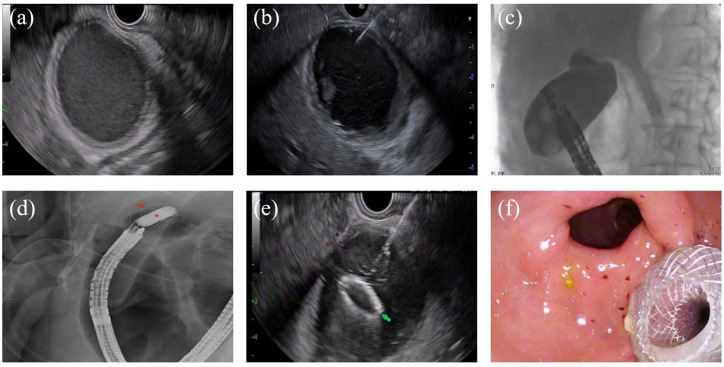
Over the last 40 years, the role of endoscopic ultrasound (EUS) has evolved from being diagnostic to therapeutic. EUS-guided gallbladder drainage (EUS-GBD) and EUS-guided gastroenterostomy (EUS-GE) are emerging techniques in recent years; however, there are limited studies and inconsistent results regarding these techniques. In addition, EUS has become a more common alternative to traditional interventions due to its super minimally invasive nature, but the mobility of both the gallbladder and intestine makes it challenging to introduce stents. An increasing number of researchers are dedicating themselves to solving this problem, leading to the development of various assisted technologies. Consequently, this review focused on the comparison of EUS-GBD and EUS-GE with other alternative approaches and explored the various assisted techniques employed for EUS-GBD and EUS-GE.
在过去40年里,内镜超声(EUS)的作用已从诊断发展到治疗。内镜超声引导下胆囊引流术(EUS-GBD)和内镜超声引导下胃肠吻合术(EUS-GE)是近年来新兴的技术;然而,关于这些技术的研究有限且结果不一致。此外,由于其超微创的特性,EUS已成为传统干预手段更常用的替代方法,但胆囊和肠道的移动性使得引入支架具有挑战性。越来越多的研究人员致力于解决这一问题,从而催生了各种辅助技术。因此,本综述重点比较了EUS-GBD和EUS-GE与其他替代方法,并探讨了用于EUS-GBD和EUS-GE的各种辅助技术。