Rehman Rida, Froehlich Albrecht, Olde Heuvel Florian, Elsayed Lobna, Boeckers Tobias, Huber-Lang Markus, Morganti-Kossmann Cristina, Roselli Francesco
Department of Neurology, Ulm University, Ulm, Germany.
Institute for Stem Cell Biology and Regenerative Medicine, Stanford University School of Medicine, Stanford, CA, United States.
Front Immunol. 2024 Nov 20;15:1443940. doi: 10.3389/fimmu.2024.1443940. eCollection 2024.
Traumatic brain injury (TBI) induces an acute reactive state of microglia, which contribute to secondary injury processes through phagocytic activity and release of cytokines. Several receptor tyrosine kinases (RTK) are activated in microglia upon TBI, and their blockade may reduce the acute inflammation and decrease the secondary loss of neurons; thus, RTKs are potential therapeutic targets. We have previously demonstrated that several members of the Fibroblast Growth Factor Receptor (FGFR) family are transiently phosporylated upon TBI; the availability for drug repurposing of FGFR inhibitors makes worthwhile the elucidation of the role of FGFR in the acute phases of the response to TBI and the effect of FGFR inhibition.
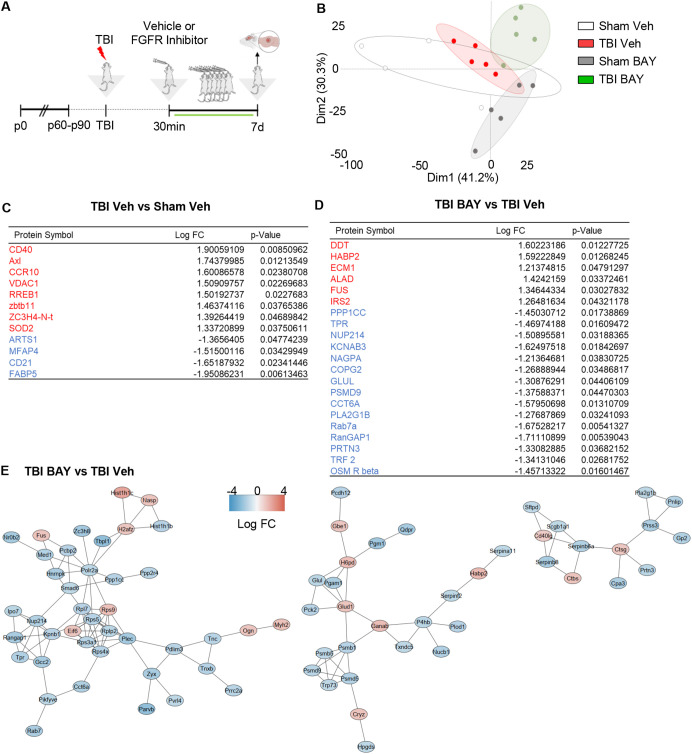
A closed, blunt, weight-drop mild TBI protocol was employed. The pan-FGFR inhibitor Rogaratinib was administered to mice 30min after the TBI and daily up to 7 days post injury. Phosphor-RTK Arrays and proteomic antibody arrays were used to determine target engagement and large-scale impact of the FGFR inhibitor. pFGFR1 and pFGFR3 immunostaining were employed for validation. As outcome parameters of the TBI injury immunostainings for NeuN, VGLUT1, VGAT at 7dpi were considered.
Inhibition of FGFR during TBI restricted phosphorylation of FGFR1, FGFR3, FGFR4 and ErbB4. Phosphorylation of FGFR1 and FGFR3 during TBI was traced back to Iba1+ microglia. Rogaratinib substantially dowregulated the proteomic signature of the neuroimmunological response to trauma, including the expression of CD40L, CXCR3, CCL4, CCR4, ILR6, MMP3 and OPG. Prolonged Rogaratinib treatment reduced neuronal loss upon TBI and prevented the loss of excitatory (vGLUT+) synapses.
The FGFR family is involved in the early induction of reactive microglia in TBI. FGFR inhibition selectively prevented FGFR phosphorylation in the microglia, dampened the overall neuroimmunological response and enhanced the preservation of neuronal and synaptic integrity. Thus, FGFR inhibitors may be relevant targets for drug repurposing aimed at modulating microglial reactivity in TBI.
创伤性脑损伤(TBI)会诱发小胶质细胞的急性反应状态,小胶质细胞通过吞噬活性和细胞因子释放参与继发性损伤过程。几种受体酪氨酸激酶(RTK)在TBI后会在小胶质细胞中被激活,阻断它们可能会减轻急性炎症并减少神经元的继发性损失;因此,RTK是潜在的治疗靶点。我们之前已经证明,成纤维细胞生长因子受体(FGFR)家族的几个成员在TBI后会短暂磷酸化;FGFR抑制剂的药物再利用潜力使得阐明FGFR在TBI反应急性期的作用以及FGFR抑制的效果变得很有价值。
采用闭合性、钝性、重物坠落致轻度TBI方案。在TBI后30分钟给小鼠施用泛FGFR抑制剂Rogaratinib,损伤后每天给药,持续7天。使用磷酸化RTK阵列和蛋白质组抗体阵列来确定FGFR抑制剂的靶点结合情况和大规模影响。采用pFGFR1和pFGFR3免疫染色进行验证。作为TBI损伤的结果参数,在损伤后7天对NeuN、VGLUT1、VGAT进行免疫染色分析。
在TBI期间抑制FGFR可限制FGFR1、FGFR3、FGFR4和ErbB4的磷酸化。TBI期间FGFR1和FGFR3的磷酸化可追溯到Iba1 +小胶质细胞。Rogaratinib显著下调了对创伤的神经免疫反应的蛋白质组特征,包括CD40L、CXCR3、CCL4、CCR4、ILR6、MMP3和OPG的表达。延长Rogaratinib治疗可减少TBI后的神经元损失,并防止兴奋性(vGLUT +)突触的丧失。
FGFR家族参与TBI中反应性小胶质细胞的早期诱导。FGFR抑制选择性地阻止了小胶质细胞中FGFR的磷酸化,减弱了整体神经免疫反应,并增强了神经元和突触完整性的保存。因此,FGFR抑制剂可能是旨在调节TBI中小胶质细胞反应性的药物再利用的相关靶点。