Harvey Georgina R, MacFadyen Christine, Tansley Sarah L
Department of Life Sciences, University of Bath, Claverton Down, Bath, BA2 7AY, UK.
Great Western Hospital, Swindon, UK.
Curr Rheumatol Rep. 2024 Dec 5;27(1):5. doi: 10.1007/s11926-024-01171-8.
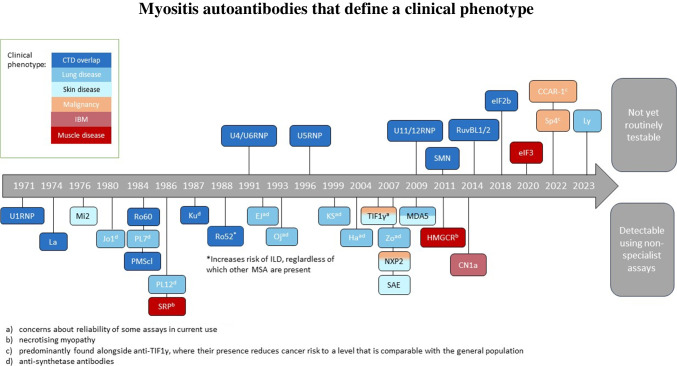
We aim to describe the immunoassays that have been used for myositis autoantibody discovery with a focus on newer methods. We describe recently identified myositis autoantibodies that do not yet form part of routine clinical testing, highlighting what is known about their associated clinical phenotype and potential clues as to their presence.
Novel approaches to autoantibody detection have been employed in recent years including chemiluminescent immunoassay, phage immunoprecipitation-sequencing and modifications to the more traditional immunoprecipitation technique. This has led to the discovery of novel autoantibodies, including novel anti-aminoacyl-tRNA synthetase autoantibodies and autoantibodies which modify cancer risk for patients with anti-TIF1ɣ associated dermatomyositis. New approaches to novel autoantibody detection have facilitated autoantibody discovery and will enable the identification of autoantibodies to a broader range of autoantigens. Challenges remain in translating this knowledge into accessible testing particularly given the rarity of most recently discovered autoantibodies.
我们旨在描述用于发现肌炎自身抗体的免疫测定方法,重点关注较新的方法。我们描述了最近鉴定出的尚未成为常规临床检测一部分的肌炎自身抗体,强调了关于其相关临床表型的已知信息以及提示其存在的潜在线索。
近年来采用了新型自身抗体检测方法,包括化学发光免疫测定、噬菌体免疫沉淀测序以及对更传统免疫沉淀技术的改进。这导致发现了新型自身抗体,包括新型抗氨酰 - tRNA合成酶自身抗体以及改变抗TIF1ɣ相关皮肌炎患者癌症风险的自身抗体。新型自身抗体检测的新方法促进了自身抗体的发现,并将有助于鉴定针对更广泛自身抗原的自身抗体。将这些知识转化为可及的检测仍面临挑战,特别是考虑到大多数最近发现的自身抗体较为罕见。