Yi Li, Harnois-Leblanc Soren, Rifas-Shiman Sheryl L, Suel Esra, Pescador Jimenez Marcia, Lin Pi-I Debby, Hystad Perry, Hankey Steve, Zhang Wenwen, Hivert Marie-France, Oken Emily, Aris Izzuddin M, James Peter
Department of Population Medicine, Harvard Medical School and Harvard Pilgrim Health Care Institute, Boston, Massachusetts.
Centre for Advanced Spatial Analysis, University College London, London, United Kingdom.
JAMA Netw Open. 2024 Dec 2;7(12):e2449113. doi: 10.1001/jamanetworkopen.2024.49113.
Green space may be associated with obesity outcomes in children by promoting physical activity and reducing stress. However, previous studies have mostly used a single measure of green space and body mass index (BMI) as the sole indicator of adiposity.
To examine associations of the satellite-based normalized difference vegetation index (NDVI) and street-view imagery-based green space metrics with comprehensive adiposity measures in children.
DESIGN, SETTING, AND PARTICIPANTS: The Project Viva cohort study observed participants from mid-childhood (mean [SD] age, 8.0 [0.8] years) and early adolescence (mean [SD] age, 13.3 [1.0] years) through late adolescence (mean [SD] age, 17.8 [0.7] years) between January 1, 2007, and December 31, 2021. This analysis included children with data on green space and adiposity measures. Data were analyzed from January 1 to June 30, 2024.
Green space metrics (ie, percentage of trees, grass, and other green space) using street-view imagery and deep learning algorithms along with the NDVI were linked with participants' home addresses during mid-childhood and early adolescence.
Body mass index (calculated as weight in kilograms divided by height in meters squared) and waist circumference z scores were calculated from anthropometric measurements during early and late adolescence. The total fat mass index (FMI; calculated as fat mass in kilograms divided by height in meters squared) and trunk FMI were obtained using dual-energy x-ray absorptiometry. Separate linear regression models adjusted for a child's age, sex, individual and neighborhood socioeconomic status, and population density estimated prospective associations of the NDVI and street-view green space (in mid-childhood or early adolescence) with 4 adiposity measures (in early or late adolescence).
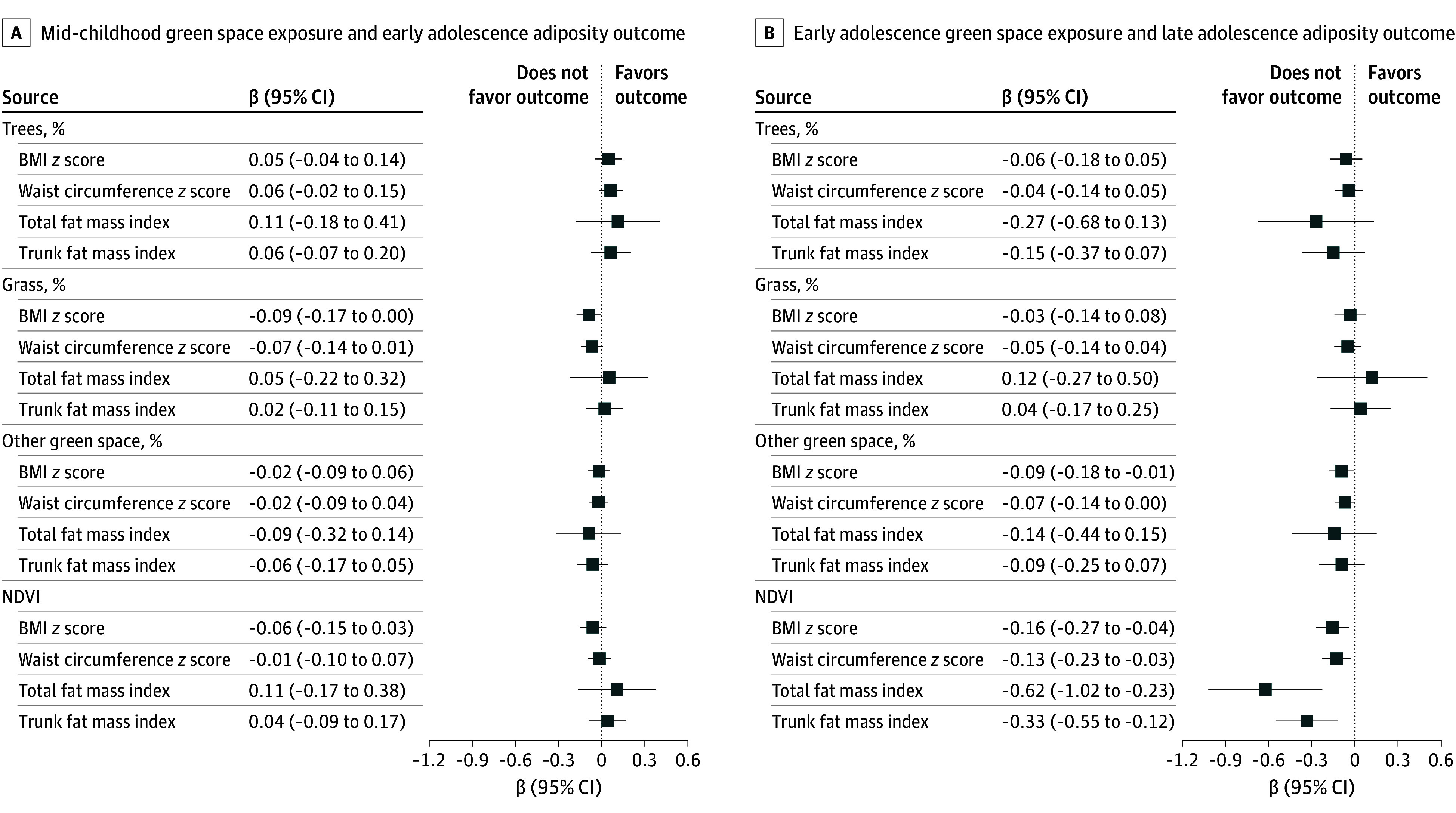
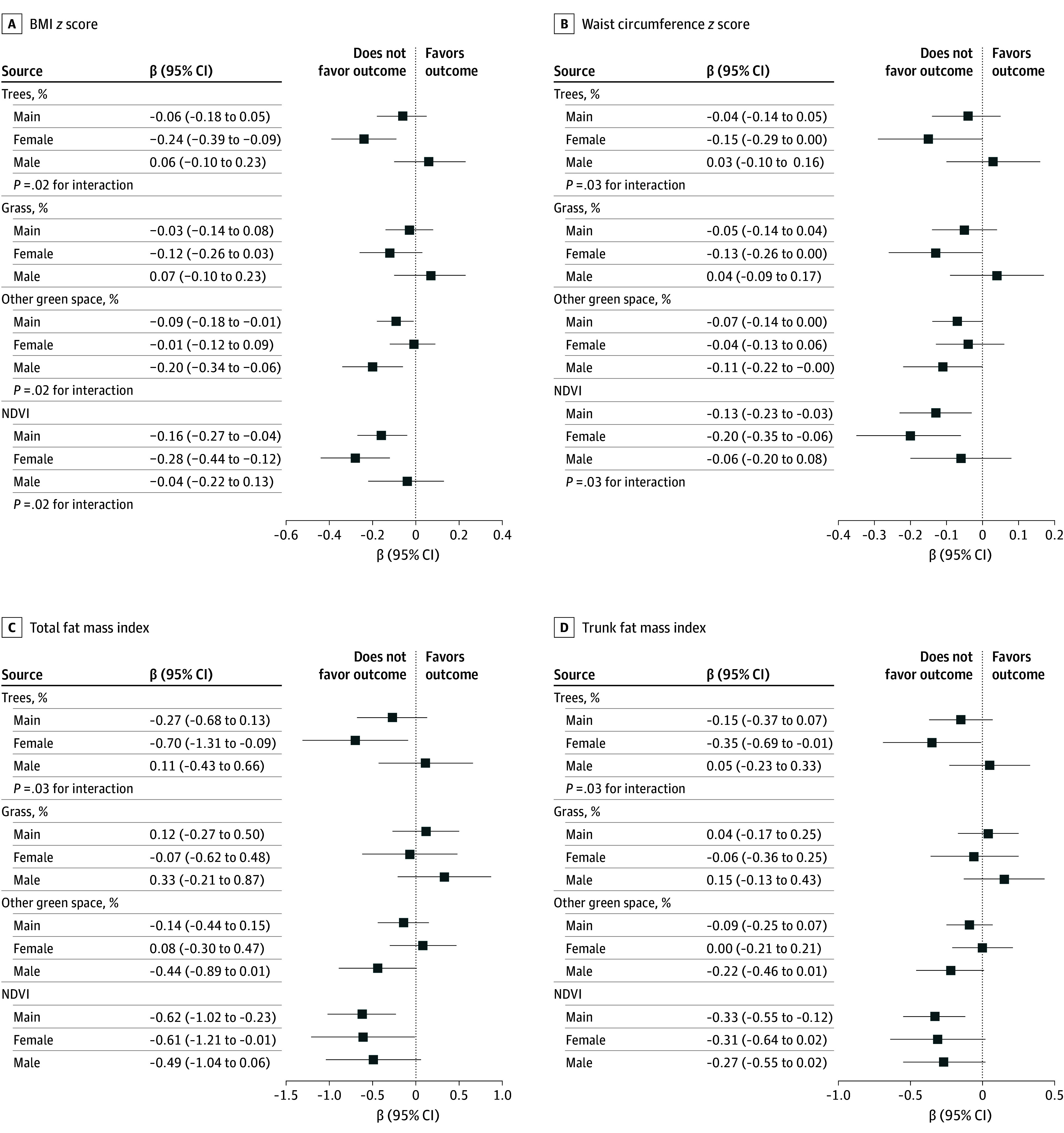
The sample included 843 children (mean [SD] age at mid-childhood, 7.9 [0.8] years; 423 girls [50.2%]) at baseline. After adjustment for confounders, a higher NDVI (per 1-SD increase) within 270 m in early adolescence was associated with lower z scores for BMI (-0.16 [95% CI, -0.27 to -0.04]) and waist circumference (-0.13 [95% CI, -0.23 to -0.03]), as well as a lower total FMI (-0.62 [95% CI, -1.02 to -0.23]) and trunk FMI (-0.33 [95% CI, -0.55 to -0.12]) in late adolescence. Higher percentages of street-view other green space (flowers, plants, and fields), but not street-view trees and grass, within 500 m in early adolescence were associated with lower BMI z scores (-0.09 [95% CI, -0.18 to -0.01) in late adolescence. The NDVI and street-view green space exposure at mid-childhood were not associated with adiposity measures in early adolescence.
This cohort study of US children suggests that higher levels of satellite-based NDVI greenness and percentages of street-level green space components (flowers, plants, and fields) were associated with lower adiposity. The findings support the exploration of increasing residential green space levels and adding specific green space components as an urban planning and public health intervention strategy to combat the prevalence of childhood obesity in the US.
绿地可能通过促进身体活动和减轻压力与儿童肥胖结果相关。然而,以往的研究大多只采用单一的绿地测量方法,并将体重指数(BMI)作为肥胖的唯一指标。
研究基于卫星的归一化差异植被指数(NDVI)和基于街景图像的绿地指标与儿童综合肥胖测量指标之间的关联。
设计、设置和参与者:活力项目队列研究观察了2007年1月1日至2021年12月31日期间从中童年期(平均[标准差]年龄,8.0[0.8]岁)、青春期早期(平均[标准差]年龄,13.3[1.0]岁)到青春期晚期(平均[标准差]年龄,17.8[0.7]岁)的参与者。该分析纳入了有绿地和肥胖测量数据的儿童。数据于2024年1月1日至6月30日进行分析。
使用街景图像和深度学习算法得出的绿地指标(即树木、草地和其他绿地的百分比)以及NDVI与参与者在童年中期和青春期早期的家庭住址相关联。
根据青春期早期和晚期的人体测量数据计算体重指数(计算方法为体重千克数除以身高米数的平方)和腰围z评分。使用双能X线吸收法获得总脂肪量指数(FMI;计算方法为脂肪量千克数除以身高米数的平方)和躯干FMI。分别针对儿童的年龄、性别、个人和邻里社会经济地位以及人口密度进行调整的线性回归模型,估计了(童年中期或青春期早期的)NDVI和街景绿地与(青春期早期或晚期的)4项肥胖测量指标之间的前瞻性关联。
样本包括843名儿童(童年中期平均[标准差]年龄,7.9[0.8]岁;423名女孩[50.2%])作为基线。在对混杂因素进行调整后,青春期早期270米范围内较高的NDVI(每增加1个标准差)与青春期晚期较低的BMI z评分(-0.16[95%置信区间,-0.27至-0.04])和腰围z评分(-0.13[95%置信区间,-0.23至-0.03])相关,同时与较低的总FMI(-0.62[95%置信区间,-1.02至-0.23])和躯干FMI(-0.33[95%置信区间,-0.55至-0.12])相关。青春期早期500米范围内较高百分比的街景其他绿地(花卉、植物和田野),而非街景树木和草地,与青春期晚期较低的BMI z评分(-0.09[95%置信区间,-0.18至-0.01])相关。童年中期的NDVI和街景绿地暴露与青春期早期的肥胖测量指标无关。
这项针对美国儿童的队列研究表明,较高水平的基于卫星的NDVI绿化程度和街道层面绿地组成部分(花卉、植物和田野)的百分比与较低的肥胖程度相关。这些发现支持探索提高居住绿地水平和增加特定绿地组成部分,作为一种城市规划和公共卫生干预策略,以应对美国儿童肥胖的流行情况。