Back Anthony L, Freeman-Young Timara K, Morgan Ladybird, Sethi Tanmeet, Baker Kelsey K, Myers Susanna, McGregor Bonnie A, Harvey Kalin, Tai Marlene, Kollefrath Austin, Thomas Brandon J, Sorta Dennis, Kaelen Mendel, Kelmendi Benjamin, Gooley Ted A
Departments of Medicine and Psychiatry, University of Washington School of Medicine, Seattle.
Departments of Medicine and Psychiatry, University of Washington, Seattle.
JAMA Netw Open. 2024 Dec 2;7(12):e2449026. doi: 10.1001/jamanetworkopen.2024.49026.
The psychological morbidity experienced by physicians, advanced practice practitioners (APPs), and nurses from working during the COVID-19 pandemic includes burnout, depression, and posttraumatic stress disorder (PTSD).
To investigate whether psilocybin therapy could improve symptoms of depression, burnout, and PTSD in US clinicians who developed these symptoms from frontline clinical work during the pandemic.
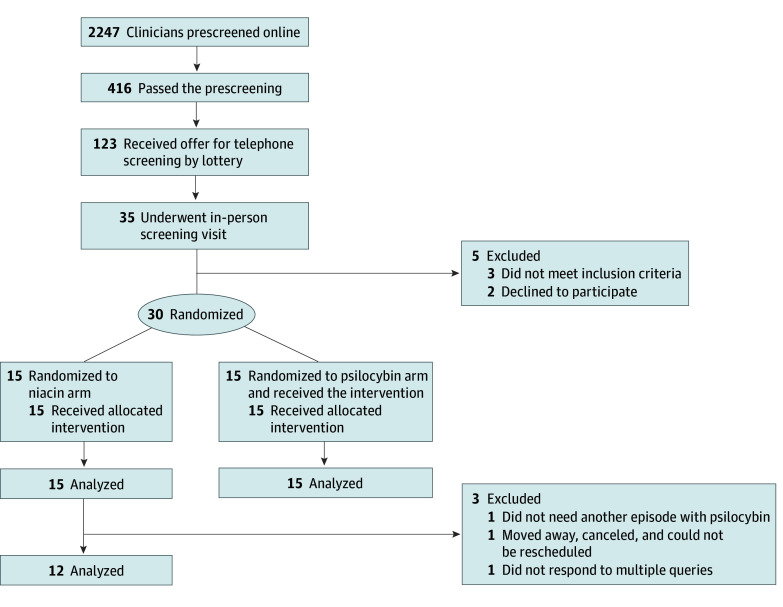
DESIGN, SETTING, AND PARTICIPANTS: This double-blind randomized clinical trial enrolled participants from February to December 2022. Participants included physicians, APPs, and nurses who provided frontline care for more than 1 month during the pandemic and had no prepandemic mental health diagnoses but had moderate or severe symptoms of depression at enrollment. Participants were randomly assigned to either the psilocybin or niacin arm. Data analysis was conducted between December 2023 and May 2024 and was based on the intention-to-treat principle.
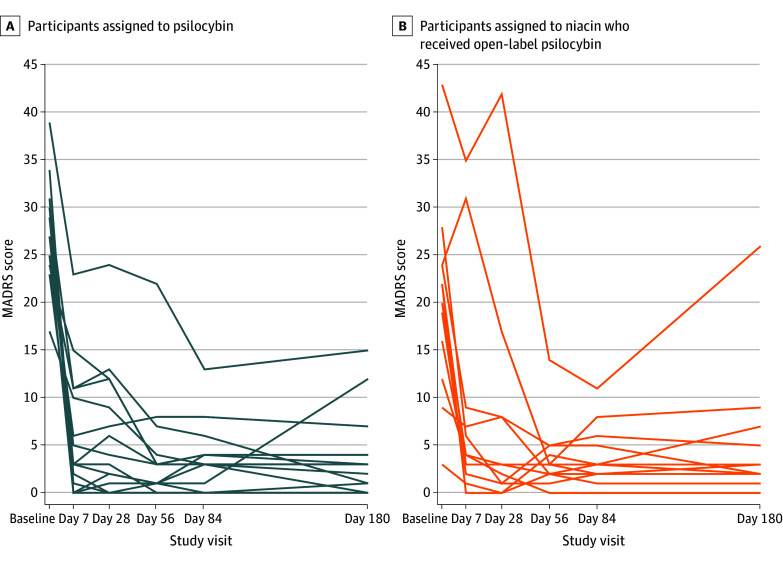
One intervention episode consisted of 2 preparation visits, 1 medication session, and 3 integration visits. At the medication session, participants received psilocybin, 25 mg, or niacin, 100 mg, orally.
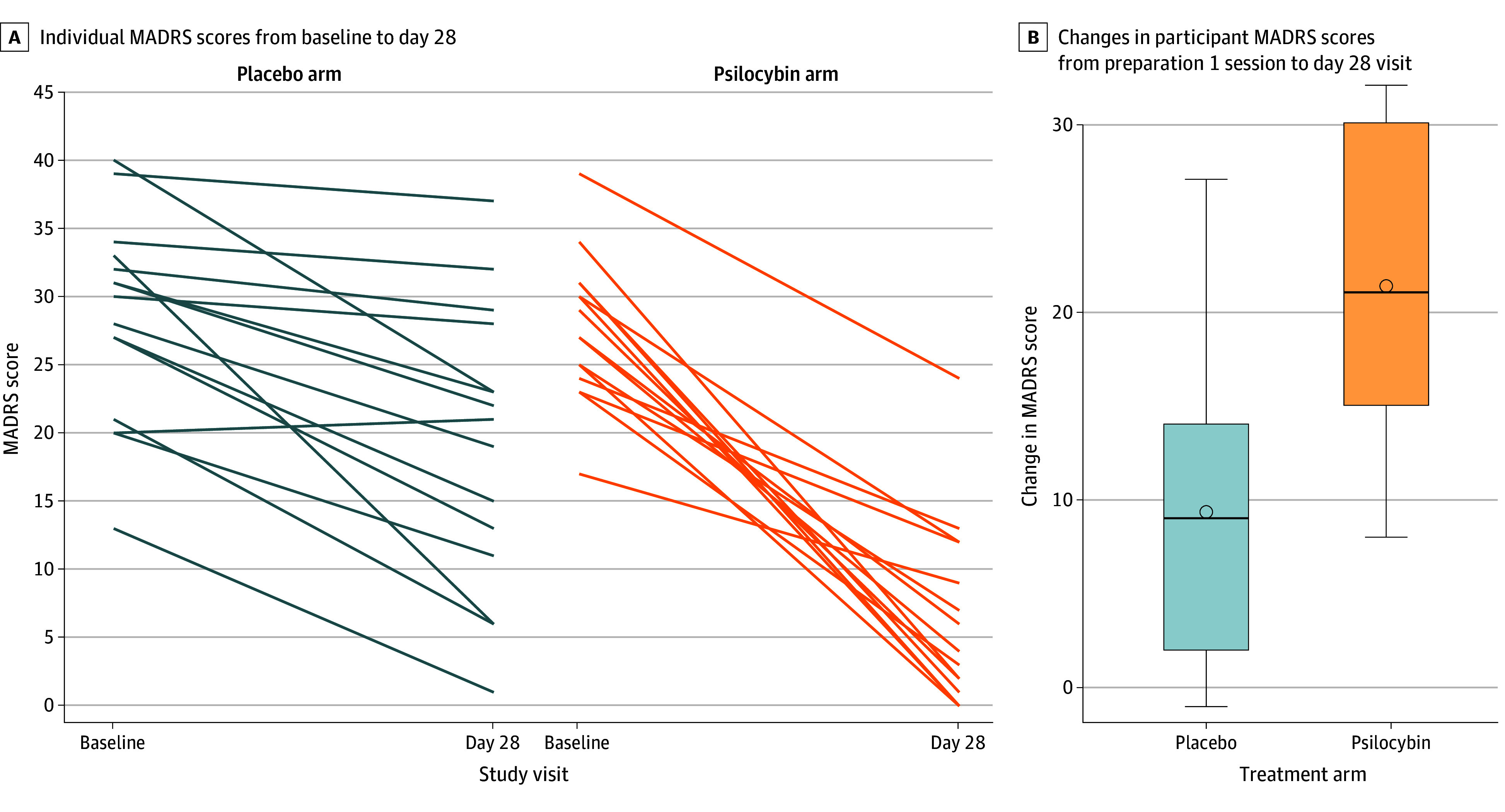
The primary outcome was a change from baseline (preparation 1 session) to day 28 (after medication administration) in symptoms of depression as measured by the clinician-administered Montgomery-Asberg Depression Rating Scale (MADRS) used by blinded raters. The secondary outcomes were a change in symptoms of burnout (measured with the Stanford Professional Fulfillment Index [SPFI]) and symptoms of PTSD (measured with the Posttraumatic Stress Disorder Checklist for Diagnostic and Statistical Manual of Mental Disorders, Fifth Edition [PCL-5]).
A total of 30 clinicians (15 females [50%]; mean [range] age, 38 [29-60] years) participated, of whom 15 were randomly assigned to receive psilocybin and 15 to receive niacin. The mean change in symptoms of depression (MADRS scores) from preparation 1 session to day 28 was -21.33 (7.84) in the psilocybin arm compared with -9.33 (7.32) in the niacin arm, with a mean difference between arms of -12.00 (95% CI, -17.67 to -6.33; P < .001), a decrease in MADRS scores indicating improvement. The mean change in SPFI scores from preparation 1 session to day 28 showed a numerically larger improvement in symptoms of burnout in the psilocybin compared with the niacin arm (-6.40 [5.00] vs -2.33 [5.97]; P = .05) but was not statistically significant. Since the SPFI score change did not reach statistical significance, the PCL-5 score change was evaluated descriptively. The mean change in PCL-5 scores showed a numerically larger decrease in symptoms of PTSD from preparation 1 session to day 28 in the psilocybin vs the niacin arm (-16.67 [15.04] vs -6.73 [10.69]), but this difference was not statistically tested.
This randomized clinical trial found that psilocybin therapy resulted in a significant, sustained reduction in symptoms of depression experienced by clinicians after frontline work during the COVID-19 pandemic. The findings establish psilocybin therapy as a new paradigm of treatment for this postpandemic condition.
ClinicalTrials.gov Identifier: NCT05163496.
在新冠疫情期间工作的医生、高级执业人员(APPs)和护士所经历的心理疾病包括职业倦怠、抑郁和创伤后应激障碍(PTSD)。
调查裸盖菇素疗法是否能改善美国临床医生在疫情期间因一线临床工作而出现的抑郁、职业倦怠和创伤后应激障碍症状。
设计、背景和参与者:这项双盲随机临床试验于2022年2月至12月招募参与者。参与者包括在疫情期间提供超过1个月一线护理的医生、APPs和护士,他们在疫情前没有心理健康诊断,但在入组时患有中度或重度抑郁症状。参与者被随机分配到裸盖菇素组或烟酸组。数据分析于2023年12月至2024年5月进行,基于意向性分析原则。
一个干预疗程包括2次准备访视、1次用药环节和3次整合访视。在用药环节,参与者口服25毫克裸盖菇素或100毫克烟酸。
主要结局是由盲法评估者使用临床医生评定的蒙哥马利-艾斯伯格抑郁评定量表(MADRS)测量的,从基线(准备1环节)到第28天(用药后)抑郁症状的变化。次要结局是职业倦怠症状(用斯坦福职业成就感指数[SPFI]测量)和创伤后应激障碍症状(用《精神障碍诊断与统计手册》第五版创伤后应激障碍检查表[PCL-5]测量)的变化。
共有30名临床医生(15名女性[50%];平均[范围]年龄38[29-60]岁)参与,其中15名被随机分配接受裸盖菇素,15名接受烟酸。从准备1环节到第28天,裸盖菇素组抑郁症状(MADRS评分)的平均变化为-21.33(7.84),烟酸组为-9.33(7.32),两组平均差异为-12.00(95%CI,-17.67至-6.33;P < .001),MADRS评分下降表明症状改善。从准备1环节到第28天,SPFI评分的平均变化显示,裸盖菇素组职业倦怠症状的改善在数值上大于烟酸组(-6.40[5.00]对-2.33[5.97];P = .05),但无统计学意义。由于SPFI评分变化未达到统计学意义,因此对PCL-5评分变化进行描述性评估。从准备1环节到第28天,PCL-5评分的平均变化显示,裸盖菇素组创伤后应激障碍症状的下降在数值上大于烟酸组(-16.67[15.04]对-6.73[10.69]),但未对该差异进行统计学检验。
这项随机临床试验发现,裸盖菇素疗法能显著、持续地减轻临床医生在新冠疫情期间一线工作后出现的抑郁症状。这些发现确立了裸盖菇素疗法作为这种疫情后状况的一种新的治疗范式。
ClinicalTrials.gov标识符:NCT05163496。