Jensen Camilla Juul Dahl, Køhler Louise G, Huwer Bastian, Werner Malin, Cieters Leslie, Jaspers Cornelia
Centre for Gelatinous Zooplankton Ecology and Evolution, National Institute of Aquatic Resources, Technical University of Denmark, Kemitorvet 202, 2800 Kgs. Lyngby, Denmark.
National Institute of Aquatic Resources, Technical University of Denmark, Kemitorvet 201, 2800 Kgs. Lyngby, Denmark.
Data Brief. 2024 Nov 2;57:111100. doi: 10.1016/j.dib.2024.111100. eCollection 2024 Dec.
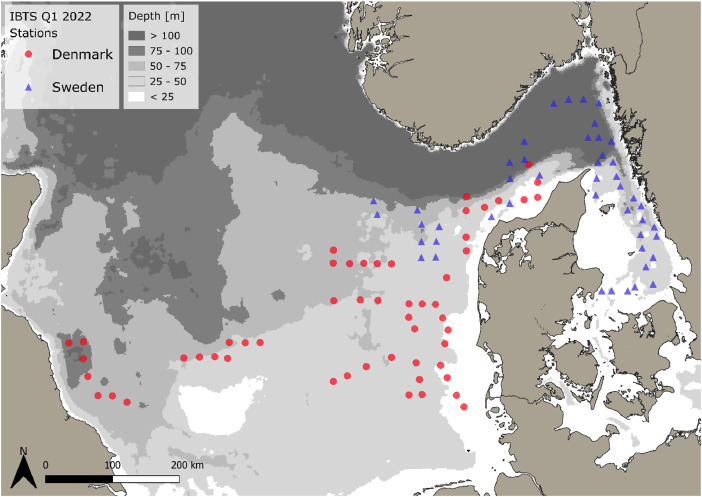
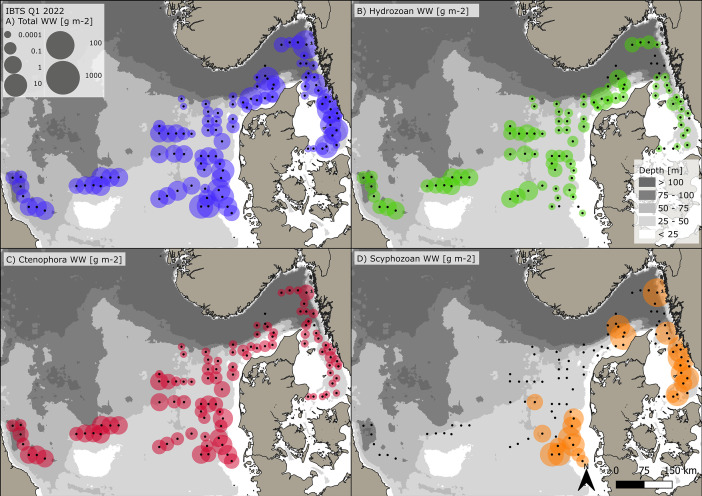
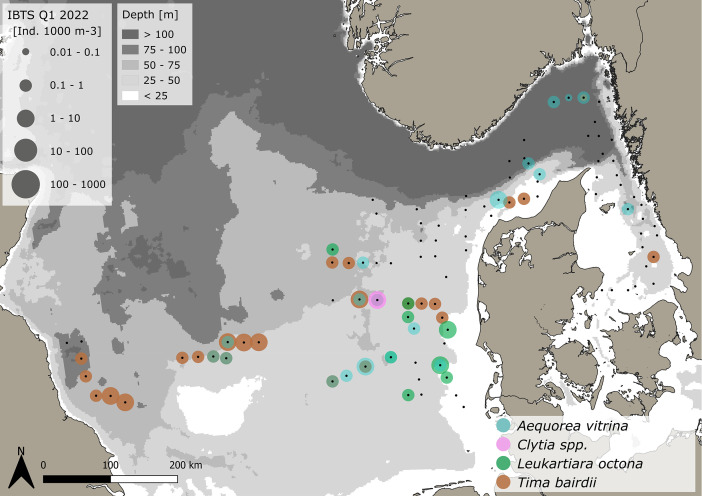
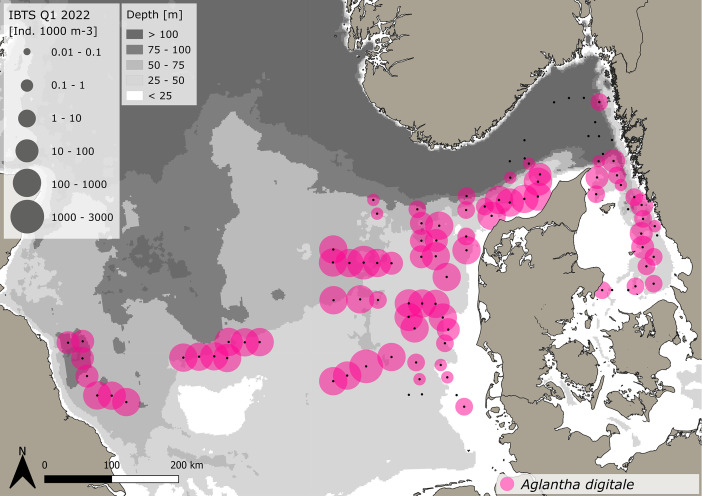
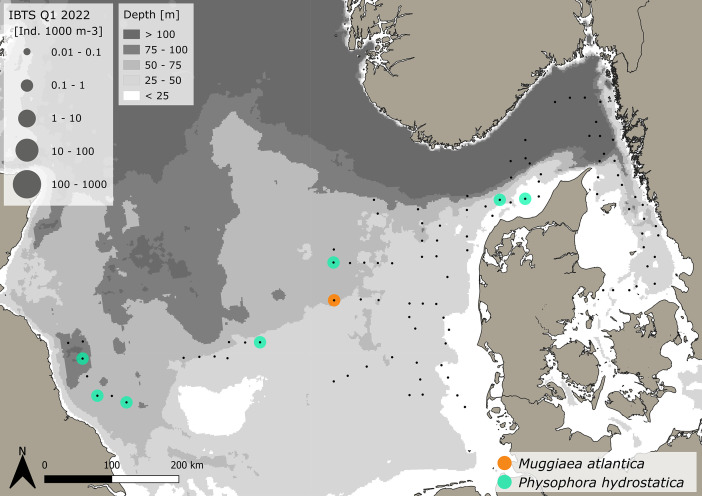
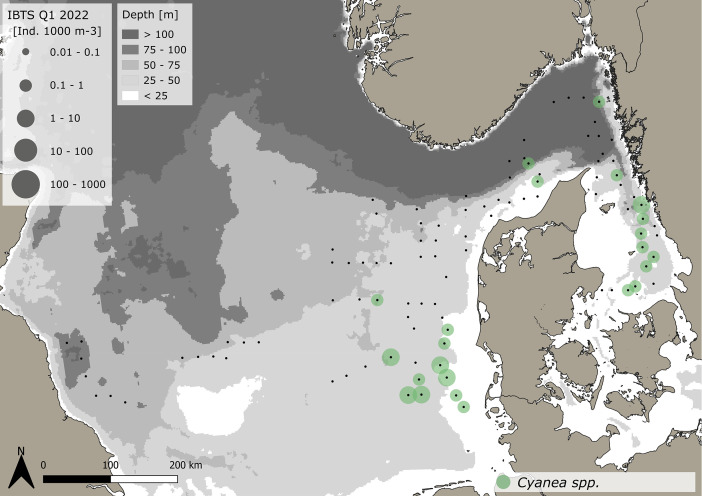
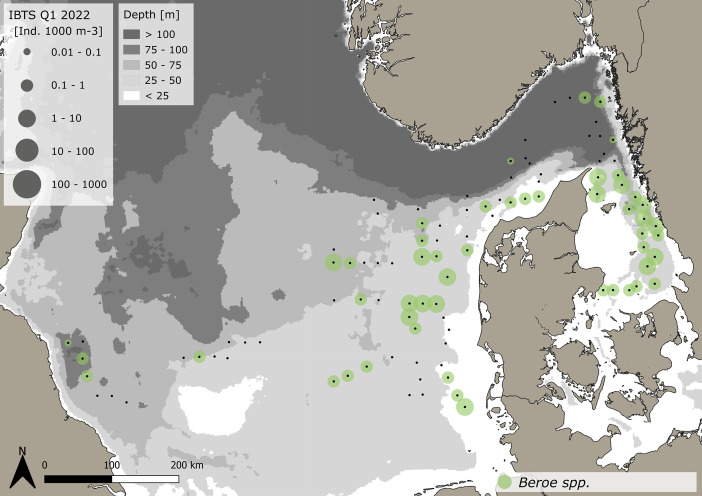
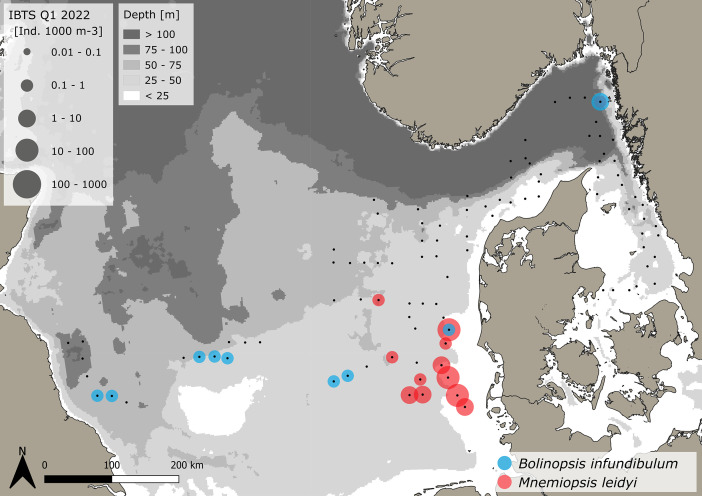
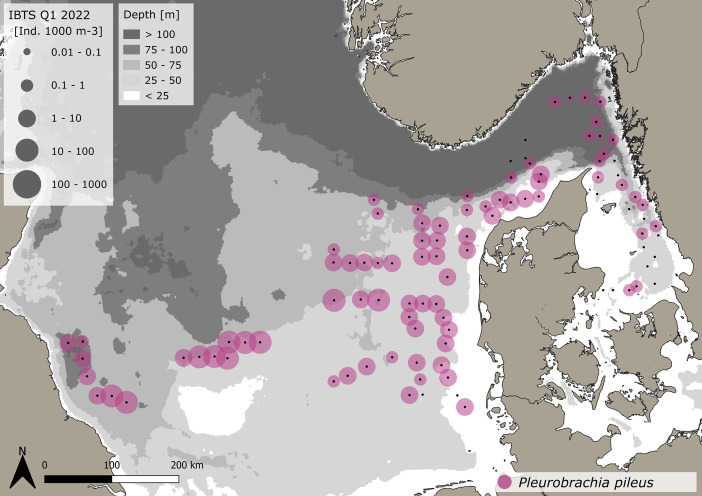
The diversity and distribution of gelatinous macrozooplankton is described by presenting qualitative and quantitative data of the jellyfish and comb jelly community encountered in the North Sea and Skagerrak/Kattegat during January/February 2022. Data were generated as part of the North Sea Midwater Ring Net (MIK) survey [1], an ichthyoplankton survey conducted at night-time during the quarter 1 (Q1) International Bottom Trawl Survey (IBTS), aboard the Danish R/V DANA (DTU Aqua) and the Swedish R/V Svea (SLU). A total of 100 stations were investigated using a 13 m long Midwater Ring Net (MIK net) with an opening diameter of 2 m and a mesh size of 1.6 mm, which is 0.5 mm meshed for the last meter of the net and the cod end [2]. Samples were collected by double oblique hauls from the surface to 5 m above the seafloor [2]. Twelve gelatinous macrozooplankton species were encountered during the Q1 2022 survey. Species encountered included the hydrozoan jellyfish i) , ii) , iii) spp., iv) , v) , vi) ; the two scyphozoan jellyfish i) and ii) as well as the comb jelly (ctenophora) species i) spp., ii) , iii) and iv) the non-indigenous . In total 4882 individual specimens from samples and sub-samples were analyzed and extrapolated to 71,888 records of gelatinous macrozooplankton in the investigation area. For rare species, the entire sample was analyzed, while for abundant taxa, sub-samples were used to assess abundances. The raw counts were converted to volume-specific densities (individuals m) and area-specific abundances (individuals m), based on calibrated flow meter recordings and recorded maximum depth of the MIK net during each haul. Further, size data for the different species were obtained from a total of 4775 individual gelatinous macrozooplankton organisms. Size data are presented in the accompanying database and was used to calculate species-specific wet weights, using published size-weight regressions [3]. In addition, we present spatial distribution patterns of the weight specific biomass for the total gelatinous macrozooplankton community as well as the sub-groups i) hydrozoa, ii) scyphozoa and iii) ctenophora across the investigation area. The presented data contribute to a baseline describing the gelatinous macrozooplankton diversity and distribution in the extended North Sea area during winter [3,4] and summer [5]. The data can contribute to address the question if gelatinous macrozooplankton densities increase due to global change pressures and will help to understand their interaction with commercially important fish species, which are assessed during the same surveys. As such, this data paper presents a valuable resource on biodiversity and non-indigenous species records and highlights the importance of monitoring gelatinous macrozooplankton to facilitate an ecosystem approach to assess if the ecosystem state meets a 'good environmental status (GES)', as demanded by the EU Marine Strategy Framework Directive (MSFD).
通过展示2022年1月/2月在北海以及斯卡格拉克海峡/卡特加特海峡所遇到的水母和栉水母群落的定性和定量数据,描述了凝胶状大型浮游动物的多样性和分布情况。这些数据是北海中层环流网(MIK)调查[1]的一部分,该调查是在第一季度(Q1)国际底层拖网调查(IBTS)的夜间进行的鱼类浮游生物调查,调查船为丹麦的“达纳”号科研船(丹麦技术大学水产研究所)和瑞典的“ Svea”号科研船(瑞典农业科学大学)。总共使用一个13米长的中层环流网(MIK网)对100个站点进行了调查,该网开口直径为2米,网目尺寸为1.6毫米,在网的最后一米和网囊处网目尺寸为0.5毫米[2]。通过从海面到海底上方5米的双斜拖网采集样本[2]。在2022年第一季度的调查中,共遇到12种凝胶状大型浮游动物物种。遇到的物种包括水螅水母类:i)、ii)、iii) 属,iv)、v)、vi);两种钵水母类水母:i) 和ii) 以及栉水母物种:i) 属,ii)、iii) 和iv) 非本地的 。总共对样本和子样本中的4882个个体标本进行了分析,并推算出调查区域内凝胶状大型浮游动物的71,888条记录。对于稀有物种,分析了整个样本,而对于丰富的分类群,则使用子样本评估丰度。根据校准后的流量计记录以及每次拖网时MIK网记录的最大深度,将原始计数转换为体积比密度(个体/立方米)和面积比丰度(个体/平方米)。此外,从总共4775个凝胶状大型浮游动物个体中获取了不同物种的大小数据。大小数据列于随附的数据库中,并用于根据已发表的大小-重量回归关系[3]计算特定物种的湿重。此外,我们展示了整个调查区域内凝胶状大型浮游动物群落以及水螅水母类、钵水母类和栉水母类亚群的重量比生物量的空间分布模式。所呈现的数据有助于建立一个基线,描述冬季[3,4]和夏季[5]北海扩展区域内凝胶状大型浮游动物的多样性和分布情况。这些数据有助于解决凝胶状大型浮游动物密度是否因全球变化压力而增加的问题,并有助于了解它们与在同一调查中评估的商业重要鱼类物种之间的相互作用。因此,本数据论文提供了关于生物多样性和非本地物种记录的宝贵资源,并强调了监测凝胶状大型浮游动物对于促进采用生态系统方法来评估生态系统状态是否符合欧盟海洋战略框架指令(MSFD)所要求的“良好环境状况(GES)”的重要性。