Zheng Que, Kei Kathy Tsam-Ling, Chiu Ka Yu, Shum Kathy Kar-Man
Department of Psychology, The University of Hong Kong, Hong Kong, Hong Kong.
Department of Psychology, The University of Hong Kong, Hong Kong, Hong Kong
BMJ Open. 2024 Dec 7;14(12):e093183. doi: 10.1136/bmjopen-2024-093183.
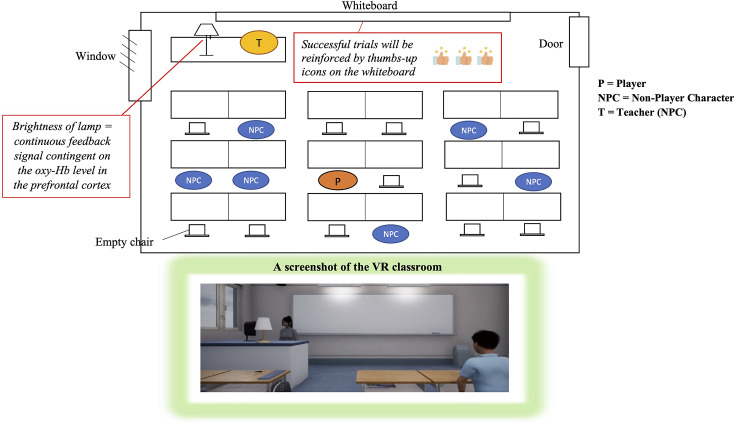
The rise in the number of children diagnosed with attention-deficit/hyperactivity disorder (ADHD) highlights the need for effective interventions targeting attentional control. Although recent research has demonstrated the potential of neurofeedback training (NFT) for children with ADHD, most studies have been conducted in laboratory settings, raising questions about their real-world applicability. To address this issue, virtual reality (VR) may offer a solution to the ecological validity challenges encountered in NFT. By coupling NFT with VR, individuals can engage in self-regulating brain activity within a simulated, realistic environment. This study aims to investigate the efficacy of near-infrared spectroscopy (NIRS)-based NFT combined with VR in alleviating ADHD symptoms among children, addressing the need for interventions with practical relevance and effectiveness.
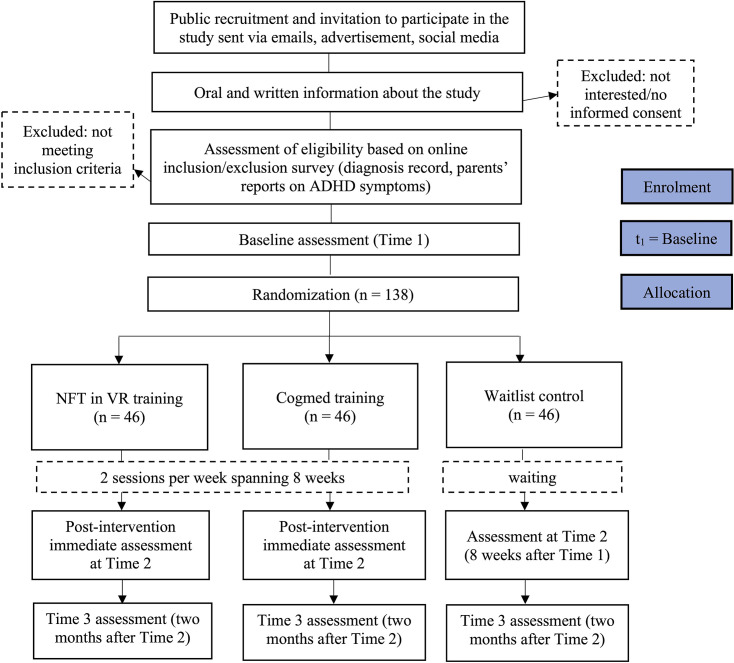
This study aims to recruit 138 children aged 7-12 diagnosed with ADHD. Following baseline assessment, participants will be randomly assigned to one of three conditions: (1) NIRS-based NFT in a VR classroom setting; (2) conventional computerised cognitive training (active control) or (3) a waitlist control group. On completion of intervention sessions in the two training groups, all groups will undergo an assessment at time 2, with a follow-up assessment scheduled 2 months post-training for all participants. Primary outcomes will include measures of executive function, such as attentional control, response inhibition and working memory, along with changes in oxygenated and deoxygenated haemoglobin levels monitored by functional NIRS. Secondary outcome measures will comprise ratings of children's ADHD symptoms and executive function behaviours in daily life, reported by parents and teachers.
The three-arm randomised controlled trial will address research gaps regarding the effectiveness of NIRS-based NFT for children with ADHD, particularly when integrated with immersive VR technology. By combining NFT and VR, this study aims to simulate a real-world environment, potentially amplifying intervention effects. The findings from the study will provide evidence for the efficacy of this innovative intervention in improving executive function and alleviating ADHD symptoms.
Ethical approval was obtained from the Human Research Ethics Committee at the University of Hong Kong (Reference: EA200247). Results will be published in peer-reviewed journals and presented at conferences.
NCT05906485.
被诊断为注意力缺陷多动障碍(ADHD)的儿童数量不断增加,这凸显了针对注意力控制进行有效干预的必要性。尽管最近的研究已经证明了神经反馈训练(NFT)对患有ADHD的儿童具有潜力,但大多数研究都是在实验室环境中进行的,这引发了对其在现实世界中适用性的质疑。为了解决这个问题,虚拟现实(VR)可能为NFT中遇到的生态效度挑战提供一个解决方案。通过将NFT与VR相结合,个体可以在模拟的现实环境中进行自我调节大脑活动。本研究旨在调查基于近红外光谱(NIRS)的NFT与VR相结合在减轻儿童ADHD症状方面的疗效,满足对具有实际相关性和有效性的干预措施的需求。
本研究旨在招募138名7至12岁被诊断为ADHD的儿童。在基线评估之后,参与者将被随机分配到以下三种情况之一:(1)在VR教室环境中进行基于NIRS的NFT;(2)传统的计算机化认知训练(积极对照组)或(3)等待名单对照组。在两个训练组完成干预课程后,所有组将在时间2进行评估,所有参与者将在训练后2个月安排进行随访评估。主要结果将包括执行功能的测量,如注意力控制、反应抑制和工作记忆,以及通过功能性NIRS监测的氧合血红蛋白和脱氧血红蛋白水平的变化。次要结果测量将包括父母和教师报告的儿童ADHD症状和日常生活中执行功能行为的评分。
这项三臂随机对照试验将解决关于基于NIRS的NFT对患有ADHD的儿童有效性的研究空白,特别是当与沉浸式VR技术相结合时。通过将NFT和VR相结合,本研究旨在模拟现实世界环境,可能会放大干预效果。该研究的结果将为这种创新干预在改善执行功能和减轻ADHD症状方面的疗效提供证据。
获得了香港大学人类研究伦理委员会的伦理批准(参考号:EA200247)。结果将发表在同行评审期刊上,并在会议上展示。
NCT05906485。