Phoungtawee Piangtawan, Sudyoadsuk Taweesak, Pettersson Torbjörn, Crespy Daniel, Svagan Anna J, Shanker Ravi
Department of Materials Science and Engineering, School of Molecular Science and Engineering, Vidyasirimedhi Institute of Science and Technology (VISTEC), Rayong, 21210, Thailand.
Frontier Research Center (FRC), Vidyasirimedhi Institute of Science and Technology (VISTEC), Rayong, 21210, Thailand.
Macromol Rapid Commun. 2025 Mar;46(5):e2400755. doi: 10.1002/marc.202400755. Epub 2024 Dec 8.
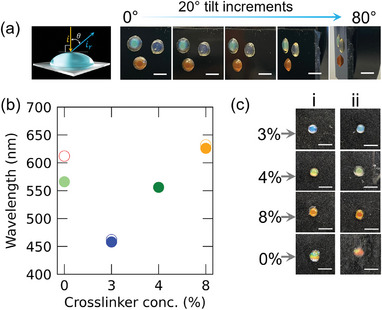
Hydroxypropyl cellulose (HPC) is known for its ability to form cholesteric liquid crystalline phases displaying vivid structural colors. However, these vibrant colors tend to fade over time when the material dries. This issue is a major bottleneck to finding practical applications for these materials. Here this problem is overcome by producing free-standing, millimeter-sized HPC structurally colored beads with spatiotemporal color retention, facilitated by a glutaraldehyde crosslinker. By leveraging the well-known chemically induced stabilization of cholesteric liquid crystalline phases, stable structural colors are achieved for at least three weeks. The presence of glutaraldehyde significantly increases the mechanical stiffness, with Young's modulus rising from 0.3± 0.1 GPa to 1.8± 0.2 GPa. This integrated approach of creating free-standing photonic HPC beads offers a strategy for developing robust and durable photonic HPC materials with enhanced stability, advancing photonic material applications with spatiotemporal color stability.
羟丙基纤维素(HPC)以其形成显示鲜明结构颜色的胆甾型液晶相的能力而闻名。然而,当材料干燥时,这些鲜艳的颜色往往会随着时间的推移而褪色。这个问题是为这些材料寻找实际应用的一个主要瓶颈。在此,通过使用戊二醛交联剂制备具有时空颜色保留的独立毫米大小的HPC结构色珠,克服了这个问题。通过利用众所周知的化学诱导胆甾型液晶相稳定化,至少三周内都能实现稳定的结构颜色。戊二醛的存在显著提高了机械刚度,杨氏模量从0.3±0.1 GPa提高到1.8±0.2 GPa。这种创建独立光子HPC珠的综合方法为开发具有更高稳定性的坚固耐用的光子HPC材料提供了一种策略,推动了具有时空颜色稳定性的光子材料应用。