Mthombeni Tiyani C, Burger Johanita R, Lubbe Martha S, Julyan Marlene, Lekalakala-Mokaba Molebogeng R
Department of Medicine Usage in South Africa (MUSA), Faculty of Health Sciences, North-West University, Potchefstroom, South Africa.
Division of Medical Microbiology, Department of Pathology, Faculty of Health Sciences, University of Limpopo, Polokwane, South Africa.
Afr J Lab Med. 2024 Nov 29;13(1):2519. doi: 10.4102/ajlm.v13i1.2519. eCollection 2024.
There is a paucity of research on the incidence and antimicrobial resistance (AMR) of , and spp. (ESKAPE) pathogens in Africa because of the inadequate establishment of AMR surveillance systems.
This study reports on the incidence and AMR of bloodstream ESKAPE pathogens at a referral hospital in northern South Africa.
This retrospective descriptive study used routinely collected bloodstream isolates (pathogen identification and antimicrobial susceptibility testing performed using automated systems) from the South African National Health Laboratory Service, from January 2014 to December 2019. Resistant phenotypes analysed included methicillin-resistant and carbapenem-resistant .
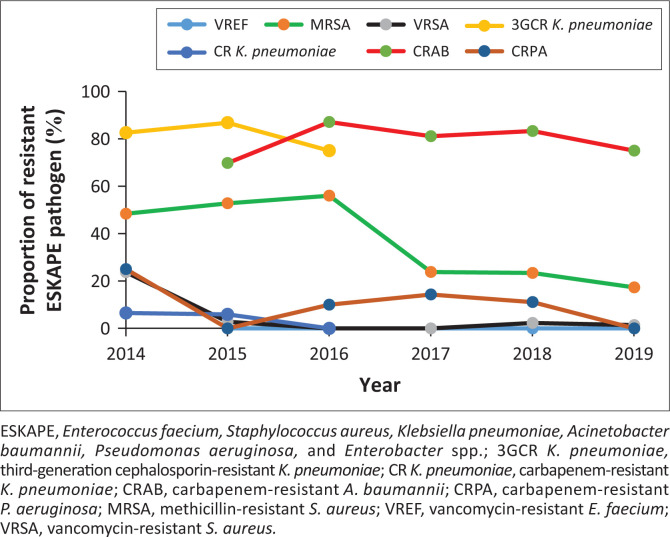
The ESKAPE pathogen incidence rate was stable from 2014 to 2019 ( = 0.133). The most isolated pathogens were (268/746; 35.9%) and (200/746; 26.8%). increased from 39 isolates in 2014 to 75 in 2019 ( = 0.132). The incidence rate of increased from 11.9% (16/134) in 2015 to 37.8% (68/180) in 2019 ( = 0.009). Most isolates (417/746; 55.9%) were from the neonatal ward. Carbapenem-resistant increased from 68.8% (11/16) in 2014 to 75.0% (51/68) in 2019 ( = 0.009). Methicillin-resistant decreased from 56.0% (14/25) in 2016 to 17.3% (13/75) in 2019 ( = 0.260).
Routine data provide essential information on the incidence of ESKAPE pathogens and AMR phenotypes, serving as a basis for an antibiogram, a surveillance tool in antibiotic stewardship programmes.
The study provided local information on the incidence and AMR pattern of ESKAPE pathogens, which is essential when developing empiric treatment protocols for appropriate antibiotic prescribing and infection prevention and control practices.
由于抗菌药物耐药性监测系统建立不完善,非洲关于肠球菌属、金黄色葡萄球菌、肺炎克雷伯菌、鲍曼不动杆菌、铜绿假单胞菌和阴沟肠杆菌(ESKAPE)病原体的发病率及抗菌药物耐药性(AMR)的研究较少。
本研究报告南非北部一家转诊医院血流感染ESKAPE病原体的发病率及AMR情况。
这项回顾性描述性研究使用了2014年1月至2019年12月期间从南非国家卫生实验室服务中心常规收集的血流分离株(使用自动化系统进行病原体鉴定和抗菌药物敏感性测试)。分析的耐药表型包括耐甲氧西林金黄色葡萄球菌和耐碳青霉烯类肺炎克雷伯菌。
2014年至2019年ESKAPE病原体发病率稳定(发病率=0.133)。分离出最多的病原体是金黄色葡萄球菌(268/746;35.9%)和肺炎克雷伯菌(200/746;26.8%)。金黄色葡萄球菌从2014年的39株增加到2019年的75株(发病率=0.132)。肺炎克雷伯菌的发病率从2015年的11.9%(16/134)增加到2019年的37.8%(68/180)(发病率=0.009)。大多数分离株(417/746;55.9%)来自新生儿病房。耐碳青霉烯类肺炎克雷伯菌从2014年的68.8%(11/16)增加到2019年的75.0%(51/68)(发病率=0.009)。耐甲氧西林金黄色葡萄球菌从2016年的56.0%(14/25)降至2019年的17.3%(13/75)(发病率=0.260)。
常规数据提供了关于ESKAPE病原体发病率及AMR表型的重要信息,可作为抗菌谱的基础,抗菌谱是抗生素管理计划中的一种监测工具。
该研究提供了ESKAPE病原体发病率及AMR模式的本地信息,这在制定经验性治疗方案以合理使用抗生素以及预防和控制感染时至关重要。