Lalitha Jino Johns, Ramalingam Natarajan, Rajan Remya, Riju Jeyashanth, Paulose Antony Abraham, Michael Rajiv Charles, Tirkey Amit Jiwan, Adhikari Twisha, Sahu Shalini, Nagayazhini R
Department of Head & Neck Surgery, Christian Medical College, Vellore, India.
Department of Endocrinology, Christian Medical College, Vellore, India.
Endocr Oncol. 2024 Nov 25;4(1):e240022. doi: 10.1530/EO-24-0022. eCollection 2024 Jan 1.
To analyse the risk factors of hypoparathyroidism and hypocalcaemia after total thyroidectomy.
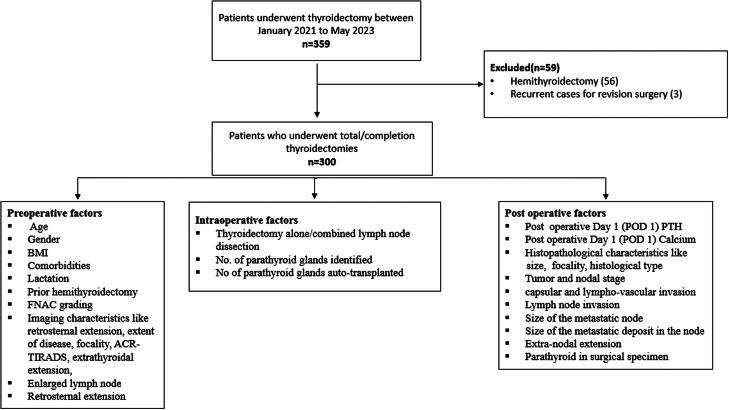
Clinical data of patients who underwent total thyroidectomy at a tertiary care hospital in southern part of India were collected retrospectively from January 2021 to May 2023. Multivariate logistic regression was used to analyse the risk factors associated with transient hypoparathyroidism and hypocalcaemia separately.
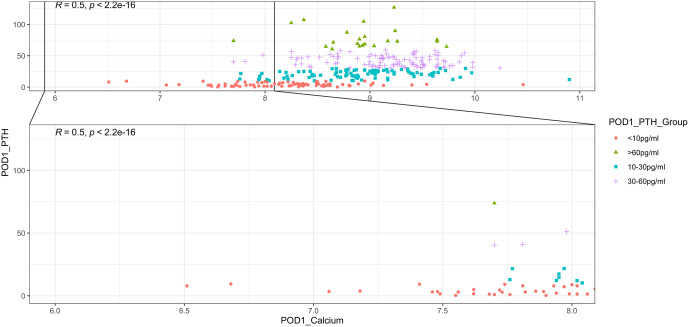
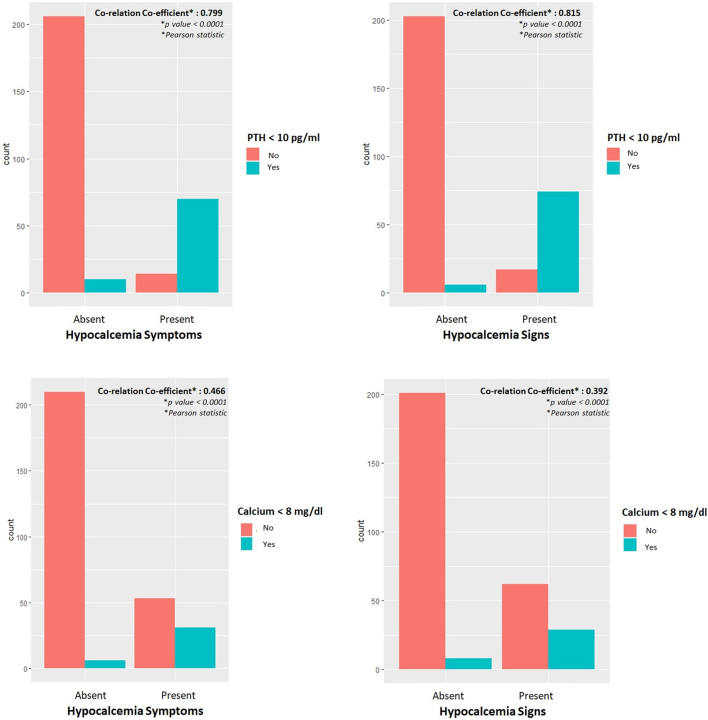
A total of 300 patients who underwent total thyroidectomy were enroled. The median age of the study population was 41 years, and 70% were females. Histopathological examination showed that 80.3% had thyroid cancer. The incidence of postoperative transient hypoparathyroidism was 26.7%, while postoperative transient hypocalcaemia was 12.3%. Multivariate analysis showed that the presence of hypothyroidism before surgery (OR = 3.230, 95% CI: 1.368-7.624, = 0.007), performing central compartment neck dissection (CCND) (OR = 2.196, 95% CI: 1.133-4.257, = 0.02) and parathyroid gland in the surgical specimen (OR = 5.547, 95% CI: 3.065-10.036, < 0.0001) were independent predictors of postoperative transient hypoparathyroidism. Female gender (OR = 2.689, 95% CI: 1.049-6.895, = 0.039), presence of parathyroid in the surgical specimen (OR = 1.067, 95% CI: 0.367-8.438, = 0.004) and performing CCND (OR = 2.192, 95% CI: 0.990-4.850, = 0.05) were independent predictors of postoperative transient hypocalcaemia.
Hypoparathyroidism and hypocalcaemia after thyroid surgery are common, and most of them are transient. The independent predictors of hypoparathyroidism and hypocalcaemia differ. Hypoparathyroidism appears to be a better predictor for patients who will develop postoperative hypocalcaemia.
分析全甲状腺切除术后甲状旁腺功能减退和低钙血症的危险因素。
回顾性收集2021年1月至2023年5月在印度南部一家三级护理医院接受全甲状腺切除术患者的临床资料。采用多因素logistic回归分别分析与短暂性甲状旁腺功能减退和低钙血症相关的危险因素。
共纳入300例行全甲状腺切除术的患者。研究人群的中位年龄为41岁,70%为女性。组织病理学检查显示80.3%患有甲状腺癌。术后短暂性甲状旁腺功能减退的发生率为26.7%,而术后短暂性低钙血症的发生率为12.3%。多因素分析显示,术前存在甲状腺功能减退(OR = 3.230,95%CI:1.368 - 7.624,P = 0.007)、进行中央区颈淋巴结清扫(CCND)(OR = 2.196,95%CI:1.133 - 4.257,P = 0.02)以及手术标本中有甲状旁腺(OR = 5.547,95%CI:3.065 - 10.036,P < 0.0001)是术后短暂性甲状旁腺功能减退的独立预测因素。女性(OR = 2.689,95%CI:1.049 - 6.895,P = 0.039)、手术标本中有甲状旁腺(OR = 1.067,95%CI:0.367 - 8.438,P = 0.004)以及进行CCND(OR = 2.192,95%CI:0.990 - 4.850,P = 0.05)是术后短暂性低钙血症的独立预测因素。
甲状腺手术后甲状旁腺功能减退和低钙血症很常见,且大多数为短暂性。甲状旁腺功能减退和低钙血症的独立预测因素不同。甲状旁腺功能减退似乎是预测患者术后发生低钙血症的更好指标。