Ren Zheng, He Liang, Wang Jing, Shu Li, Li Chenyang, Ma Yuan
Xinjiang Institute of Spinal Surgery, Sixth Affiliated Hospital of Xinjiang Medical University, Urumqi, China.
Institute of General Surgery, Wulumuqi General Hospital of People's Liberation Army (PLA), Urumqi, China.
Front Endocrinol (Lausanne). 2024 Nov 22;15:1369466. doi: 10.3389/fendo.2024.1369466. eCollection 2024.
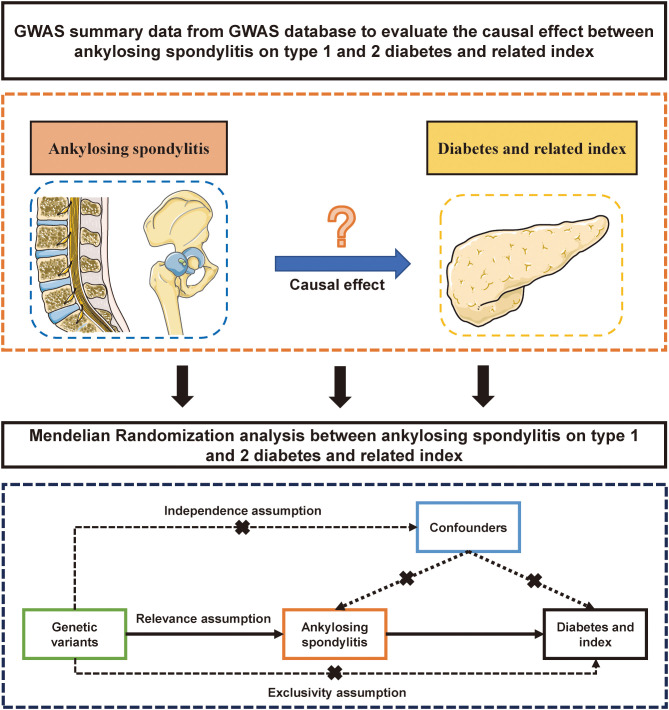
While observational research has highlighted a possible link between ankylosing spondylitis (AS) and type 2 diabetes (T2DM), the quality of evidence remains limited, and the causal relationship is yet to be established. This study aims to explore the causal link between AS and T2DM, as well as its impact on traits related to glucose metabolism.
To infer a causal relationship between AS and various diabetes-related traits, including type 1 diabetes (T1DM), T2DM, blood glucose levels, fasting glucose, glycated hemoglobin, and fasting insulin, we employed Mendelian randomization (MR) analysis. We sourced GWAS summary data for both exposure and outcome variables from the IEU OpenGWAS database, GWAS Catalog, and FinnGen database. To synthesize the results of the MR analyses, we applied meta-analysis techniques using either a fixed or random effects model. For identifying and excluding instrumental variants (IVs) that exhibit horizontal pleiotropy with the outcomes, we utilized the MR-PRESSO method. Sensitivity analyses were conducted using the MR-Egger method, along with Q and I^2 tests, to ensure the robustness of our findings.
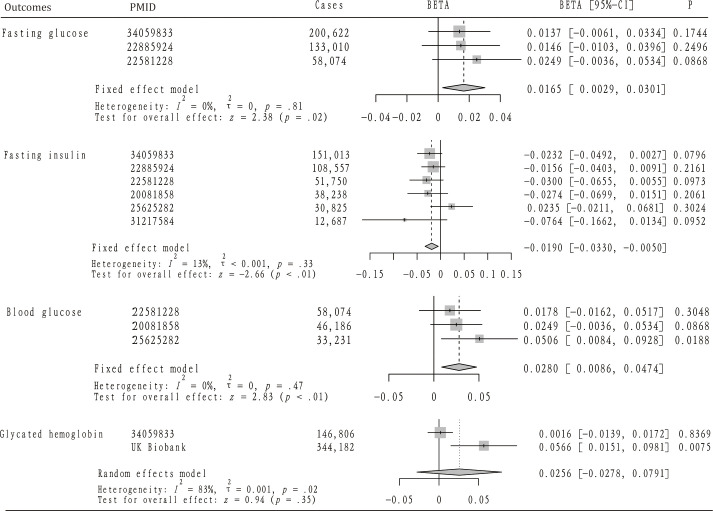
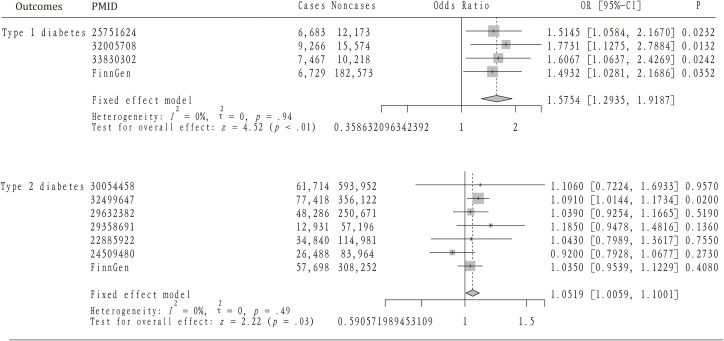
Our analysis revealed a significant association between AS and an increased risk of T1DM with an odds ratio (OR) of 1.5754 (95% CI: 1.2935 to 1.9187) and T2DM with an OR of 1.0519 (95% CI: 1.0059 to 1.1001). Additionally, AS was associated with elevated levels of fasting glucose (beta coefficient = 0.0165, 95% CI: 0.0029 to 0.0301) and blood glucose (beta coefficient = 0.0280, 95% CI: 0.0086 to 0.0474), alongside a decrease in fasting insulin levels (beta coefficient = -0.0190, 95% CI: -0.0330 to -0.0050).
Our findings collectively underscore the detrimental impact of AS on the development of diabetes, highlighting the critical influence of autoimmune disorders in diabetes onset. This provides profound insights into the pathogenesis of diabetes from an immunological standpoint.
虽然观察性研究强调了强直性脊柱炎(AS)与2型糖尿病(T2DM)之间可能存在联系,但证据质量仍然有限,因果关系尚未确立。本研究旨在探讨AS与T2DM之间的因果联系,以及其对糖代谢相关特征的影响。
为了推断AS与各种糖尿病相关特征之间的因果关系,包括1型糖尿病(T1DM)、T2DM、血糖水平、空腹血糖、糖化血红蛋白和空腹胰岛素,我们采用了孟德尔随机化(MR)分析。我们从IEU OpenGWAS数据库、GWAS Catalog和FinnGen数据库中获取暴露和结局变量的全基因组关联研究(GWAS)汇总数据。为了综合MR分析的结果,我们使用固定效应或随机效应模型应用荟萃分析技术。为了识别和排除与结局表现出水平多效性的工具变量(IVs),我们使用了MR-PRESSO方法。使用MR-Egger方法以及Q和I²检验进行敏感性分析,以确保我们研究结果的稳健性。
我们的分析显示,AS与T1DM风险增加之间存在显著关联,优势比(OR)为1.5754(95%置信区间:1.2935至1.9187),与T2DM风险增加之间也存在显著关联,OR为1.0519(95%置信区间:1.0059至1.1001)。此外,AS与空腹血糖水平升高(β系数 = 0.0165,95%置信区间:0.0029至0.0301)和血糖升高(β系数 = 0.0280,95%置信区间:0.0086至0.0474)相关,同时空腹胰岛素水平降低(β系数 = -0.0190,95%置信区间:-0.0330至-0.0050)。
我们的研究结果共同强调了AS对糖尿病发展的有害影响,突出了自身免疫性疾病在糖尿病发病中的关键作用。这从免疫学角度为糖尿病的发病机制提供了深刻见解。