Rahman Mosiur, Khatun Mahfuza, Pinkey Asrafun Naher, Haque Syed Emdadul, Liza Farhana Akhter, Haque Md Nuruzzaman, Sarkar Prosannajid, Roy Tapan Kumar, Islam G M Rabiul, Alam Md Rashed, Hasan Mahmudul, Adam Izzeldin Fadl, Duc Nguyen Huu Chau, Al-Sobaihi Saber, Hasan Abid
Department of Population Science and Human Resource Development, University of Rajshahi, Rajshahi-6205, Bangladesh.
Uchicago Research Bangladesh, Dhaka, Bangladesh.
Glob Heart. 2024 Dec 5;19(1):90. doi: 10.5334/gh.1372. eCollection 2024.
Our objectives were to ascertain: the prevalence and socio-economic distribution of hypertension, as well as the rates of undiagnosed and untreated hypertension; the association between socioeconomic status (SES) and the occurrence of hypertension, as well as the rates of undiagnosed and untreated hypertension; and the factors influencing the poor-non-poor gap in terms of the prevalence, diagnosis, and treatment of hypertension.
Cross-sectional nationally representative study.
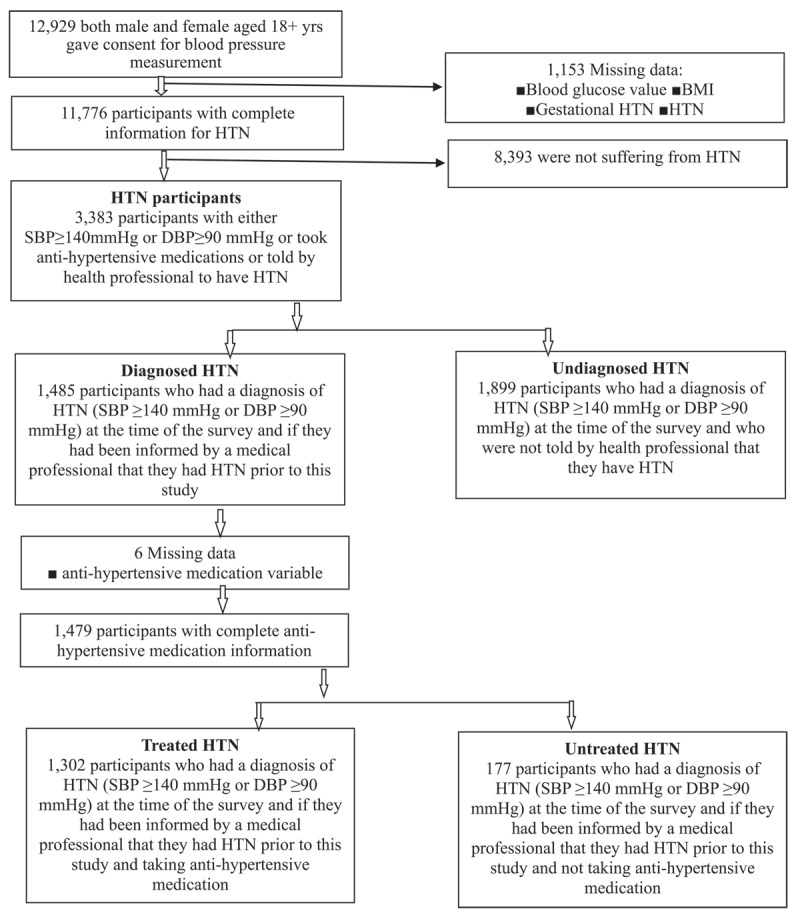
Data from the 2017-18 Bangladesh Demographic Health Survey were used. 11,776 participants who were 18 years of age or older responded to our analysis. We used the wealth index as a proxy for SES. The prevalence of hypertension, both diagnosed and undiagnosed, as well as its untreated states, were the outcome variables.
The age-adjusted prevalence of hypertension, undiagnosed as having hypertension, and untreated cases were 25.1%, 57.2%, and 12.3%, respectively. People in the poor SES groups had a 0.88 times (95% confidence interval [CI] 0.77-0.99) lower likelihood of having hypertension compared to those in the non-poor SES group. Individuals belonging to the poor SES group exhibited a likelihood of 1.68 and 1.53 times greater for having untreated hypertension and being undiagnosed with the condition, respectively, compared to those in the non-poor SES group. The results indicated that BMI played a role in increasing the disparity between the poor and non-poor populations concerning hypertension risk. Additionally, factors such as age, gender, and education were found to exacerbate the gap in the risk of undiagnosed hypertension between these two groups.
The results of this study suggest that appropriate policy measures be developed for ongoing care and early identification, especially for older adults, men, and individuals with low levels of education from low socioeconomic backgrounds. Additionally, efforts must be made to reduce the prevalence of overweight and obesity among people in the non-poor SES category.
我们的目标是确定:高血压的患病率及社会经济分布,以及未诊断和未治疗的高血压比例;社会经济地位(SES)与高血压发生之间的关联,以及未诊断和未治疗的高血压比例;以及影响高血压患病率、诊断和治疗方面贫富差距的因素。
具有全国代表性的横断面研究。
使用了2017 - 18年孟加拉国人口与健康调查的数据。11776名18岁及以上的参与者接受了我们的分析。我们使用财富指数作为SES的替代指标。高血压的患病率(包括已诊断和未诊断的)及其未治疗状态为结果变量。
年龄调整后的高血压患病率、未被诊断为高血压以及未治疗病例的比例分别为25.1%、57.2%和12.3%。与非贫困SES组相比,贫困SES组的人患高血压的可能性低0.88倍(95%置信区间[CI] 0.77 - 0.99)。与非贫困SES组相比,贫困SES组的人未治疗高血压和未被诊断出患有该疾病的可能性分别高出1.68倍和1.53倍。结果表明,体重指数在增加贫困和非贫困人群在高血压风险方面的差距中起作用。此外,年龄、性别和教育等因素被发现会加剧这两组人群在未诊断高血压风险方面的差距。
本研究结果表明,应制定适当的政策措施用于持续护理和早期识别,特别是针对来自低社会经济背景的老年人、男性和低教育水平的个体。此外,必须努力降低非贫困SES类别人群中超重和肥胖的患病率。