Ravelo Anay D, Dufour Ellan I, Klejeski Makaila, Ziegler Bruce, Golombeski Angie, Salfer Isaac J
Department of Veterinary Population Medicine, University of Minnesota, Saint Paul, MN, 55108.
Hubbard Feeds, Mankato, MN 56001.
JDS Commun. 2024 May 10;5(6):553-557. doi: 10.3168/jdsc.2024-0557. eCollection 2024 Nov.
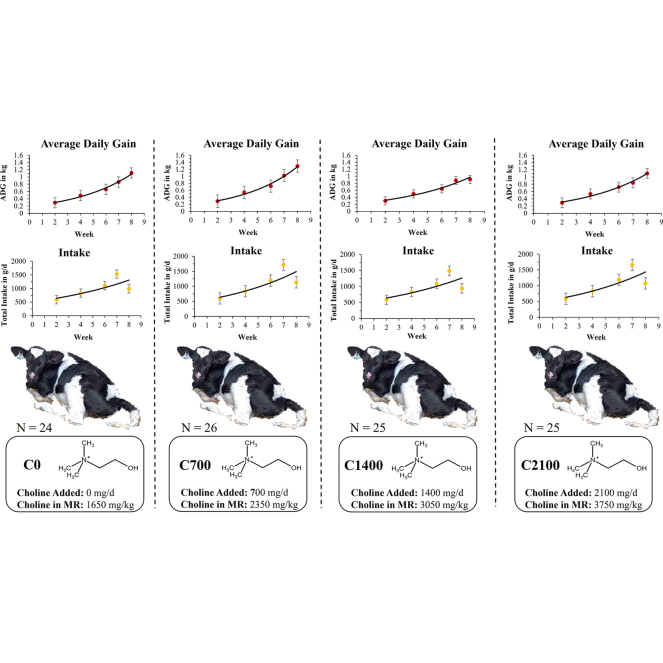
The objective of this study was to evaluate the effect of increasing choline supplementation on the intake of milk replacer (MR) and calf starter (CS), growth performance, and fecal scores of calves over 8 wk. One hundred calves from commercial herds were transported to the University of Minnesota Southern Research and Outreach Center (SROC) calf facility randomized to one of 4 treatments differing in choline supplementation within MR including: 0 (C0; n = 24), 700 (C700; n = 26), 1,400 (C1400; n = 25), and 2,100 mg/kg choline (C2100; n = 25). Milk replacer contained a basal concentration of 1,650 mg/kg MR resulting in total choline concentrations in the MR of 1,650 mg/kg for C0, 2,350 mg/kg for C700, 3,050 mg/kg for C1400, and 3,750 mg/kg for C2100. Calves were weaned at 49 d, and the trial ended at 56 d. Body weight was measured at d 0, 14, 28, 42, 49, and 56. Fecal scores were measured weekly. Feed intake was measured daily and calculated every 2 wk. All feeding, BW measurements, and fecal scoring were conducted by the research staff at the University of Minnesota SROC. Growth, feed intake, and gain to feed ratio were analyzed using a linear mixed effects model with choline concentration as a fixed effect and source herd and room as random effects. Initial BW was included as a covariate for average daily gain. Fecal scores were analyzed as a chi-squared test of significance. Feeding 700 mg/kg supplemental choline increased MR intake throughout the preweaning period and increased ADG in both the preweaning and postweaning periods compared with the other treatments. No differences were observed for fecal scores across treatments. Results suggest that calf performance can be improved with MR containing 2,350 mg/kg choline, contrasting with current NASEM (2021) requirements of 1,000 mg/kg.
本研究的目的是评估在8周内增加胆碱补充量对犊牛代乳粉(MR)和开食料(CS)采食量、生长性能及粪便评分的影响。来自商业牛群的100头犊牛被运至明尼苏达大学南部研究与推广中心(SROC)的犊牛设施,随机分为4种处理组之一,各处理组代乳粉中的胆碱补充量不同,分别为:0(C0;n = 24)、700(C700;n = 26)、1400(C1400;n = 25)和2100 mg/kg胆碱(C2100;n = 25)。代乳粉中胆碱的基础浓度为1650 mg/kg MR,因此C0组代乳粉中的总胆碱浓度为1650 mg/kg,C700组为2350 mg/kg,C1400组为3050 mg/kg,C2100组为3750 mg/kg。犊牛在49日龄时断奶,试验于56日龄结束。在第0、14、28、42、49和56天测量体重。每周测量粪便评分。每天测量采食量并每2周计算一次。明尼苏达大学SROC的研究人员进行所有的饲养、体重测量和粪便评分。使用线性混合效应模型分析生长、采食量和增重与采食量之比,将胆碱浓度作为固定效应,牛群来源和栏舍作为随机效应。初始体重作为平均日增重的协变量纳入分析。粪便评分采用卡方显著性检验进行分析。与其他处理组相比,添加700 mg/kg胆碱可使断奶前整个时期的代乳粉采食量增加,并使断奶前和断奶后时期的平均日增重均增加。各处理组之间的粪便评分未观察到差异。结果表明,与美国国家科学院、工程院和医学院(NASEM,2021)目前1000 mg/kg的要求相比,含2350 mg/kg胆碱的代乳粉可提高犊牛性能。