Wang Xin, Han Xu, Yang Xiaolei, Hidru Tesfaldet Habtemariam, Wang Chengfang, Xia Yunlong, Che Ying
Department of Ultrasound, First Affiliated Hospital of Dalian Medical University, Dalian, Liaoning, China.
Department of Ultrasound, The Affiliated Hospital of Innermongolia Medical University, Hohhot, China.
Front Cardiovasc Med. 2024 Nov 22;11:1506143. doi: 10.3389/fcvm.2024.1506143. eCollection 2024.
The risk of comorbidity of cancer is increased in atrial fibrillation (AF) patients, which is a massive challenge for clinical management in cardiovascular settings. This study aimed to analyze whether cancer affects the decision of radiofrequency ablation and to explore the efficacy and safety of radiofrequency ablation in AF patients with cancer.
We conducted a retrospective cohort study of patients who were first diagnosed AF and identified who were with cancer. The propensity score matching method was utilized to balance the differences between the cancer and non-cancer groups. Logistic regression analysis was used to study the related factors affecting the ablation of AF. Cox regression analysis was used to evaluate the effect of cancer on the recurrence of AF after radiofrequency ablation.
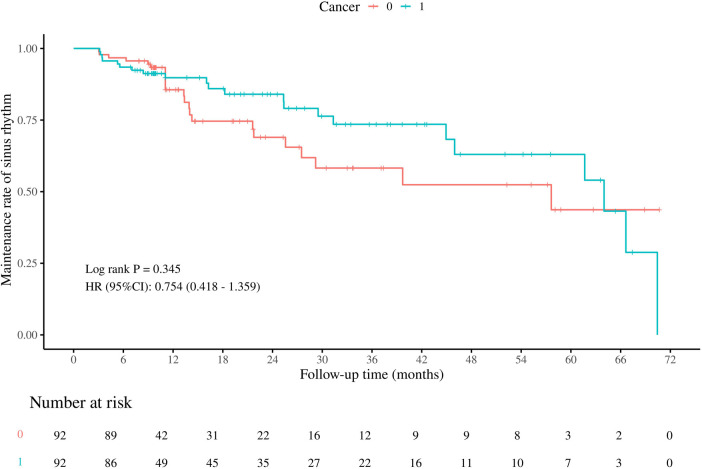
Among 9,159 patients who were first diagnosed AF, the prevalence of cancer was 4.48%. Cancer did not affect the decision of rhythm intervention in AF patients ( = 0.46). There was no significant difference in the incidence of perioperative complications, bleeding events, and embolization events between cancer and non-cancer groups ( = 1.000). The median follow-up time was 342 (293,866) days, and 45 patients had AF recurrence. Multivariable Cox regression showed no statistically significant relationship between concomitant cancer and AF recurrence after radiofrequency ablation (hazard ratio = 0.82, 95% confidence interval 0.36-1.83, = 0.62).
The combination of cancer did not affect the decision of patients to perform ablation therapy. Radiofrequency catheter ablation could be used as a strategy to maintain long-term sinus rhythm in patients with concomitant cancer without affecting AF recurrence.
心房颤动(AF)患者发生癌症合并症的风险增加,这对心血管疾病的临床管理构成了巨大挑战。本研究旨在分析癌症是否会影响射频消融的决策,并探讨射频消融在合并癌症的AF患者中的疗效和安全性。
我们对首次诊断为AF的患者进行了一项回顾性队列研究,并确定了合并癌症的患者。采用倾向评分匹配法来平衡癌症组和非癌症组之间的差异。使用逻辑回归分析来研究影响AF消融的相关因素。使用Cox回归分析来评估癌症对射频消融后AF复发的影响。
在9159例首次诊断为AF的患者中,癌症患病率为4.48%。癌症不影响AF患者的节律干预决策(P=0.46)。癌症组和非癌症组在围手术期并发症、出血事件和栓塞事件的发生率上无显著差异(P=1.000)。中位随访时间为342(293,866)天,45例患者发生AF复发。多变量Cox回归显示,合并癌症与射频消融后AF复发之间无统计学显著关系(风险比=0.82,95%置信区间0.36-1.83,P=0.62)。
合并癌症不影响患者进行消融治疗的决策。射频导管消融可作为一种策略,用于维持合并癌症患者的长期窦性心律,且不影响AF复发。