Bakare Damola, Salako Julius, Sogbesan Abiodun, Olojede Omotayo Emmanuel, Akinsola Kofoworola Olamide, Subhi Rami, Graham Hamish, Falade Adegoke, King Carina, Bakare Ayobami Adebayo
Department of Paediatrics, University of Ibadan, Ibadan, 200005, Nigeria.
Centre for International Child Health, Murdoch Children's Research Institute, University of Melbourne, Royal Children's Hospital, Parkville, Victoria, 3052, Australia.
Pan Afr Med J. 2024 Aug 14;48:176. doi: 10.11604/pamj.2024.48.176.42913. eCollection 2024.
in Nigeria, studies on mpox among primary healthcare workers are scarce despite increasing incidence of mpox disease between 2017-2022. This study aimed to assess primary healthcare workers knowledge and perception of mpox in Nigeria.
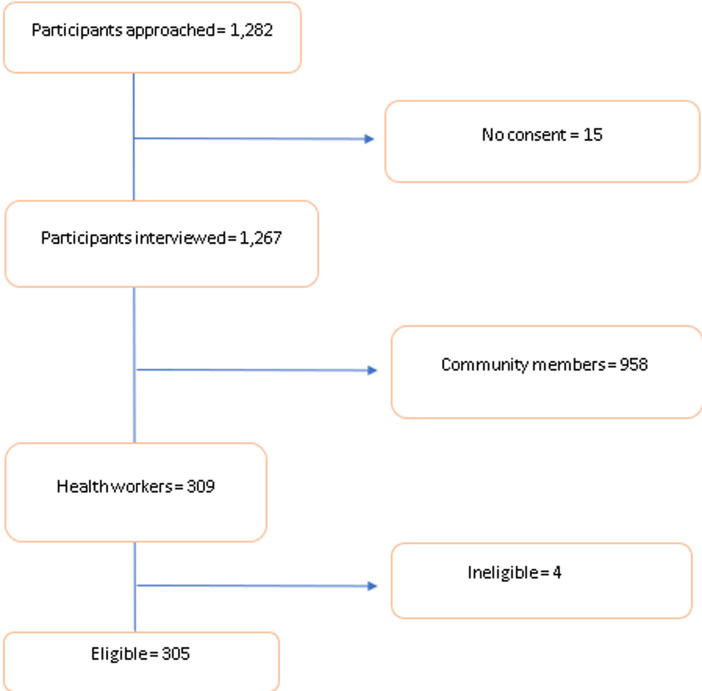
we conducted a cross-sectional survey among primary healthcare workers in Nigeria (Oyo, Lagos, and Jigawa) to represent different health system capacities and socio-economic contexts. Knowledge of mpox was evaluated in four domains: general knowledge, transmission, signs and symptoms, and prevention and treatment. Each correct response received a score of 1. We categorize the level of knowledge based on the score using the mean score as the cut-off by re-classifying the composite score of respondents for each state into a binary outcome of "good knowledge" if the mean composite score was greater or equals to the mean of overall knowledge score for the three states (16.1), and "poor knowledge" if the mean score equals to sixteen or less than sixteen (≤16). Factors associated with mpox knowledge were explored using multivariable logistic regression at a 5% significance level. Perception of mpox was assessed using five constructs from the health belief model, measured on 3-point Likert scales. Factors associated with each construct were analyzed using Kruskal-Wallis and Mann-Whitney-U tests.
in our study on healthcare workers, 78.3% (n=239) were aware of mpox disease. Their overall knowledge was moderate, particularly regarding transmission. Meanwhile, less than 50% knew mpox can be transmitted through sharing utensils, and 65.3% (n=156) understood contact with infected animals could lead to transmission. Lagos had lower overall knowledge scores (15.3±2.3) compared to Jigawa (16.9±2.3) and Oyo (16.3±2.5) (p<0.001). Perceived susceptibility was similar across states (p=0.127), and 97.5% (n=233) believed mpox can affect anyone, while 47.3% (113) felt they couldn't contract it. Jigawa exhibited higher perceived severity (p<0.001) and barriers to prevention (p<0.001).
primary healthcare workers in all settings had limited knowledge of mpox transmission, with the perception of mpox varying by state and participants' socio-economic characteristics. The responsibility of HCW encompasses a range of activities that include diagnosis, patient care and education, and public health interventions amongst others. Hence it is important to educate HCWs on mpox disease to successfully curtail the spread of mpox.
在尼日利亚,尽管2017年至2022年间猴痘发病率不断上升,但针对初级卫生保健工作者开展的猴痘研究却很匮乏。本研究旨在评估尼日利亚初级卫生保健工作者对猴痘的认知和看法。
我们在尼日利亚的初级卫生保健工作者(来自奥约州、拉各斯州和吉加瓦州)中开展了一项横断面调查,以代表不同的卫生系统能力和社会经济背景。从四个领域评估对猴痘的认知:一般知识、传播、体征和症状以及预防和治疗。每个正确答案得1分。我们以平均分数为临界值,根据得分对知识水平进行分类,将每个州受访者的综合得分重新分类为二元结果:如果平均综合得分大于或等于三个州的总体知识得分平均值(16.1),则为“知识良好”;如果平均得分等于或低于16分(≤16),则为“知识欠佳”。使用多变量逻辑回归在5%的显著性水平下探索与猴痘知识相关的因素。使用健康信念模型中的五个结构来评估对猴痘的看法,采用3分李克特量表进行测量。使用Kruskal-Wallis检验和Mann-Whitney-U检验分析与每个结构相关的因素。
在我们对卫生保健工作者的研究中,78.3%(n = 239)知晓猴痘疾病。他们的总体知识水平中等,尤其是在传播方面。与此同时,不到50%的人知道猴痘可通过共用器具传播,65.3%(n = 156)了解接触受感染动物可能导致传播。与吉加瓦州(16.9±2.3)和奥约州(16.3±2.5)相比,拉各斯州的总体知识得分较低(15.3±2.3)(p<0.001)。各州的感知易感性相似(p = 0.127),97.5%(n = 233)的人认为猴痘可感染任何人,而47.3%(113)的人觉得自己不会感染。吉加瓦州表现出更高的感知严重性(p<0.001)和预防障碍(p<0.001)。
所有地区的初级卫生保健工作者对猴痘传播的知识都有限,对猴痘的看法因州和参与者的社会经济特征而异。卫生保健工作者的职责包括一系列活动,其中包括诊断、患者护理和教育以及公共卫生干预等。因此,对卫生保健工作者进行猴痘疾病教育对于成功遏制猴痘传播很重要。