Rodriguez Arroyo Brenda Paola, Mondragón-Cardona Alvaro, Pacheco-Orozco Rafael Adrián, Tamayo Andrea, Moreno Juan Camilo, Baena-Valencia Juan Camilo
Internal Medicine Department, Foundation Valle del Lili, Cali, Colombia.
Haematology and Oncology Department, Foundation Valle del Lili, Cali, Colombia.
Eur J Case Rep Intern Med. 2024 Nov 15;11(12):004887. doi: 10.12890/2024_004887. eCollection 2024.
Lung cancer is the second most common cancer worldwide and the leading cause of cancer deaths; non-small cell lung cancer (NSCLC) constitutes about 85% of lung cancer cases, with ALK fusions representing 3-6% of them. The SQSTM1-ALK fusion is a rare finding in NSCLC, accounting for only 1.1% of ALK rearrangements. We present a case of lung adenocarcinoma with documentation of SQSTM1-ALK fusion that showed a partial response to alectinib.
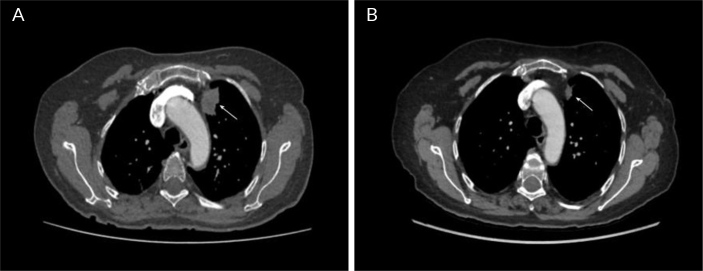
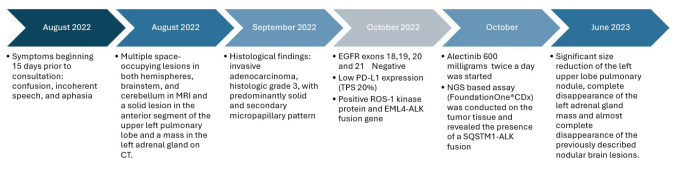
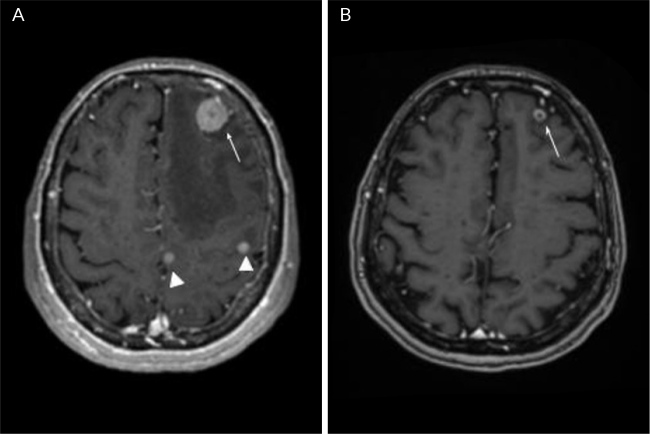
This case details the clinical course of a 71-year-old, non-smoking woman with no significant medical history who presented with confusion, aphasia and multiple cerebral lesions detected on imaging. Further investigations revealed a stage IV lung adenocarcinoma with metastases to the brain and adrenal gland. Molecular profiling identified a rare SQSTM1-ALK fusion mutation alongside other genetic abnormalities, including low programmed death-ligand 1 expression and ROS1 kinase protein presence. Treatment with alectinib, initiated based on the identified ALK fusion, resulted in significant tumour regression in the lungs and complete resolution of the adrenal mass, as evidenced by follow-up imaging and clinical assessments.
This case highlights the efficacy of alectinib in treating rare ALK fusion variants in and underscores the importance of comprehensive molecular profiling in guiding targeted therapy decisions.
This case highlights the importance of identifying rare ALK fusions, such as SQSTM1-ALK, in non-small cell lung cancer (NSCLC), which can guide personalised treatment strategies. The use of next-generation sequencing alongside immunohistochemistry is crucial for accurately detecting ALK and ROS1 rearrangements, avoiding false positives and enabling the identification of druggable mutations. This case reinforces the value of personalised medicine in NSCLC, where molecular profiling can uncover unique genetic alterations, allowing for more tailored and potentially more effective treatments.
肺癌是全球第二常见的癌症,也是癌症死亡的主要原因;非小细胞肺癌(NSCLC)约占肺癌病例的85%,其中ALK融合占3%-6%。SQSTM1-ALK融合在NSCLC中较为罕见,仅占ALK重排的1.1%。我们报告一例肺腺癌病例,记录了SQSTM1-ALK融合,该病例对阿来替尼显示出部分缓解。
本病例详细介绍了一名71岁、无吸烟史且无重大病史的女性患者的临床过程,该患者出现意识模糊、失语,影像学检查发现多处脑病变。进一步检查显示为IV期肺腺癌,已转移至脑和肾上腺。分子分析确定了一种罕见的SQSTM1-ALK融合突变以及其他基因异常,包括程序性死亡配体1低表达和ROS1激酶蛋白存在。基于确定的ALK融合开始使用阿来替尼治疗,后续影像学检查和临床评估证明,肺部肿瘤显著消退,肾上腺肿块完全消失。
本病例突出了阿来替尼治疗罕见ALK融合变异的疗效,并强调了全面分子分析在指导靶向治疗决策中的重要性。
本病例突出了在非小细胞肺癌(NSCLC)中识别罕见ALK融合(如SQSTM1-ALK)的重要性,这可以指导个性化治疗策略。将下一代测序与免疫组织化学结合使用对于准确检测ALK和ROS1重排、避免假阳性以及识别可药物化突变至关重要。本病例强化了个性化医学在NSCLC中的价值,分子分析可以揭示独特的基因改变,从而实现更具针对性且可能更有效的治疗。