Duan Lixia, Lin Rujiao, Wang Dan, Wang Xi, Zhang Xinyi, Ding Liping, Liu Chenxi
Zhejiang Provincial People's Hospital, Hangzhou, China.
School of Medicine and Health Management, Tongji Medical School, Huazhong University of Science and Technology, Wuhan, China.
J Glob Health. 2024 Dec 9;14:04220. doi: 10.7189/jogh.14.04220.
Addressing antibiotic resistance is important for reducing parents' self-medication of antibiotics for children's upper respiratory tract infections (URTIs). However, the decision-making process for parents who irrationally use such antibiotics is still unclear. In this study, we aimed to explore the reasons why parents self-medicate antibiotics for children's URTIs based on a discrete choice experiment.
We conducted a systematic review and in-depth interviews to identify the key attributes of choices when parents self-medicate antibiotics for children's URTIs. We developed and applied a discrete choice experiment in Wuhan and Chongqing, China. We used a mixed logit model to determine the impact of various attributes on parents' decisions, while we applied latent class logit models to explore different decision-making patterns within populations.
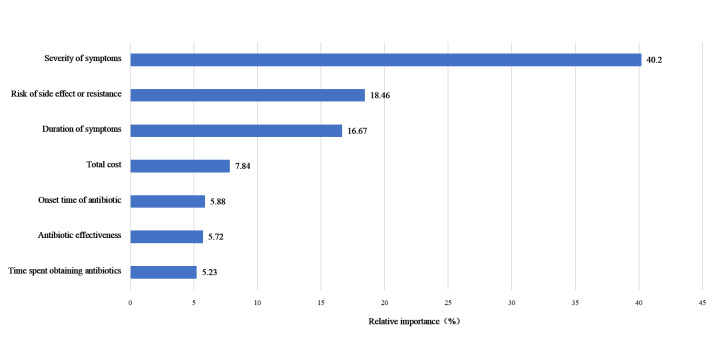
A total of 400 valid responses were returned from parents. It was shown that symptom severity was the most important in parents' decision-making to self-medicate antibiotics for children's URTIs, followed by risk of side effects or resistance, duration, total cost, onset time of antibiotic, and antibiotic effectiveness. More severe and longer symptoms, perceived higher effectiveness, and fewer side effects of antibiotics consistently were significantly associated with parents' more likely to self-medicate with antibiotics for children's URTIs. There are also different patterns of decision-making of parents, including 'symptoms-oriented,' 'safety-oriented,' and 'comprehensive consideration.' Parents' gender and educational level were associated with decision-making patterns.
Parents' self-medication of antibiotics for children's URTIs was mainly driven by symptoms, followed by perceived antibiotic value. We recommend a multi-faceted intervention strategy to enhance parents' ability to differentiate mild from severe URTIs, as well as their knowledge of antibiotics.
应对抗生素耐药性对于减少家长给儿童上呼吸道感染(URTI)自行使用抗生素的情况至关重要。然而,家长不合理使用此类抗生素的决策过程仍不明确。在本研究中,我们旨在基于离散选择实验探索家长给儿童URTI自行使用抗生素的原因。
我们进行了系统综述和深入访谈,以确定家长给儿童URTI自行使用抗生素时选择的关键属性。我们在中国武汉和重庆开展并应用了离散选择实验。我们使用混合逻辑模型来确定各种属性对家长决策的影响,同时应用潜在类别逻辑模型来探索人群中的不同决策模式。
共收到400份家长的有效回复。结果表明,症状严重程度在家长给儿童URTI自行使用抗生素的决策中最为重要,其次是副作用或耐药风险、病程、总成本、抗生素起效时间和抗生素疗效。症状越严重、病程越长、抗生素疗效越高以及副作用越少,与家长更有可能给儿童URTI自行使用抗生素显著相关。家长的决策模式也存在差异,包括“以症状为导向”“以安全为导向”和“综合考虑”。家长的性别和教育水平与决策模式有关。
家长给儿童URTI自行使用抗生素主要受症状驱动,其次是对抗生素价值的认知。我们建议采取多方面的干预策略,以提高家长区分轻度和重度URTI的能力以及他们对抗生素的认识。