Goto Hideki, Kumode Takahiro, Mishima Yuko, Kataoka Keisuke, Ogawa Yoshiaki, Kanemura Nobuhiro, Shimada Kazuyuki, Uchida Toshiki, Kuroe Yukano, Kawasaki Atsuko, Sato Jotaro, Teshima Takanori
Department of Hematology, Faculty of Medicine and Graduate School of Medicine, Hokkaido University, Hokkaido, Japan.
Division of Laboratory and Transfusion Medicine, Hokkaido University Hospital, Hokkaido, Japan.
Int J Clin Oncol. 2025 Feb;30(2):389-396. doi: 10.1007/s10147-024-02662-5. Epub 2024 Dec 9.
In a global phase I/II study (GO29781; NCT02500407), single-agent mosunetuzumab had a manageable safety profile and induced durable complete responses in patients with relapsed/refractory (R/R) B-cell non-Hodgkin lymphoma, including in patients with R/R follicular lymphoma (FL). In this analysis, the efficacy and safety of mosunetuzumab monotherapy were evaluated in an expansion cohort, FLMOON-1, in Japanese patients with R/R FL who had received ≥ 2 prior lines of therapy in a phase I study (JO40295, jRCT2080223801).
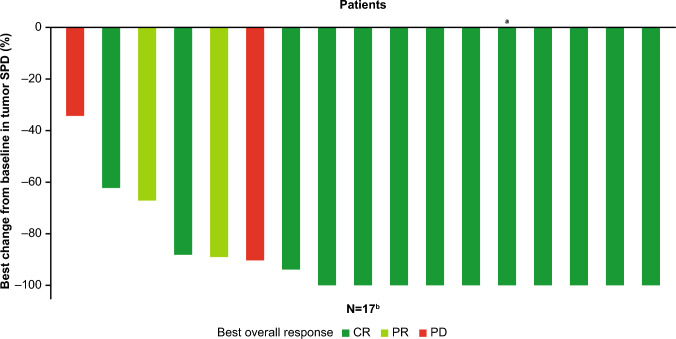
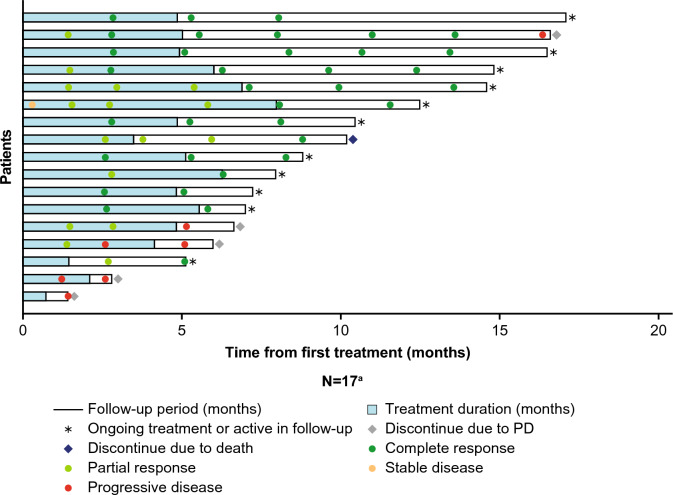
Mosunetuzumab was administered intravenously at the recommended phase II dose (with cycle 1 step-up dosing) for eight cycles or up to 17 cycles, or until disease progression or unacceptable toxicity. The pre-specified primary endpoint was Independent Review Facility (IRF)-assessed complete response rate (CRR; as best overall response). Secondary objectives included investigator (INV)-assessed CRR, INV- and IRF-assessed objective response rate (ORR), and safety.
At the data cutoff (October 13, 2023), 19 patients (median age 72 years) were evaluated. The IRF-assessed CRR and ORR were 68.4% and 78.9%, respectively; the INV-assessed CRR and ORR were 63.2% and 84.2%, respectively. Grade 3-4 adverse events (AEs) were observed in 89.5% of patients, with a low incidence of AEs leading to mosunetuzumab discontinuation (10.5%) and one fatal AE unrelated to mosunetuzumab. Cytokine release syndrome occurred in 47.4% of patients and were mostly Grade 1 in severity.
These findings indicate mosunetuzumab has a consistent efficacy and manageable safety profile in Japanese patients with R/R FL compared with previously reported data from the global phase I/II study.
在一项全球I/II期研究(GO29781;NCT02500407)中,单药mosunetuzumab具有可控的安全性,并且在复发/难治性(R/R)B细胞非霍奇金淋巴瘤患者中诱导了持久的完全缓解,包括R/R滤泡性淋巴瘤(FL)患者。在本分析中,评估了mosunetuzumab单药治疗在一个扩展队列FLMOON-1中的疗效和安全性,该队列纳入了在一项I期研究(JO40295,jRCT2080223801)中接受过≥2线既往治疗的日本R/R FL患者。
Mosunetuzumab以推荐的II期剂量静脉给药(第1周期逐步递增剂量),共8个周期或直至17个周期,或直至疾病进展或出现不可接受的毒性。预先指定的主要终点是独立审查机构(IRF)评估的完全缓解率(CRR;作为最佳总体缓解)。次要目标包括研究者(INV)评估的CRR、INV和IRF评估的客观缓解率(ORR)以及安全性。
在数据截止日期(2023年10月13日),评估了19例患者(中位年龄72岁)。IRF评估的CRR和ORR分别为68.4%和78.9%;INV评估的CRR和ORR分别为63.2%和84.2%。89.5%的患者观察到3-4级不良事件(AE),导致mosunetuzumab停药的AE发生率较低(10.5%),且有1例与mosunetuzumab无关的致命AE。47.4%的患者发生细胞因子释放综合征,严重程度大多为1级。
这些发现表明,与全球I/II期研究先前报告的数据相比,mosunetuzumab在日本R/R FL患者中具有一致的疗效和可控的安全性。