Fenoglio Ivana, Gul Shagufta, Barbero Francesco, Mecarelli Enrica, Medana Claudio, Gallo Angelo, Polizzi Carlotta
Department of Chemistry, University of Torino, via P. Giuria 7, 10125, Torino, Italy.
Department of Molecular Biotechnology and Health Sciences, University of Torino, via Nizza 44, 10126, Torino, Italy.
Heliyon. 2024 Nov 20;10(23):e40587. doi: 10.1016/j.heliyon.2024.e40587. eCollection 2024 Dec 15.
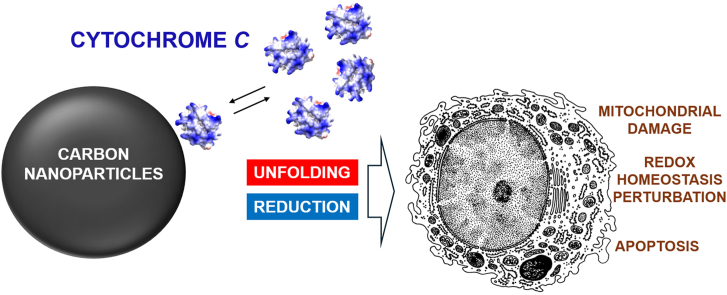
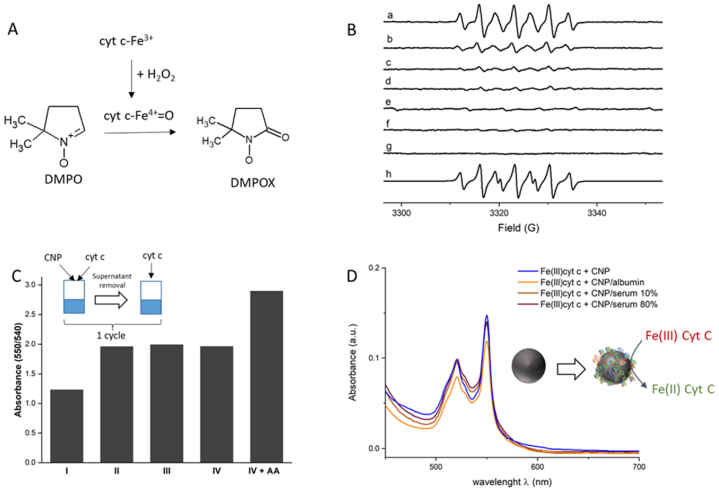
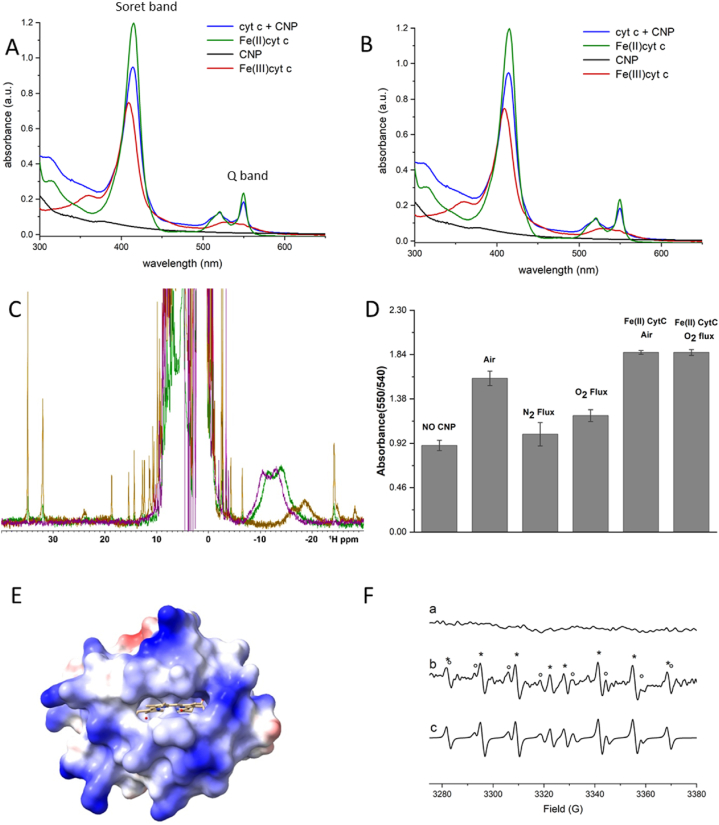
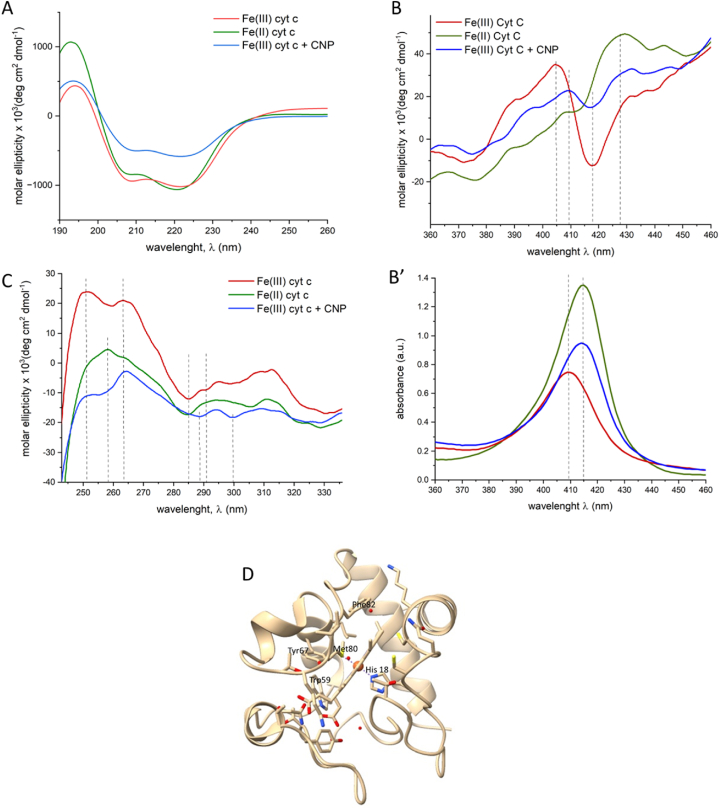
Carbon nanomaterials (CNMs) are a heterogeneous class of advanced materials. Their widespread use is associated with human safety concerns, which can be addressed by safe-by design strategies. This implies a deep knowledge of how physico-chemical properties drive biological effects. The ability of CNMs to interact with cytochrome (cyt ), a heme-protein playing a key role in the respiratory chain, in apoptosis and in cellular redox homeostasis, has been reported in some studies. However, the consequences of this interaction on the cyt functions are controversial. Here the mechanism of interaction of carbon nanoparticles (CNPs), chosen as model of redox-active CNMs, with cyt has been studied with the aim to shed light into these discrepancies. The effect of CNPs on the redox state of cyt was monitored by UV-vis spectroscopy and 1D H NMR, while the effect on the primary, secondary, and tertiary cyt structure was investigated by FIA/LC-MS and Circular Dichroism (CD). Finally, the peroxidase activity of cyt and the involvement of superoxide radicals was evaluated by EPR spectroscopy. We demonstrate the existence of two mechanisms, one leading to the suppression of the cyt peroxidase activity following the NADH-independent reduction of the heme-iron, and the other resulting in the irreversible protein unfolding. Overall, the results suggest that these two processes might be independently modulated by redox and surface properties respectively.
碳纳米材料(CNMs)是一类性质各异的先进材料。它们的广泛应用引发了人们对人类安全的担忧,而通过设计安全策略可以解决这些问题。这意味着需要深入了解物理化学性质如何驱动生物效应。一些研究报道了CNMs与细胞色素c(cyt c)相互作用的能力,细胞色素c是一种在呼吸链、细胞凋亡和细胞氧化还原稳态中起关键作用的血红素蛋白。然而,这种相互作用对细胞色素c功能的影响存在争议。在此,我们以具有氧化还原活性的CNMs模型——碳纳米颗粒(CNPs)为例,研究了其与细胞色素c的相互作用机制,旨在揭示这些差异。通过紫外可见光谱和一维氢核磁共振监测CNPs对细胞色素c氧化还原状态的影响,同时通过流动注射分析/液相色谱 - 质谱联用(FIA/LC-MS)和圆二色光谱(CD)研究其对细胞色素c一级、二级和三级结构的影响。最后,通过电子顺磁共振光谱(EPR)评估细胞色素c的过氧化物酶活性以及超氧自由基的参与情况。我们证明存在两种机制,一种是在血红素铁非依赖于NADH的还原后导致细胞色素c过氧化物酶活性受到抑制,另一种则导致蛋白质不可逆展开。总体而言,结果表明这两个过程可能分别由氧化还原和表面性质独立调节。