Dong Wanyu, Matsukawa Yuko, Long Yanglifu, Hayashi Yoshinao, Nakamura Jin, Suzuki Kazumasa, Ohtsuki Chikara
Graduate School of Engineering, Nagoya University Furo-cho, Chikusa-ku Nagoya 464-8603 Japan
Graduate School of Life Science and Systems Engineering, Kyushu Institute of Technology 2-4 Hibikino, Wakamatsu-ku Kitakyushu-shi Fukuoka 808-0196 Japan.
RSC Adv. 2024 Dec 9;14(52):38660-38667. doi: 10.1039/d4ra07739c. eCollection 2024 Dec 3.
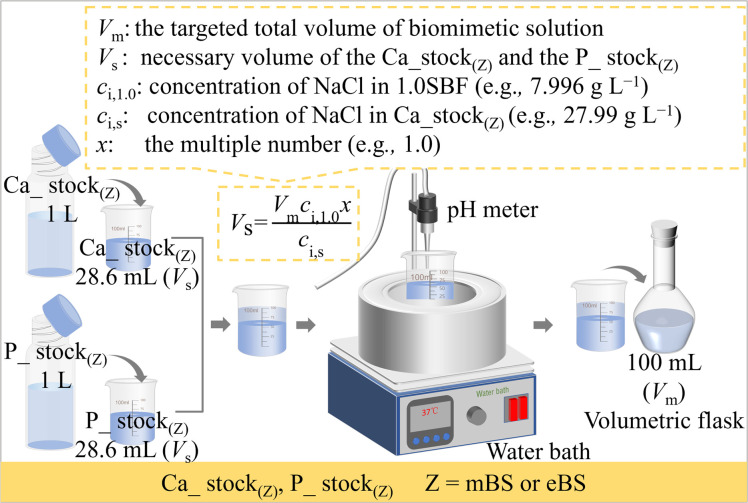
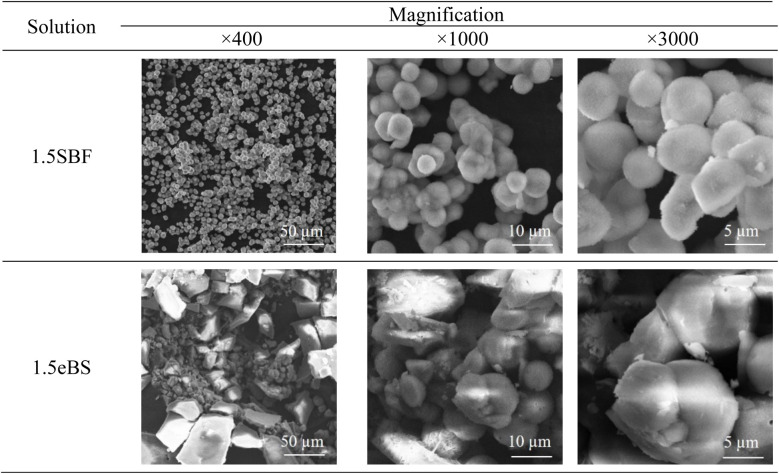
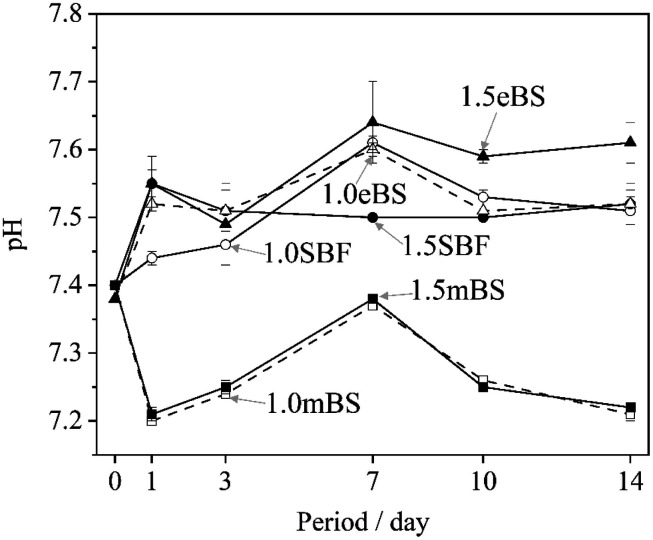
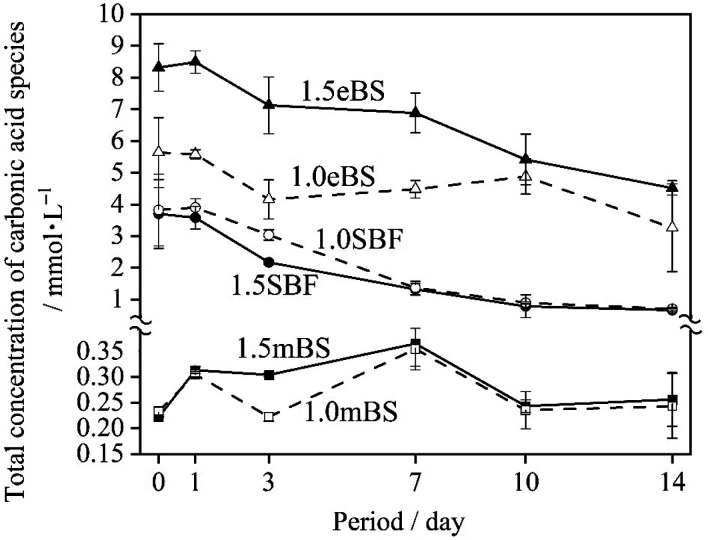
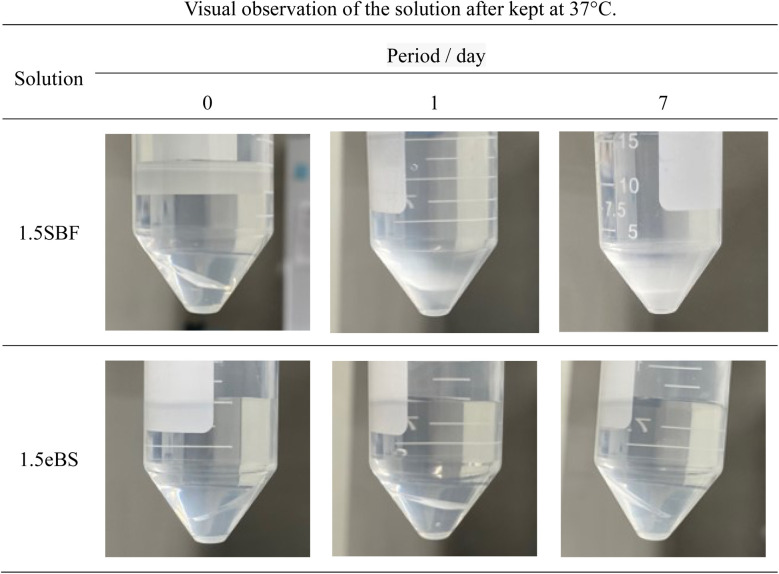
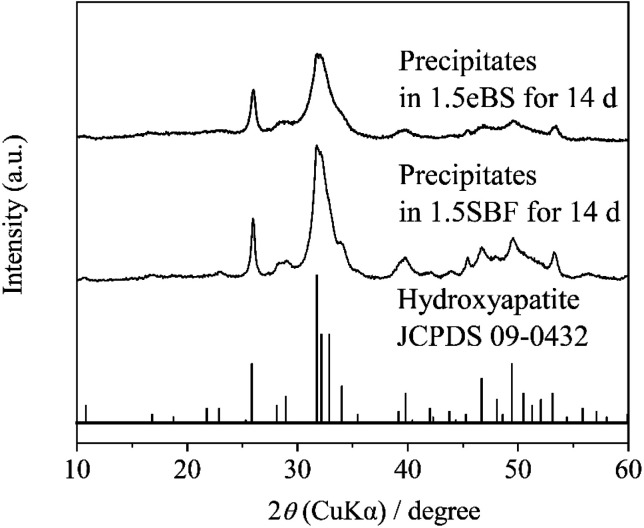
Bioactive glasses and glass-ceramics exhibit osteoconductivity, which is the ability to form a direct bond with living bone tissue. This property is typically assessed by observing the formation of a hydroxyapatite layer using simulated body fluid (SBF), a solution designed to mimic the inorganic constituents of human blood plasma. SBF was developed by Kokubo (T. Kokubo, H. Kushitani, S. Sakka, T. Kitsugi and T. Yamamuro, , 1990, , 721-734), and its preparation and storage procedures are precisely regulated according to ISO 23317. However, despite following the regulations, SBF may precipitate during storage owing to local ion concentration fluctuations during preparation because it is a supersaturated solution of hydroxyapatite. The present study is focused on designing a preparation process that enhances the stability of SBF-type biomimetic solutions. Solutions with a nominal composition that is the same as that of SBF were prepared by mixing stock solutions containing calcium or phosphate ions separately. Depending on the preparation procedure, two types of solutions-modified biomimetic solution (mBS) and evolved biomimetic solution (eBS)-were proposed. To evaluate the stability of these solutions, variants with 1.5 times the concentration of the original solutions were prepared, and the prepared solutions were denoted as SBF, mBS, and eBS (where = 1.0 or 1.5). It was found that the formation of calcium phosphate precipitates in 1.5mBS and 1.5eBS was slower than that in 1.5SBF. Additionally, the precipitate in 1.5eBS exhibited a different morphology from hydroxyapatite precipitate, which may be due to a higher hydrogencarbonate concentration than that in 1.5SBF. eBS demonstrated increased stability and a higher concentration of carbonic acid species (carbonate ions) than SBF, while mBS showed increased stability with a lower carbonate concentration than SBF. The newly proposed routes allow the production of an aqueous solution supersaturated with hydroxyapatite as a conventional SBF that has the potential to evaluate apatite formation examination under high initial stability.
生物活性玻璃和玻璃陶瓷具有骨传导性,即与活骨组织形成直接结合的能力。这种特性通常通过使用模拟体液(SBF)观察羟基磷灰石层的形成来评估,模拟体液是一种旨在模拟人体血浆无机成分的溶液。SBF由小久保(T. Kokubo、H. Kushitani、S. Sakka、T. Kitsugi和T. Yamamuro,1990年,721 - 734页)开发,其制备和储存程序根据ISO 23317精确规定。然而,尽管遵循规定,但由于制备过程中局部离子浓度波动,SBF在储存期间可能会沉淀,因为它是羟基磷灰石的过饱和溶液。本研究专注于设计一种提高SBF型仿生溶液稳定性的制备工艺。通过分别混合含钙离子或磷酸根离子的储备溶液,制备了名义成分与SBF相同的溶液。根据制备程序,提出了两种类型的溶液——改性仿生溶液(mBS)和进化仿生溶液(eBS)。为了评估这些溶液的稳定性,制备了浓度为原始溶液1.5倍的变体,并将制备的溶液记为SBF、mBS和eBS(其中 = 1.0或1.5)。发现1.5mBS和1.5eBS中磷酸钙沉淀的形成比1.5SBF中慢。此外,1.5eBS中的沉淀呈现出与羟基磷灰石沉淀不同的形态,这可能是由于碳酸氢盐浓度高于1.5SBF中的浓度。eBS表现出更高的稳定性,且碳酸物种(碳酸根离子)浓度高于SBF,而mBS表现出更高的稳定性,碳酸根浓度低于SBF。新提出的方法能够制备出羟基磷灰石过饱和的水溶液,作为一种具有在高初始稳定性下评估磷灰石形成潜力的传统SBF。