Pickering Gisèle, O'Keeffe Mary, Bannister Kirsty, Becker Susanne, Cottom Sonia, Cox Felicia J, Eisenberg Elon, Finn David P, Forget Patrice, Graven-Nielsen Thomas, Kalso Eija, Kocot-Kepska Magdalena, Leite-Almeida Hugo, Lopez-Garcia Jose Antonio, Meeus Mira, Mouraux André, Pereira Bruno, Puljak Livia, Reneman Michiel F, Rohde Iben, Sotiropoulos Ioannis, Skidmore Nathan, Tölle Thomas R, Todorovic Snezana Tomasevic, Truini Andrea, Vowles Kevin E, Pogatzki-Zahn Esther, Garcia-Larrea Luis, Fullen Brona M
Platform of Clinical Investigation, Inserm CIC 1405, University Hospital, CHU Clermont-Ferrand, Clermont-Ferrand, France.
Fundamental and Clinical Pharmacology of Pain, University Clermont Auvergne, Clermont-Ferrand, France.
Eur J Pain. 2025 Jan;29(1):e4767. doi: 10.1002/ejp.4767.
Pain is the leading cause of disability and reduced quality of life worldwide. Despite the increasing burden for patients and healthcare systems, pain research remains underfunded and under focused. Having stakeholders identify and prioritize areas that need urgent attention in the field will help focus funding topics, reduce 'research waste', improve the effectiveness of pain research and therapy and promote the uptake of research evidence. In this study, the European Pain Federation (EFIC) developed a Pain Research Strategy for Europe.
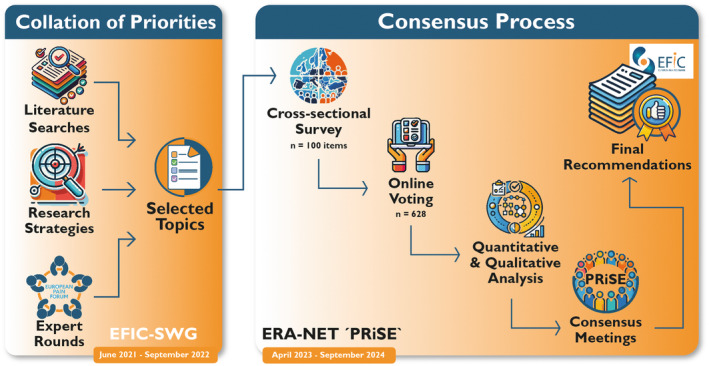
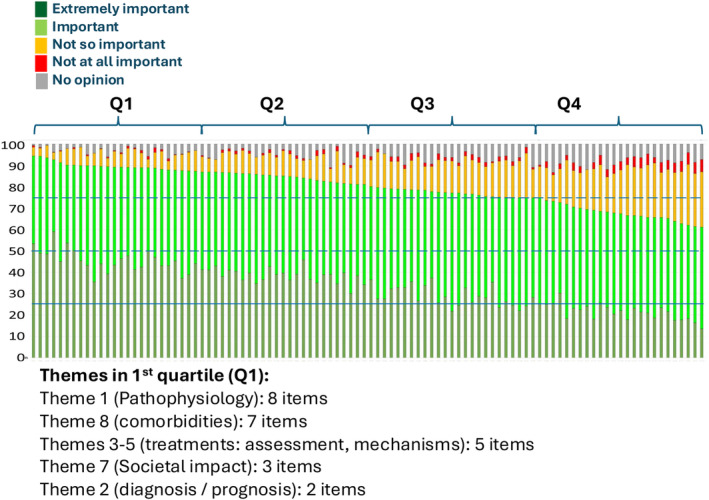
The study used multiple methods, including literature searches, multidisciplinary expert debate, a survey and a final consensus meeting. The cross-sectional survey was conducted among 628 European pain researchers, clinicians, educators and industry professionals to obtain the rating and hierarchy of pain research priorities. The final consensus meeting involved a multidisciplinary expert panel including people with lived experience from 23 countries. The survey results guided discussions where top priorities were agreed.
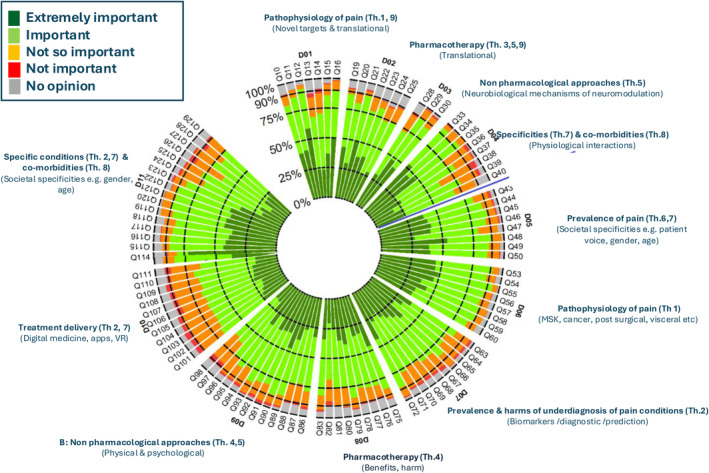
Content analysis identified nine survey themes, of which five emerged as top priorities: (i) understand the pathophysiology of pain; (ii) understand and address comorbidities; (iii) critically assess current therapies; (iv) develop new treatments; and (v) explore the biopsychosocial impacts of pain. Physical, psychological and social approaches were prioritized at the same level as pharmacological treatments. The top priorities were endorsed by a multidisciplinary expert panel. The panel emphasized the importance of also clearly communicating the concepts of prediction, prevention self-management and personalized pain management in the final strategy.
The content of the final top research priorities' list reflects a holistic approach to pain management. The equal importance given to physical, psychological and social aspects alongside pharmacological treatments highlights the importance of a comprehensive biopsychosocial-orientated research strategy. The expert panel's endorsement of five top priorities, coupled with an emphasis on communicating the concepts of prediction, prevention, self-management and personalized pain management, provides a clear direction for future basic, translational and clinical research.
EFIC has developed a Pain Research Strategy for Europe that identifies pain research areas deserving the most focus and financial support. Implementation and wide dissemination of this Strategy is vital to increase the conduct of urgent pain projects, pain research funding and the implementation of research findings into practice, to ultimately decrease the personal, societal and financial burden of pain.
疼痛是全球致残和生活质量下降的主要原因。尽管给患者和医疗系统带来的负担日益加重,但疼痛研究的资金仍然不足,关注度也不够。让利益相关者确定该领域需要紧急关注的领域并确定其优先顺序,将有助于聚焦资助主题,减少“研究浪费”,提高疼痛研究和治疗的有效性,并促进研究证据的应用。在本研究中,欧洲疼痛联合会(EFIC)制定了欧洲疼痛研究战略。
该研究采用了多种方法,包括文献检索、多学科专家辩论、一项调查和一次最终共识会议。对628名欧洲疼痛研究人员、临床医生、教育工作者和行业专业人士进行了横断面调查,以获得疼痛研究优先事项的评级和等级。最终共识会议由一个多学科专家小组参与,其中包括来自23个国家有实际经验的人员。调查结果为讨论提供了指导,会上确定了首要优先事项。
内容分析确定了九个调查主题,其中五个成为首要优先事项:(i)了解疼痛的病理生理学;(ii)了解并处理合并症;(iii)严格评估当前治疗方法;(iv)开发新的治疗方法;以及(v)探索疼痛的生物心理社会影响。物理、心理和社会方法与药物治疗被列为同等优先级别。首要优先事项得到了一个多学科专家小组的认可。该小组强调在最终战略中清晰传达预测、预防、自我管理和个性化疼痛管理概念的重要性。
最终首要研究优先事项清单的内容反映了一种整体的疼痛管理方法。物理、心理和社会方面与药物治疗同等重要,这凸显了全面的生物心理社会导向研究战略的重要性。专家小组对五个首要优先事项的认可,以及对传达预测、预防、自我管理和个性化疼痛管理概念的强调,为未来的基础、转化和临床研究提供了明确方向。
EFIC制定了一项欧洲疼痛研究战略,确定了最值得关注和资金支持的疼痛研究领域。实施并广泛传播该战略对于增加紧急疼痛项目的开展、疼痛研究资金以及将研究结果应用于实践至关重要,最终可减轻疼痛带来的个人、社会和经济负担。