Sun Rong-Qi, Ye Yu-Hang, Xu Ye, Wang Bo, Pan Si-Yuan, Li Ning, Chen Long, Pan Jing-Yue, Hu Zhi-Qiang, Fan Jia, Zhou Zheng-Jun, Zhou Jian, Song Cheng-Li, Zhou Shao-Lai
Department of Liver Surgery and Transplantation, Zhongshan Hospital, Fudan University, Shanghai, China.
Liver Cancer Institute, Zhongshan Hospital, Fudan University, Shanghai, China.
Clin Mol Hepatol. 2025 Apr;31(2):426-444. doi: 10.3350/cmh.2024.0686. Epub 2024 Dec 10.
BACKGROUNDS/AIMS: Sarcomatoid hepatocellular carcinoma (HCC) is a rare histological subtype of HCC characterized by extremely poor prognosis; however, its molecular characterization has not been elucidated.
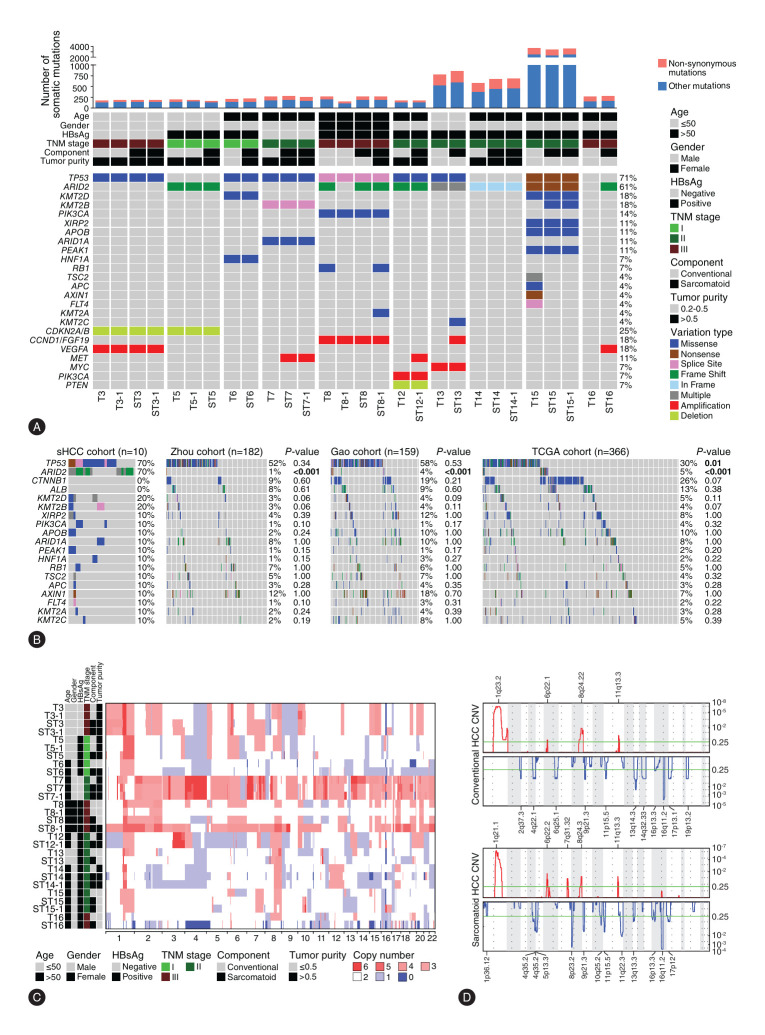
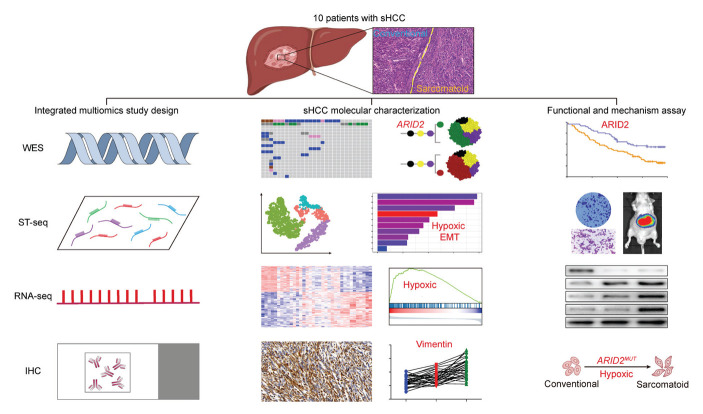
In this study, we conducted an integrated multiomics study of whole-exome sequencing, RNA-seq, spatial transcriptome, and immunohistochemical analyses of 28 paired sarcomatoid tumor components and conventional HCC components from 10 patients with sarcomatoid HCC, in order to identify frequently altered genes, infer the tumor subclonal architectures, track the genomic evolution, and delineate the transcriptional characteristics of sarcomatoid HCCs.
Our results showed that the sarcomatoid HCCs had poor prognosis. The sarcomatoid tumor components and the conventional HCC components were derived from common ancestors, mostly accessing similar mutational processes. Clonal phylogenies demonstrated branched tumor evolution during sarcomatoid HCC development and progression. TP53 mutation commonly occurred at tumor initiation, whereas ARID2 mutation often occurred later. Transcriptome analyses revealed the epithelial-mesenchymal transition (EMT) and hypoxic phenotype in sarcomatoid tumor components, which were confirmed by immunohistochemical staining. Moreover, we identified ARID2 mutations in 70% (7/10) of patients with sarcomatoid HCC but only 1-5% of patients with non-sarcomatoid HCC. Biofunctional investigations revealed that inactivating mutation of ARID2 contributes to HCC growth and metastasis and induces EMT in a hypoxic microenvironment.
We offer a comprehensive description of the molecular basis for sarcomatoid HCC, and identify genomic alteration (ARID2 mutation) together with the tumor microenvironment (hypoxic microenvironment), that may contribute to the formation of the sarcomatoid tumor component through EMT, leading to sarcomatoid HCC development and progression.
背景/目的:肉瘤样肝细胞癌(HCC)是一种罕见的HCC组织学亚型,预后极差;然而,其分子特征尚未阐明。
在本研究中,我们对10例肉瘤样HCC患者的28对肉瘤样肿瘤成分和传统HCC成分进行了全外显子测序、RNA测序、空间转录组和免疫组化分析的综合多组学研究,以确定频繁改变的基因,推断肿瘤亚克隆结构,追踪基因组进化,并描绘肉瘤样HCC的转录特征。
我们的结果表明,肉瘤样HCC预后较差。肉瘤样肿瘤成分和传统HCC成分源自共同祖先,大多经历相似的突变过程。克隆系统发育显示肉瘤样HCC发生和发展过程中肿瘤呈分支进化。TP53突变通常发生在肿瘤起始阶段,而ARID2突变往往发生在后期。转录组分析揭示了肉瘤样肿瘤成分中的上皮-间质转化(EMT)和低氧表型,这通过免疫组化染色得到证实。此外,我们在70%(7/10)的肉瘤样HCC患者中发现了ARID2突变,但在非肉瘤样HCC患者中仅为1%-5%。生物功能研究表明,ARID2的失活突变促进HCC生长和转移,并在低氧微环境中诱导EMT。
我们全面描述了肉瘤样HCC的分子基础,并确定了基因组改变(ARID2突变)以及肿瘤微环境(低氧微环境),它们可能通过EMT促进肉瘤样肿瘤成分的形成,导致肉瘤样HCC的发生和发展。