
通过原位纳米聚焦X射线光电子能谱揭示轴向异质结钙钛矿CsPb(BrCl)纳米线器件中的离子迁移和氧化还原反应
Ion Migration and Redox Reactions in Axial Heterojunction Perovskite CsPb(BrCl) Nanowire Devices Revealed by Operando Nanofocused X-ray Photoelectron Spectroscopy.
作者信息
Liu Yen-Po, Lamers Nils, Zhang Zhaojun, Zaiats Nelia, Mikkelsen Anders, Wallentin Jesper, Dittmann Regina, Timm Rainer
机构信息
Division of Synchrotron Radiation Research, Department of Physics, Lund University, 221 00 Lund, Sweden.
Peter Grünberg Institut (PGI-7), Forschungszentrum Jülich GmbH, 52428 Jülich, Germany.
出版信息
ACS Nano. 2024 Dec 24;18(51):34763-34775. doi: 10.1021/acsnano.4c11458. Epub 2024 Dec 11.
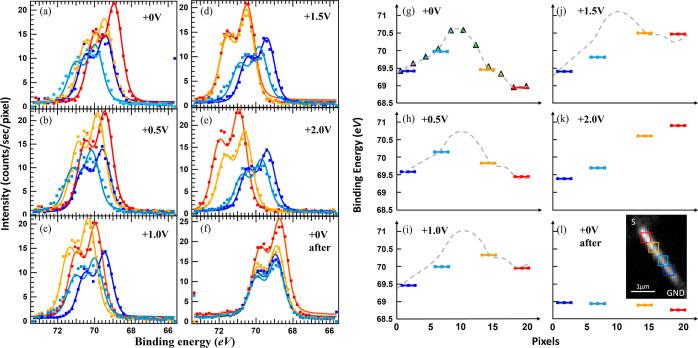
Metal-halide perovskites (MHPs) have gained substantial interest in the energy and optoelectronics field. MHPs in nanostructure forms, such as nanocrystals and nanowires (NWs), have further expanded the horizons for perovskite nanodevices in geometry and properties. A partial anion exchange within the nanostructure, creating axial heterojunctions, has significantly augmented the potential applications. However, surface degradation and halide ion migration are deteriorating device performance. Quantitative analysis of halide metal concentration and mapping of the electrical surface potential along the operating NW device are needed to better understand ion transportation, band structure, and chemical states, which have not been experimentally reported yet. This requires a characterization approach that is capable to provide surface-sensitive chemical and electrical information at the subμm scale. Here, we used operando nanofocused X-ray photoelectron spectroscopy (nano-XPS) to study CsPbBr/CsPb(BrCl) heterojunction NW devices with a spatial resolution of 120 nm. We monitored Br and Cl ion migration and comprehended the potential drop along the device during operation. Ion migration and healing of defects and vacancies are found for applied voltages of as low as 1 V. We present a model delineating band bending along the device based on precise XPS peak positions. Notably, a reversible redox reaction of Pb was observed, that reveals the interaction of migrating halide ions, vacancies, and biased metal electrodes under electrical operation. We further demonstrate how X-ray-induced surface modification can be avoided, by limiting exposure times to less than 100 ms. The results facilitate the understanding of halide ion migration in MHP nanodevices under operation.
金属卤化物钙钛矿(MHP)在能源和光电子领域引起了广泛关注。纳米结构形式的MHP,如纳米晶体和纳米线(NW),在几何形状和性能方面进一步拓展了钙钛矿纳米器件的应用前景。纳米结构内的部分阴离子交换形成轴向异质结,显著增加了潜在应用。然而,表面降解和卤离子迁移正在降低器件性能。为了更好地理解离子传输、能带结构和化学状态,需要对卤化物金属浓度进行定量分析,并绘制沿工作NW器件的表面电势图,但目前尚未有相关实验报道。这需要一种能够在亚微米尺度提供表面敏感化学和电学信息的表征方法。在此,我们使用操作纳米聚焦X射线光电子能谱(nano-XPS)研究了空间分辨率为120 nm的CsPbBr/CsPb(BrCl)异质结NW器件。我们监测了Br和Cl离子的迁移,并了解了器件在运行过程中的电势降。发现对于低至1 V的施加电压,存在离子迁移以及缺陷和空位的修复。我们基于精确的XPS峰位置提出了一个描述沿器件能带弯曲的模型。值得注意的是,观察到了Pb的可逆氧化还原反应,这揭示了在电操作下迁移的卤离子、空位和偏置金属电极之间的相互作用。我们还进一步证明了通过将曝光时间限制在100 ms以内可以避免X射线诱导的表面改性。这些结果有助于理解MHP纳米器件在运行过程中的卤离子迁移情况。


 Zotero 插件