
使用光子计数探测器计算机断层扫描的超低剂量冠状动脉计算机断层扫描血管造影术。
Ultra-low-dose coronary computed tomography angiography using photon-counting detector computed tomography.
作者信息
Araki Suguru, Nakamura Satoshi, Takafuji Masafumi, Ichikawa Yasutaka, Sakuma Hajime, Kitagawa Kakuya
机构信息
Department of Radiology, Mie University Hospital, Tsu, Japan.
Department of Advanced Diagnostic Imaging, Mie University Graduate School of Medicine, 2-174 Edobashi, Tsu, Mie 514-8507, Japan.
出版信息
Eur Heart J Imaging Methods Pract. 2024 Nov 27;2(3):qyae125. doi: 10.1093/ehjimp/qyae125. eCollection 2024 Jul.
AIMS
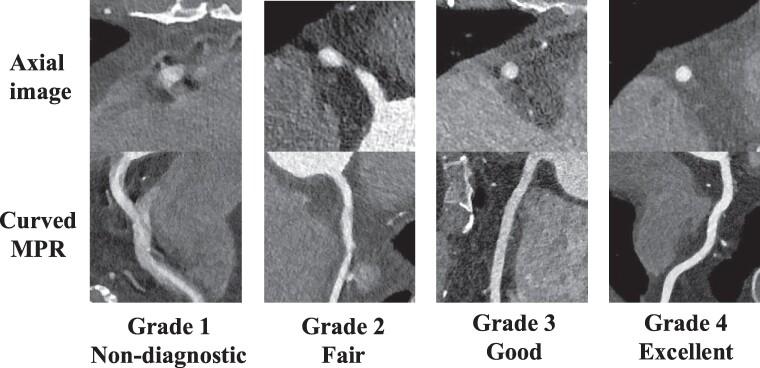
Photon-counting detector computed tomography (PCD-CT), which allows the exclusion of electronic noise, shows promise for significant dose reduction in coronary CT angiography (CCTA). This study aimed to assess the radiation dose and image quality of CCTA using PCD-CT, combined with high-pitch helical scanning and an ultra-low tube potential of 70 kVp, and investigate the effect of a sharp kernel on image quality and stenosis assessment in such an ultra-low-dose CCTA setting.
METHODS AND RESULTS
Forty patients (65% male) with stable heart rates and no prior coronary interventions were included. Data on CT dose index volume (CTDIvol) and dose-length product (DLP) were collected, with effective radiation dose estimated using a conversion factor of 0.014. Images were reconstructed using kernels of Bv64 and Bv40 for image quality and stenosis assessment. The mean CTDIvol, DLP, and effective dose of CCTA were 1.72 ± 0.38 mGy, 29.1 ± 6.8 mGy·cm, and 0.41 ± 0.09 mSv, respectively. Image quality was similar ( = 0.75) between the two kernels, with over 95% of segments achieving a rating of good image quality for both kernels. The per-segment stenosis score distribution between Bv40 and Bv64 reconstruction images showed significant differences for both non-calcified and calcified plaques ( < 0.001 for both).
CONCLUSION
PCD-CT technology with high-pitch helical scanning and the tube potential of 70 kVp can provide CCTA with ultra-low radiation exposure (DLP, 29 mGy·cm). The noise reduction capability of PCD-CT allows the use of a sharp kernel even in this low-dose CCTA setting without compromising image quality, potentially improving the evaluation of coronary artery stenosis.
目的
光子计数探测器计算机断层扫描(PCD-CT)能够排除电子噪声,在冠状动脉CT血管造影(CCTA)中显示出显著降低辐射剂量的前景。本研究旨在评估使用PCD-CT、结合高螺距螺旋扫描和70 kVp超低管电压进行CCTA的辐射剂量和图像质量,并研究在这种超低剂量CCTA设置下锐利内核对图像质量和狭窄评估的影响。
方法与结果
纳入40例心率稳定且既往无冠状动脉介入治疗的患者(65%为男性)。收集CT剂量指数容积(CTDIvol)和剂量长度乘积(DLP)数据,使用0.014的转换系数估算有效辐射剂量。使用Bv64和Bv40内核重建图像以进行图像质量和狭窄评估。CCTA的平均CTDIvol、DLP和有效剂量分别为1.72±0.38 mGy、29.1±6.8 mGy·cm和0.41±0.09 mSv。两种内核之间的图像质量相似(=0.75),超过95%的节段在两种内核下图像质量评级均为良好。Bv40和Bv64重建图像之间的节段狭窄评分分布在非钙化和钙化斑块方面均显示出显著差异(两者均<0.001)。
结论
采用高螺距螺旋扫描和70 kVp管电压的PCD-CT技术可为CCTA提供超低辐射暴露(DLP,29 mGy·cm)。PCD-CT的降噪能力允许即使在这种低剂量CCTA设置下也能使用锐利内核而不影响图像质量,有可能改善冠状动脉狭窄的评估。




 Zotero 插件