Lugli Licia, Rossi Cecilia, Berardi Alberto, Pugliese Marisa, Ceccarelli Pier Luca, Sileo Filomena Giulia, Chiossi Giuseppe, Contu Giannina, Calabrese Olga, La Marca Antonio, Bertucci Emma
Neonatology Unit, Department of Medical and Surgical Sciences for Mothers, Children and Adults, University of Modena and Reggio Emilia, Azienda Ospedaliero-Universitaria Policlinico, Modena, Italy.
Psychology Unit, Department of Medical and Surgical Sciences for Mothers, Children and Adults, University of Modena and Reggio Emilia, Azienda Ospedaliero-Universitaria Policlinico, Modena, Italy.
Int J Gynaecol Obstet. 2025 May;169(2):498-510. doi: 10.1002/ijgo.16068. Epub 2024 Dec 11.
Prenatal multidisciplinary counseling for fetuses with congenital anomalies involves a collaborative approach, integrating expertise from various medical fields.
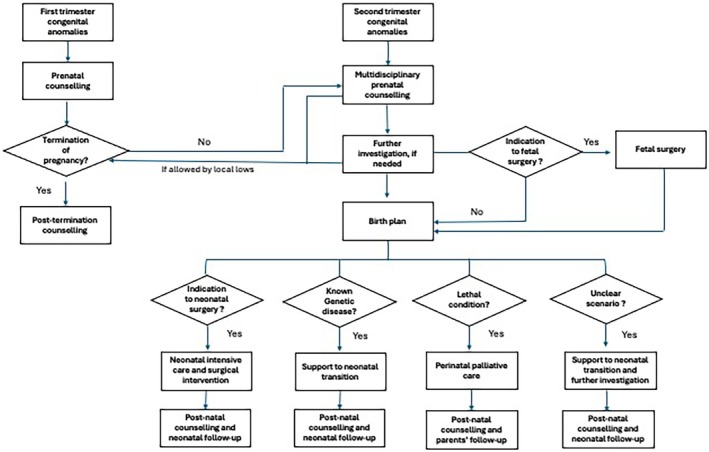
This comprehensive strategy aims to provide expectant parents with accurate information about the diagnosis, potential outcomes, and available interventions. Genetic counselors, obstetricians, neonatologists, and other specialists work together to address medical, psychological, and ethical aspects. The prenatal multidisciplinary counseling approach emphasizes open communication, fostering a supportive environment for the couple to express their concerns and ask questions. In the case of prenatally detected fetal congenital anomalies, several different scenarios can be delineated: (1) detection of surgically correctable congenital anomalies, (2) identification of genetic disease or fetal anomalies likely to result in disabilities, (3) discovery of severe and lethal congenital anomalies, and (4) encountering fetal anomalies that are not well-defined, leading to an unclear scenario. The process of counseling includes discussing the possibility of pregnancy termination, treatment options, potential challenges, and emotional support, enabling expectant parents to make informed decisions aligned with their values and preferences. Additionally, the counseling process extends beyond the initial diagnosis, providing ongoing support as the pregnancy progresses and helping families to prepare for the difficulties they may face after the birth of the child with congenital anomalies. This collaborative effort not only focuses on the medical aspects but also considers the emotional and ethical dimensions of decision-making.
The multidisciplinary approach enhances the quality of care and empower parents, facilitating a more informed and compassionate journey throughout the prenatal period.
对患有先天性异常的胎儿进行产前多学科咨询采用协作方式,整合了各个医学领域的专业知识。
这一综合策略旨在为准父母提供有关诊断、潜在结果和可用干预措施的准确信息。遗传咨询师、产科医生、新生儿科医生和其他专家共同努力,解决医学、心理和伦理方面的问题。产前多学科咨询方法强调开放沟通,营造一个支持性环境,让夫妻能够表达他们的担忧并提问。对于产前检测出的胎儿先天性异常,可勾勒出几种不同情况:(1)检测出可手术矫正的先天性异常;(2)识别可能导致残疾的遗传疾病或胎儿异常;(3)发现严重和致命的先天性异常;(4)遇到定义不明确的胎儿异常,导致情况不明。咨询过程包括讨论终止妊娠的可能性、治疗选择、潜在挑战和情感支持,使准父母能够根据自己的价值观和偏好做出明智的决定。此外,咨询过程不仅限于初始诊断,在孕期进展过程中持续提供支持,并帮助家庭为孩子出生后可能面临的困难做好准备。这种协作努力不仅关注医学方面,还考虑决策的情感和伦理层面。
多学科方法提高了护理质量,增强了父母的能力,在整个孕期促进了更明智、更具同情心的过程。