Robador Alberto
Department of Biological Sciences, University of Southern California, Los Angeles, CA, United States.
Front Microbiol. 2024 Nov 27;15:1495895. doi: 10.3389/fmicb.2024.1495895. eCollection 2024.
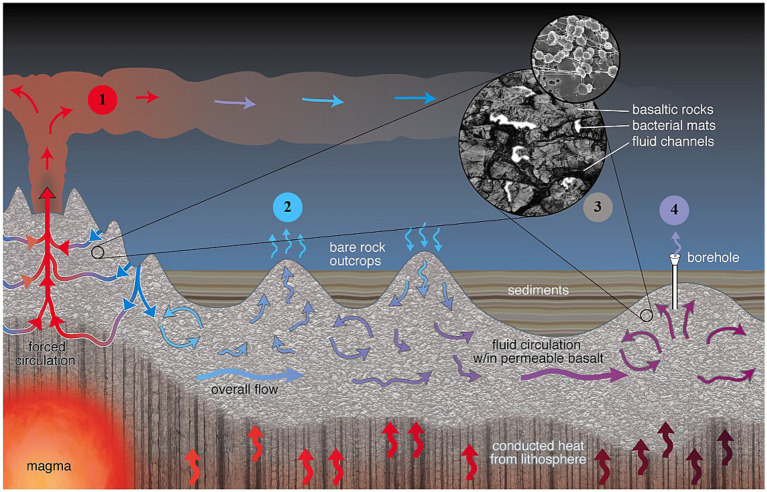
Underlying the thick sediment layer in ocean basins, the flow of seawater through the cracked and porous upper igneous crust supports a previously hidden and largely unexplored active subsurface microbial biome. Subseafloor crustal systems offer an enlarged surface area for microbial habitats and prolonged cell residence times, promoting the evolution of novel microbial lineages in the presence of steep physical and thermochemical gradients. The substantial metabolic potential and dispersal capabilities of microbial communities within these systems underscore their crucial role in biogeochemical cycling. However, the intricate interplay between fluid chemistry, temperature variations, and microbial activity remains poorly understood. These complexities introduce significant challenges in unraveling the factors that regulate microbial distribution and function within these dynamic ecosystems. Using synthesized data from previous studies, this work describes how the ocean crustal biosphere functions as a continuous-flow biogechemical reactor. It simultaneously promotes the breakdown of surface-derived organic carbon and the creation of new, chemosynthetic material, thereby enhancing element recycling and ocean carbon productivity. Insights gained from the qualitative analysis of the extent of biogeochemical microbial activity and diversity across the temperature and chemical gradients that characterize these habitats, as reviewed herein, challenge traditional models of global ocean carbon productivity and provide the development of a new conceptual framework for understanding the quantitative metabolic potential and broad dispersal of the crustal microbial biome.
在海洋盆地厚厚的沉积层之下,海水通过破裂且多孔的上部火成岩地壳流动,支撑着一个此前隐藏且在很大程度上未被探索的活跃的地下微生物生物群落。海底地壳系统为微生物栖息地提供了更大的表面积和更长的细胞停留时间,在存在陡峭的物理和热化学梯度的情况下促进了新的微生物谱系的进化。这些系统内微生物群落巨大的代谢潜力和扩散能力突出了它们在生物地球化学循环中的关键作用。然而,流体化学、温度变化和微生物活动之间复杂的相互作用仍知之甚少。这些复杂性给揭示调节这些动态生态系统中微生物分布和功能的因素带来了重大挑战。利用先前研究的综合数据,这项工作描述了海洋地壳生物圈如何作为一个连续流动的生物地球化学反应器发挥作用。它同时促进了源自表层的有机碳的分解和新的化学合成物质的产生,从而增强了元素循环和海洋碳生产力。如本文所综述的,通过对这些栖息地特征温度和化学梯度上生物地球化学微生物活动程度和多样性的定性分析所获得的见解,挑战了全球海洋碳生产力的传统模型,并为理解地壳微生物生物群落的定量代谢潜力和广泛扩散提供了一个新的概念框架的发展。