Liu Yuxin, Sun Qihao, Long Houtao, Zhang Daofeng, Zheng Junhao, Zhang Haiyang
Department of Urology, Shandong Provincial Hospital, Shandong University, Jinan, China.
Department of Urology, Shandong Provincial Hospital Affiliated to Shandong First Medical University, Jinan, China.
Front Oncol. 2024 Nov 26;14:1495381. doi: 10.3389/fonc.2024.1495381. eCollection 2024.
Urothelial carcinoma is a common malignant tumor of the urinary system, with prognosis linked to pathological grade and TNM stage. Alterations in chromosomes 3, 7, and 17, along with the P16 locus on chromosome 9 (CSP3, CSP7, CSP17, and GLPp16), are associated with cancer progression and may serve as important biomarkers. This study aimed to explore the relationships between these chromosomal factors and the pathological grade and TNM stage of UCC, potentially leading to a novel diagnostic approach that enhances patient stratification and treatment planning.
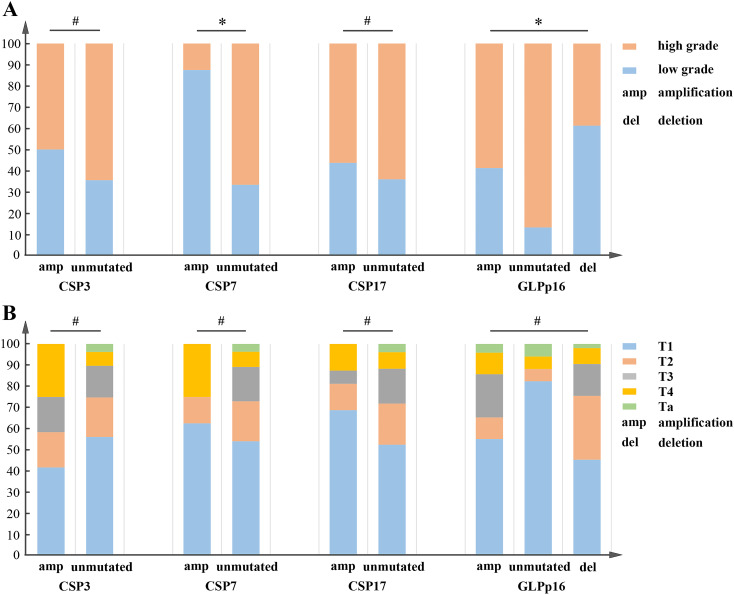
A retrospective analysis was conducted on 149 patients to evaluate the correlation between CSP3, CSP7, CSP17, GLPp16, TNM stage, and pathological grade using chi-square tests and logistic regression. Immunohistochemistry was employed to assess the associated changes.
Univariate analysis indicated that only CSP7 and GLPp16 were significantly associated with pathological grade. Logistic regression linked GLPp16 and gender to pathological grade in urothelial carcinoma. A nomogram model incorporating these factors demonstrated reliable calibration in the training set (non-significant Hosmer-Lemeshow test, P = 0.436; AUC = 0.785, 95% CI: 0.707 - 0.863) and effective discrimination in the test set (AUC = 0.740, 95% CI: 0.559 - 0.920). Immunohistochemistry revealed P16 gene deletion in low-grade urothelial carcinoma and amplification in high-grade urothelial carcinoma.
Mutations at the GLPp16 were significantly correlated with the pathological grade of urothelial carcinoma. Additionally, the amplification of GLPp16 was recognized as a contributing factor to the development of high-grade urothelial carcinoma.
尿路上皮癌是泌尿系统常见的恶性肿瘤,其预后与病理分级和TNM分期相关。3号、7号和17号染色体的改变,以及9号染色体上的P16位点(CSP3、CSP7、CSP17和GLPp16)与癌症进展相关,可能作为重要的生物标志物。本研究旨在探讨这些染色体因素与尿路上皮癌病理分级和TNM分期之间的关系,有望带来一种新的诊断方法,改善患者分层和治疗规划。
对149例患者进行回顾性分析,采用卡方检验和逻辑回归评估CSP3、CSP7、CSP17、GLPp16、TNM分期和病理分级之间的相关性。采用免疫组织化学评估相关变化。
单因素分析表明,只有CSP7和GLPp16与病理分级显著相关。逻辑回归显示GLPp16和性别与尿路上皮癌的病理分级相关。纳入这些因素的列线图模型在训练集显示出可靠的校准(Hosmer-Lemeshow检验无显著性,P = 0.436;AUC = 0.785,95%CI:0.707 - 0.863),在测试集有有效的区分能力(AUC = 0.740,95%CI:0.559 - 0.920)。免疫组织化学显示低级别尿路上皮癌存在P16基因缺失,高级别尿路上皮癌存在扩增。
GLPp16突变与尿路上皮癌的病理分级显著相关。此外,GLPp16扩增被认为是高级别尿路上皮癌发生的一个促成因素。