Liu Yen-Ling, Liao Tzu-Yi, Ho Kai-Wen, Liu En-Shuo, Huang Bo-Cheng, Hong Shih-Ting, Hsieh Yuan-Chin, Chang Mu-Shen, Wu Bing-Tsung, Chen Fang-Ming, Roffler Steve R, Chen Chiao-Yun, Yang Yuan-Chieh, Cheng Tian-Lu
Graduate Institute of Medicine, College of Medicine, Kaohsiung Medical University, Kaohsiung, Taiwan.
Drug Development and Value Creation Research Center, Kaohsiung Medical University, Kaohsiung, Taiwan.
Biomater Res. 2024 Dec 11;28:0112. doi: 10.34133/bmr.0112. eCollection 2024.
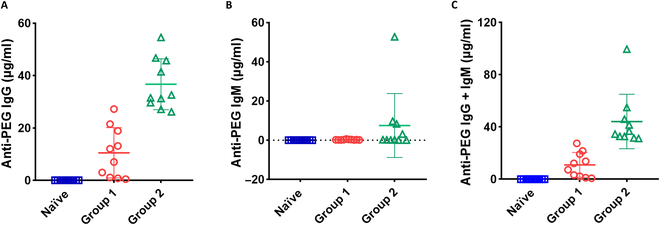
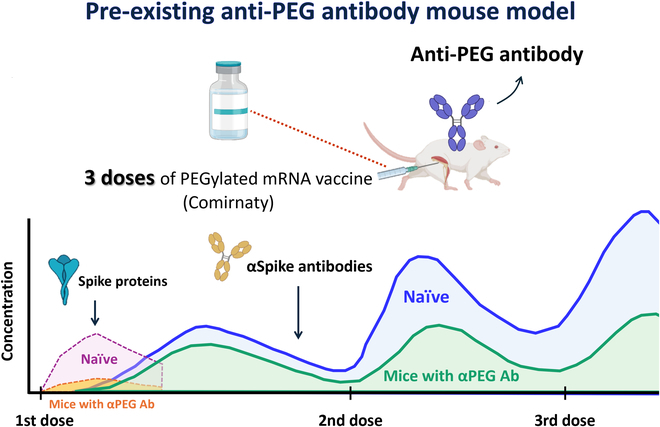
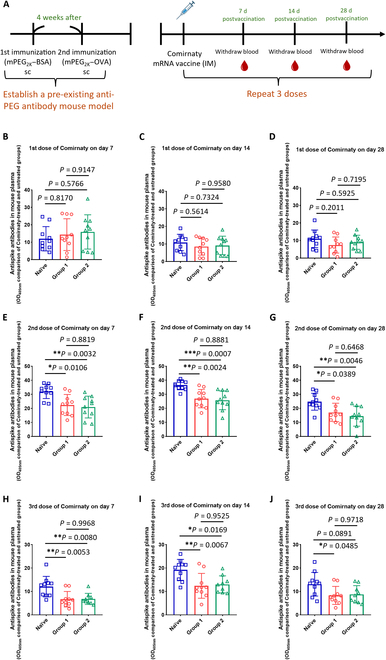
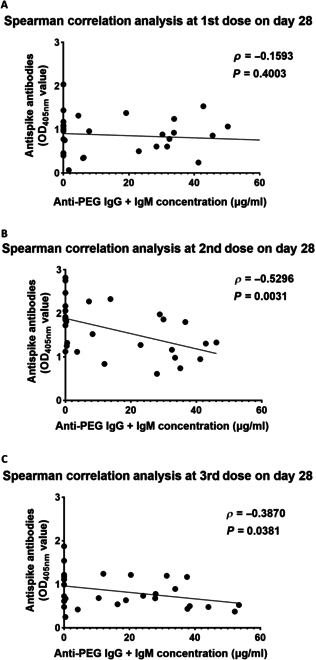
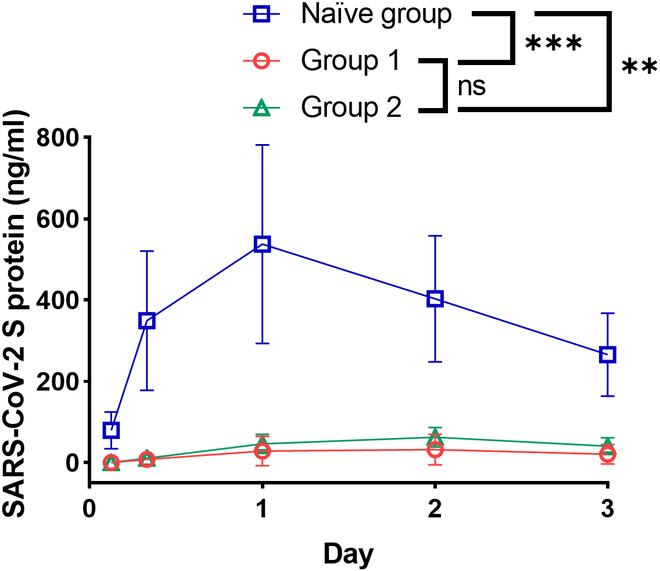
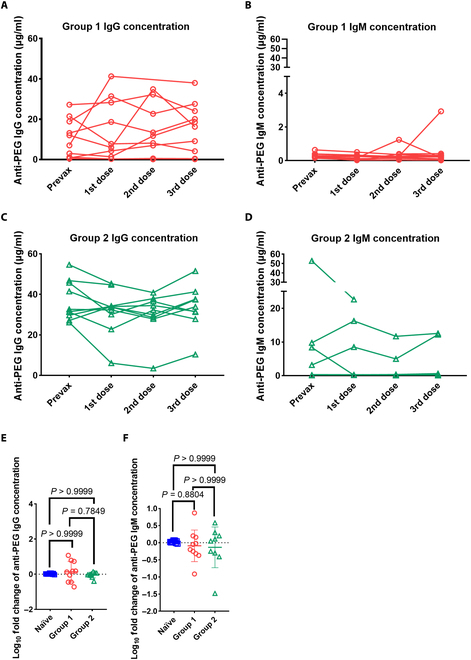
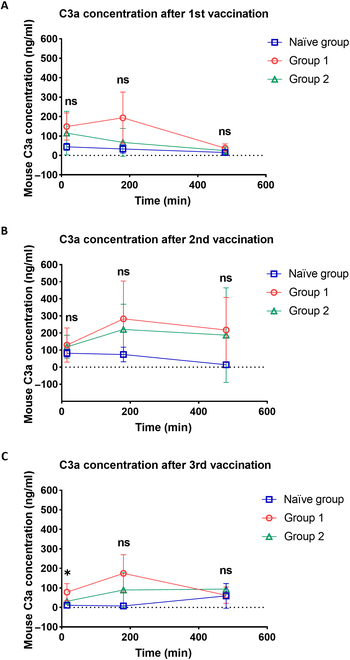
The presence of anti-polyethylene glycol (anti-PEG) antibodies can hinder the therapeutic efficacy of PEGylated drugs. With the widespread use of a PEGylated coronavirus disease 2019 (COVID-19) messenger RNA vaccine (Comirnaty), the impact of pre-existing anti-PEG antibodies on vaccine potency has become a point of debate. To investigate this, we established mouse models with pre-existing anti-PEG antibodies and divided them into 3 groups: group 1 with anti-PEG immunoglobulin G + immunoglobulin M concentrations of 0.76 to 27.41 μg/ml, group 2 with concentrations of 31.27 to 99.52 μg/ml, and a naïve group with no detectable anti-PEG antibodies. Results indicated that anti-spike antibody concentrations significantly decreased in group 1 and group 2 after the 2nd vaccine dose compared to those in the naïve group. Spearman's rank correlation analysis demonstrated a negative relationship between anti-spike antibody production and anti-PEG antibody levels at both the 2nd and 3rd doses (2nd dose: = -0.5296, = 0.0031; 3rd dose: = -0.387, = 0.0381). Additionally, spike protein concentrations were 31.4-fold and 46.6-fold lower in group 1 and group 2, respectively, compared to those in the naïve group at 8 h postvaccination. The concentration of complement C3a in group 2 was significantly higher than that in the naïve group after the 3rd dose. These findings confirm that pre-existing anti-PEG antibodies diminish vaccine efficacy, alter pharmacokinetics, and elevate complement activation. Therefore, detecting pre-existing anti-PEG antibodies is crucial for optimizing vaccine efficacy, ensuring patient safety, and developing improved therapeutic strategies.
抗聚乙二醇(anti-PEG)抗体的存在会阻碍聚乙二醇化药物的治疗效果。随着聚乙二醇化的2019冠状病毒病(COVID-19)信使核糖核酸疫苗(Comirnaty)的广泛使用,预先存在的抗PEG抗体对疫苗效力的影响已成为一个争论点。为了研究这一问题,我们建立了预先存在抗PEG抗体的小鼠模型,并将它们分为3组:第1组抗PEG免疫球蛋白G + 免疫球蛋白M浓度为0.76至27.41μg/ml,第2组浓度为31.27至99.52μg/ml,以及一个未检测到抗PEG抗体的未免疫组。结果表明,与未免疫组相比,第2剂疫苗接种后第1组和第2组的抗刺突抗体浓度显著降低。Spearman等级相关分析表明,在第2剂和第3剂时,抗刺突抗体产生与抗PEG抗体水平之间呈负相关(第2剂:r = -0.5296,P = 0.0031;第3剂:r = -0.387,P = 0.0381)。此外,接种疫苗后8小时,第1组和第2组的刺突蛋白浓度分别比未免疫组低31.4倍和46.6倍。第3剂疫苗接种后,第2组的补体C3a浓度显著高于未免疫组。这些发现证实,预先存在的抗PEG抗体会降低疫苗效力、改变药代动力学并增强补体激活。因此,检测预先存在的抗PEG抗体对于优化疫苗效力、确保患者安全以及制定改进的治疗策略至关重要。