Liu Yang, Wang Zhiye, Zhang Zuonian, Lu Zhaomin, Zhang Lihua, Ding Wei, Fang Kai, Pan Xijin, Ni Mengyuan, Liu Junjun
Department of Neurology, Nanjing Meishan Hospital, Nanjing, China.
Department of Neurology, Drum Tower Hospital of Nanjing University, Nanjing, China.
Front Neurol. 2024 Nov 28;15:1441116. doi: 10.3389/fneur.2024.1441116. eCollection 2024.
The Triglyceride-glucose Index (TyG) index is a dependable metric for assessing the degree of insulin resistance, serving as a standalone predictor of ischemic stroke risk, but its precise relationship with early neurological deterioration (END) remains incompletely expounded within the context of acute mild ischemic stroke patients. This research is to examine the correlation of the TyG index with END among patients experiencing acute mild ischemic stroke in China.
This retrospective analysis was conducted to systematically gather data regarding patients experiencing their maiden episode of acute mild ischemic stroke and hospitalized at the Neurology Department of Nanjing Meishan Hospital, located in Nanjing, Jiangsu Province, China, over the period extending from January 2020 to December 2022. The severity of stroke was determined through the utilization of the National Institutes of Health Stroke Scale (NIHSS) scores upon their admission. Demographic characteristics were collected, and measurements of fasting blood glucose, blood lipids, and glycosylated hemoglobin Alc levels were taken. END was defined as a one-point rise in the motor item function score on the NIHSS or a two-point increase in the overall score during the initial 72 h of hospitalization. For evaluating the correlation of the TyG index with END, a multivariate logistic regression analysis was carried out. To investigate whether there is a nonlinear relationship between the TyG index and END, smoothed curves were utilized.
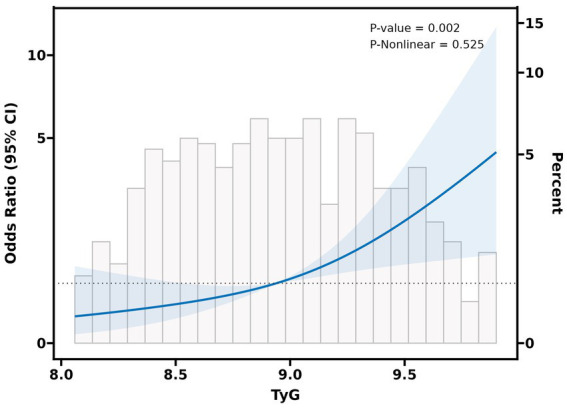
The study included 402 patients diagnosed with acute mild ischemic stroke, with a mean age of 66.15 ± 10.04 years. Within this population, 205 were males (51.00%) and 197 were females (49.00%). Among these patients, 107 (26.62%) experienced END within 72 h of admission. Patients who developed END showed higher levels of the TyG index in comparison to those who remained stable (9.18 ± 0.46 vs. 8.87 ± 0.46, < 0.001). In a comprehensive multivariate logistic regression analysis, the TyG index positively correlates with END ( = 3.63, 95% CI: 1.75-7.54, = 0.001). Furthermore, individuals in the fourth TyG index quartile exhibited a 2.36-fold heightened risk of END compared to those in the first quartile (95% CI: 1.38-8.19, = 0.008). TyG index has a linear correlation with END in the generalized additive model (Log likelihood ratio test, = 0.525).
Our findings demonstrate that TyG index has a significant, independent, and positive correlation with END in Chinese individuals diagnosed with acute mild ischemic stroke. This underscores the TyG index's potential usefulness as a valuable risk stratification tool for stroke patients.
甘油三酯-葡萄糖指数(TyG指数)是评估胰岛素抵抗程度的可靠指标,可作为缺血性中风风险的独立预测因子,但在急性轻度缺血性中风患者中,其与早期神经功能恶化(END)的确切关系尚未完全阐明。本研究旨在探讨中国急性轻度缺血性中风患者中TyG指数与END的相关性。
本回顾性分析系统收集了2020年1月至2022年12月期间在江苏省南京市梅山医院神经内科住院的首次发生急性轻度缺血性中风患者的数据。通过入院时使用美国国立卫生研究院卒中量表(NIHSS)评分来确定中风的严重程度。收集人口统计学特征,并测量空腹血糖、血脂和糖化血红蛋白Alc水平。END定义为住院最初72小时内NIHSS运动项目功能评分升高1分或总分升高2分。为评估TyG指数与END的相关性,进行了多因素逻辑回归分析。为研究TyG指数与END之间是否存在非线性关系,采用了平滑曲线。
该研究纳入了402例诊断为急性轻度缺血性中风的患者,平均年龄为66.15±10.04岁。其中,男性205例(51.00%),女性197例(49.00%)。在这些患者中,107例(26.62%)在入院72小时内发生END。发生END的患者与病情稳定的患者相比,TyG指数水平更高(9.18±0.46 vs. 8.87±0.46,<0.001)。在全面的多因素逻辑回归分析中,TyG指数与END呈正相关(=3.63,95%CI:1.75-7.54,=0.001)。此外,与第一四分位数的患者相比,TyG指数第四四分位数的个体发生END的风险高2.36倍(95%CI:1.38-8.19,=0.008)。在广义相加模型中,TyG指数与END呈线性相关(对数似然比检验,=0.525)。
我们的研究结果表明,在中国诊断为急性轻度缺血性中风的个体中,TyG指数与END存在显著、独立的正相关。这凸显了TyG指数作为中风患者有价值的风险分层工具的潜在用途。