Maurin Max, Hennebique Aurélie, Brunet Camille, Pondérand Léa, Pelloux Isabelle, Boisset Sandrine, Caspar Yvan
Centre Hospitalier Universitaire Grenoble Alpes, Centre National de Référence Francisella Tularensis, , Grenoble, France.
Recherche Translationnelle et Innovation en Médecine et Complexité (TIMC), Centre National de la Recherche Scientifique (CNRS), Université Grenoble Alpes, Grenoble, France.
Front Microbiol. 2024 Nov 28;15:1507469. doi: 10.3389/fmicb.2024.1507469. eCollection 2024.
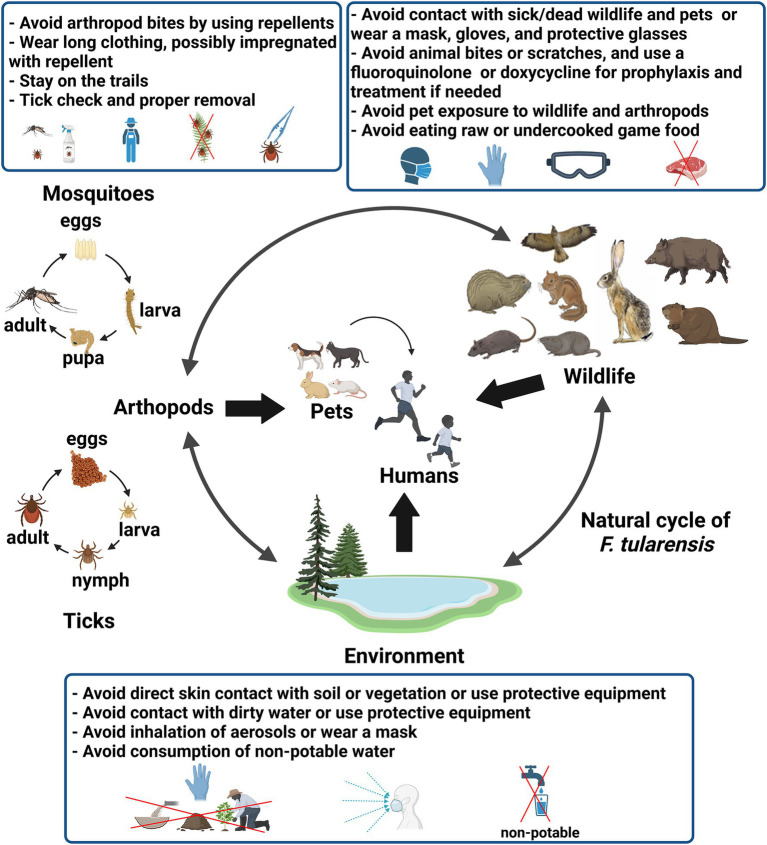
Tularemia is a re-emerging zoonosis in many endemic countries. It is caused by , a gram-negative bacterium and biological threat agent. Humans are infected from the wild animal reservoir, the environmental reservoir or by the bite of arthropod vectors. This infection occurs through the cutaneous, conjunctival, digestive or respiratory routes. Tularemia generally manifests itself as an infection at the site of entry of the bacteria with regional lymphadenopathy, or as a systemic disease, particularly pulmonary. It is often a debilitating condition due to persistent symptoms and sometimes a life-threatening condition. There is effective antibiotic treatment for this disease but no vaccine is currently available for humans or animals. Due to the complexity of the life cycle and multiple modes of human infection, non-vaccine prophylaxis of tularemia is complex and poorly defined. In this review, we summarize the various individual prophylactic measures available against tularemia based on the different risk factors associated with the disease. We also discuss the currently underdeveloped possibilities for collective prophylaxis. Prophylactic measures must be adapted in each tularemia endemic area according to the predominant modes of human and animal infection. They requires a One Health approach to control both animal and environmental reservoirs of , as well as arthropod vectors, to slow the current expansion of endemic areas of this disease in a context of climate change.
兔热病在许多流行国家呈再度出现的人畜共患病。它由一种革兰氏阴性菌及生物威胁因子引起。人类可从野生动物宿主、环境宿主感染,或通过节肢动物媒介叮咬感染。这种感染通过皮肤、结膜、消化道或呼吸道途径发生。兔热病通常表现为细菌进入部位的感染并伴有局部淋巴结病,或表现为全身性疾病,尤其是肺部疾病。由于症状持续,它往往使人虚弱,有时还会危及生命。这种疾病有有效的抗生素治疗方法,但目前尚无针对人类或动物的疫苗。由于该菌生活周期复杂且人类感染方式多样,兔热病的非疫苗预防措施复杂且定义不明确。在本综述中,我们根据与该疾病相关的不同风险因素,总结了针对兔热病的各种个体预防措施。我们还讨论了目前集体预防方面尚不完善的可能性。在每个兔热病流行地区,必须根据人类和动物感染的主要方式调整预防措施。控制该菌的动物宿主和环境宿主以及节肢动物媒介需要采取“同一健康”方法,以便在气候变化背景下减缓这种疾病流行地区目前的扩张速度。