Barbosa Lívia Mirelle, Silva Joana de Ângelis Alves, da Silva José Ivson Soares, Ren Tsang Ing, Vasconcelos Belmiro Cavalcanti do Egito, Filho José Rodrigues Laureano
Department of Oral and Maxillofacial Surgery, University of Pernambuco, Recife-PE, Brazil.
Information Technology Center at the Federal University of Pernambuco, Recife-PE, Brazil.
J Clin Exp Dent. 2024 Nov 1;16(11):e1386-e1392. doi: 10.4317/jced.62088. eCollection 2024 Nov.
Facial analysis for orthognathic surgery aims to identify facial features and determine how occlusion should be corrected to achieve facial balance. Several artificial neural networks have been developed to detect facial landmarks; however, no publications have reported the application of neural networks to measure facial proportions specifically for orthognathic surgery planning. Objectives: To develop a computer program that automates facial measurements through photograph capture, as well as to present the development stages of the program and the test results evaluating its effectiveness.
Researchers from the Postgraduate Program in Oral and Maxillofacial Surgery at the University of Pernambuco (UPE), in collaboration with researchers from the IT Center at the Federal University of Pernambuco (UFPE), developed a computer program to automate facial measurements through photographic capture.
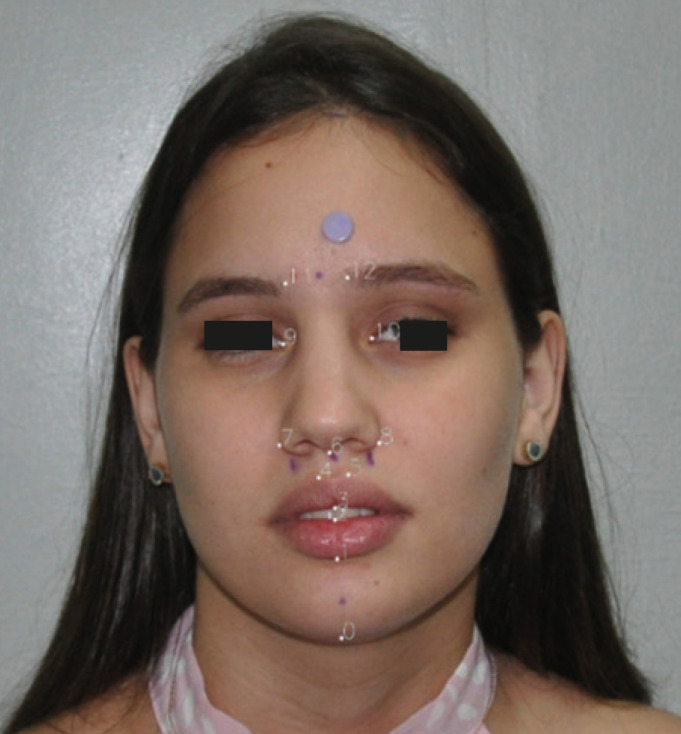
The developed program successfully detected nine measurements: (M1) middle third of the face, (M2) lower third, (M3) intercanthal distance, (M4) alar base, (M5) upper lip, (M6) upper lip vermilion, (M7) lower lip, (M8) lower lip vermilion, and (M9) interlabial gap. Of these measurements, only two showed significant discrepancies (<0.01) compared to the actual size in both versions of the program. These discrepancies referred to the middle third of the face and the lower lip vermilion.
The developed program can be considered effective, as it automatically detected seven facial measurements relevant to orthognathic surgery. However, this line of research must be continued to create a larger database and train the network more robustly, increasing its ability to detect more facial landmarks and allowing the automated acquisition of additional measurements important for orthognathic surgery planning. Dentofacial deformities, maxillofacial abnormalities, orthognathic surgery, artificial intelligence, software.
正颌外科手术的面部分析旨在识别面部特征,并确定应如何矫正咬合以实现面部平衡。已经开发了几种人工神经网络来检测面部标志点;然而,尚无出版物报道神经网络在测量正颌外科手术规划中特定面部比例方面的应用。目的:开发一种通过照片捕捉自动进行面部测量的计算机程序,并展示该程序的开发阶段以及评估其有效性的测试结果。
伯南布哥大学(UPE)口腔颌面外科研究生项目的研究人员与伯南布哥联邦大学(UFPE)信息技术中心的研究人员合作,开发了一种通过照片捕捉自动进行面部测量的计算机程序。
所开发的程序成功检测到九个测量值:(M1)面部中三分之一,(M2)下三分之一,(M3)内眦间距,(M4)鼻翼基底,(M5)上唇,(M6)上唇唇红,(M7)下唇,(M8)下唇唇红,以及(M9)唇间隙。在这些测量值中,与程序的两个版本中的实际尺寸相比,只有两个显示出显著差异(<0.01)。这些差异涉及面部中三分之一和下唇唇红。
所开发的程序可被认为是有效的,因为它自动检测到了七个与正颌外科手术相关的面部测量值。然而,必须继续这一研究方向,以创建更大的数据库并更强大地训练网络,提高其检测更多面部标志点的能力,并允许自动获取对正颌外科手术规划重要的其他测量值。牙颌面畸形、颌面异常、正颌外科手术、人工智能、软件。