Pinkerton Monica, Adler Gabrielle L, Ledger Mallory, Ni Chen Yue, Yang Yue, Tan Rachel H
Faculty of Medicine and Health, School of Medical Sciences, University of Sydney, Camperdown, Sydney, NSW, 2050, Australia.
Brain and Mind Centre, University of Sydney, Sydney, NSW, 2050, Australia.
Brain Commun. 2024 Nov 1;6(6):fcae352. doi: 10.1093/braincomms/fcae352. eCollection 2024.
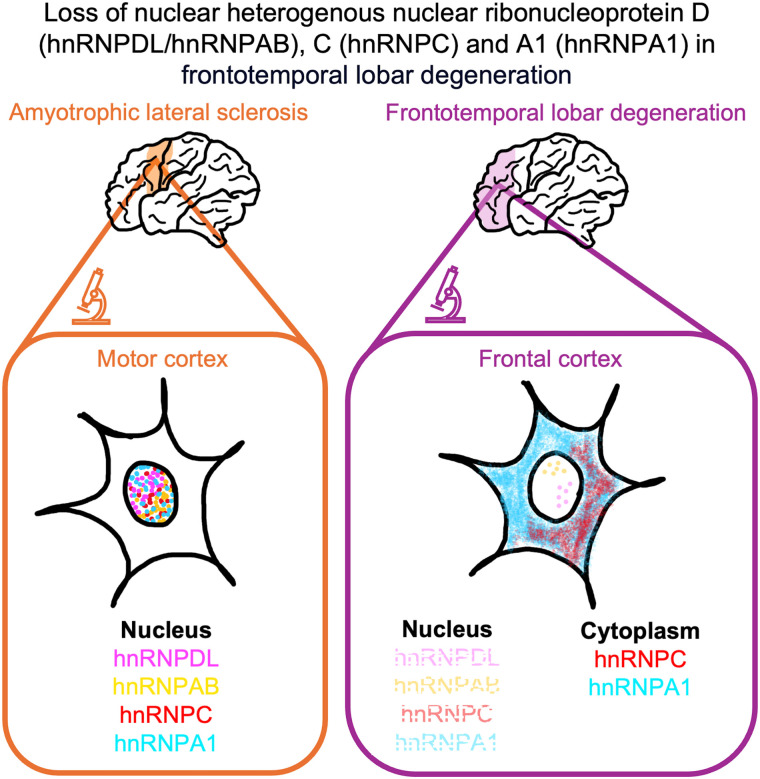
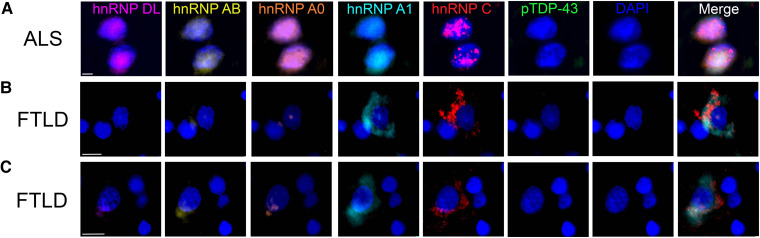
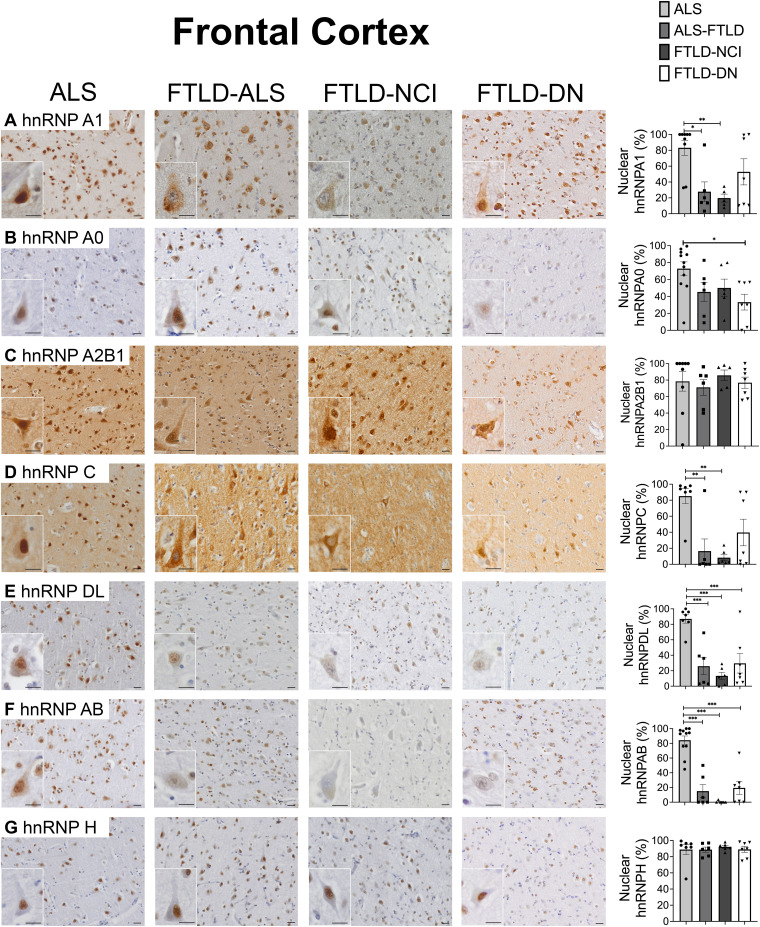
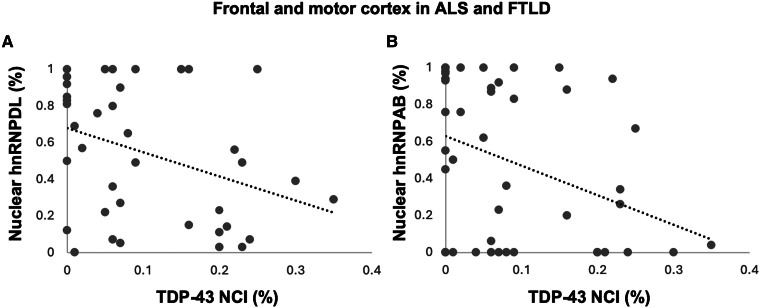
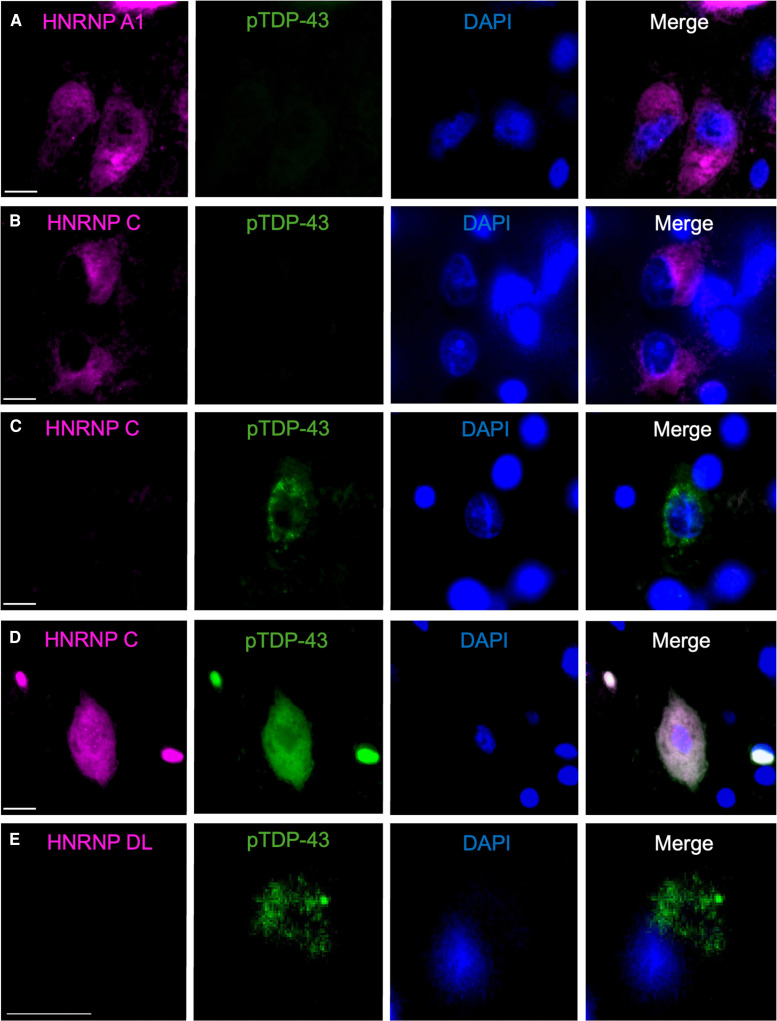
Despite the recognition that heterogeneous nuclear ribonucleoproteins (hnRNPs) modulate TDP-43 and can limit aberrant splicing events to compensate for TDP-43 loss, their role in TDP-43 proteinopathies remains poorly understood and studies in patient tissue are lacking. This study assesses seven heterogeneous nuclear ribonucleoproteins from the A/B, C, D and H subfamilies in two cortical regions implicated in early TDP-43 dysfunction versus late TDP-43 dysfunction in sporadic amyotrophic lateral sclerosis and/or frontotemporal lobar degeneration. Our results reveal significant nuclear loss of hnRNPD, hnRNPC and hnRNPA1 in the frontal cortex of frontotemporal lobar degeneration compared to amyotrophic lateral sclerosis but not in the motor cortical neurons or Betz cells of amyotrophic lateral sclerosis cases. Cytoplasmic co-occurrence was observed between hnRNPA1 and hnRNPC but not with phosphorylated TDP-43 (pTDP-43). Interestingly, nuclear hnRNPD loss associated with increasing cytoplasmic pTDP-43, highlighting an understudied subfamily in sporadic TDP-43 proteinopathies. In summary, this study identifies the nuclear loss of hnRNPD, C and A1 in a predilection brain region of TDP-43 in frontotemporal lobar degeneration compared to amyotrophic lateral sclerosis cases without significant pTDP-43 in this region. This highlights the need for further investigation into the involvement of these heterogeneous nuclear ribonucleoproteins in disease pathogenesis and potential to serve as modulatory targets and/or proximal markers of TDP-43 dysfunction in sporadic TDP-43 proteinopathies.
尽管人们认识到异质性核核糖核蛋白(hnRNPs)可调节TDP - 43,并能限制异常剪接事件以补偿TDP - 43的缺失,但其在TDP - 43蛋白病中的作用仍知之甚少,且缺乏对患者组织的研究。本研究评估了来自A/B、C、D和H亚家族的七种异质性核核糖核蛋白,这些核蛋白存在于散发性肌萎缩侧索硬化症和/或额颞叶痴呆中与早期TDP - 43功能障碍和晚期TDP - 43功能障碍相关的两个皮质区域。我们的结果显示,与肌萎缩侧索硬化症相比,额颞叶痴呆患者额叶皮质中hnRNPD、hnRNPC和hnRNPA1的核内缺失显著,但在肌萎缩侧索硬化症患者的运动皮质神经元或贝茨细胞中未观察到这种情况。观察到hnRNPA1和hnRNPC在细胞质中共存,但与磷酸化TDP - 43(pTDP - 43)不共存。有趣的是,核内hnRNPD的缺失与细胞质中pTDP - 43的增加相关,这突出了散发性TDP - 43蛋白病中一个研究较少的亚家族。总之,本研究发现,与肌萎缩侧索硬化症患者相比,在额颞叶痴呆患者中,TDP - 43偏好的脑区存在hnRNPD、C和A1的核内缺失,且该区域无显著的pTDP - 43。这凸显了进一步研究这些异质性核核糖核蛋白在疾病发病机制中的作用以及作为散发性TDP - 43蛋白病中TDP - 43功能障碍的调节靶点和/或近端标志物的潜力的必要性。