Huang Xiao, Liu Peng-Bo, Niu Guang-Yun, Hu Hai-Bao
School of Marine Science and Technology, Northwestern Polytechnical University, Xi'an, 710072, Shaanxi, China; Research & Development Institute of Northwestern Polytechnical University in Shenzhen, Shenzhen, 518057, Guangdong, China.
School of Marine Science and Technology, Northwestern Polytechnical University, Xi'an, 710072, Shaanxi, China.
Ultrason Sonochem. 2025 Jan;112:107188. doi: 10.1016/j.ultsonch.2024.107188. Epub 2024 Dec 10.
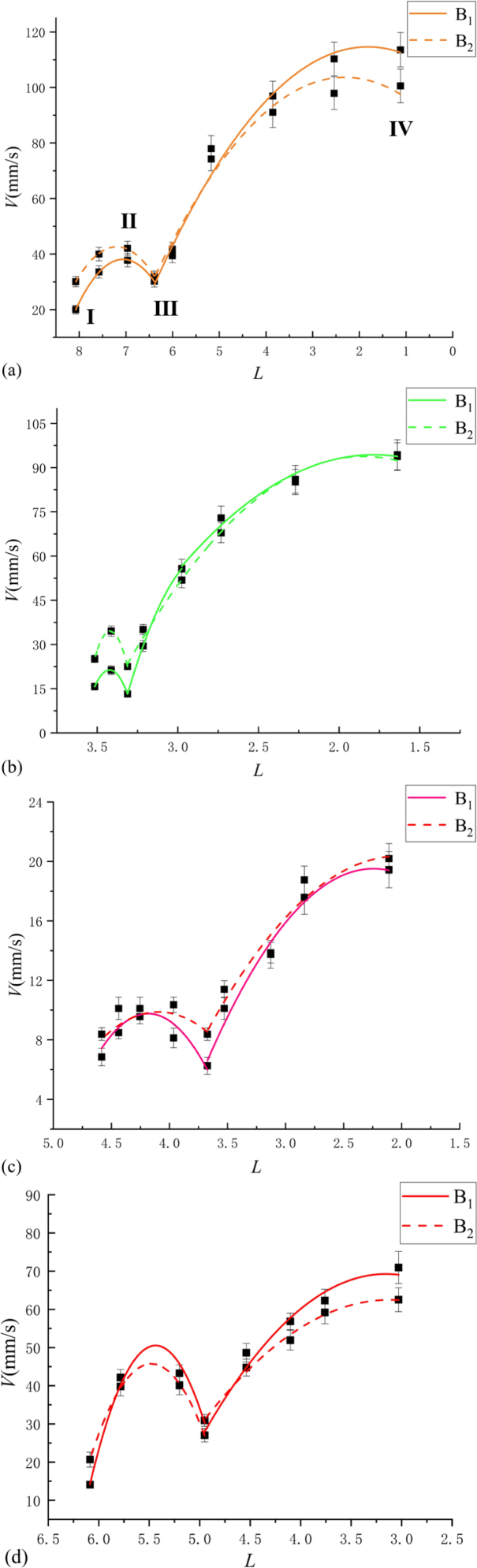
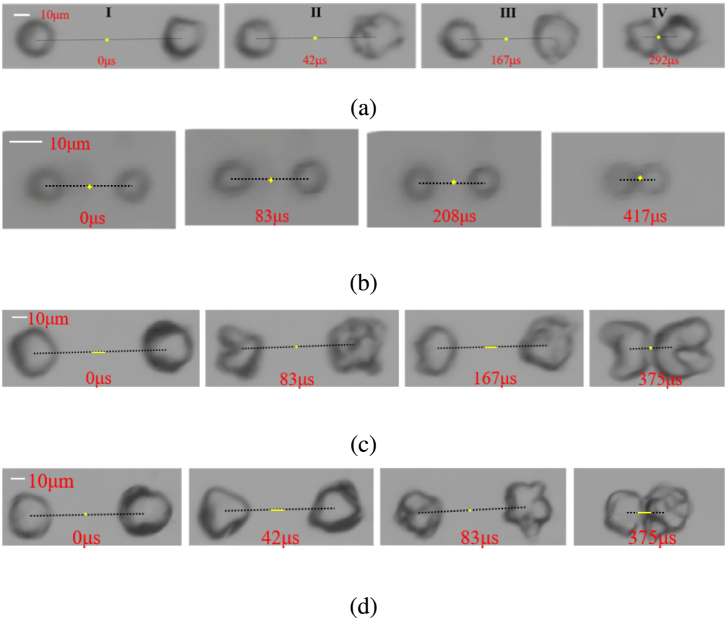
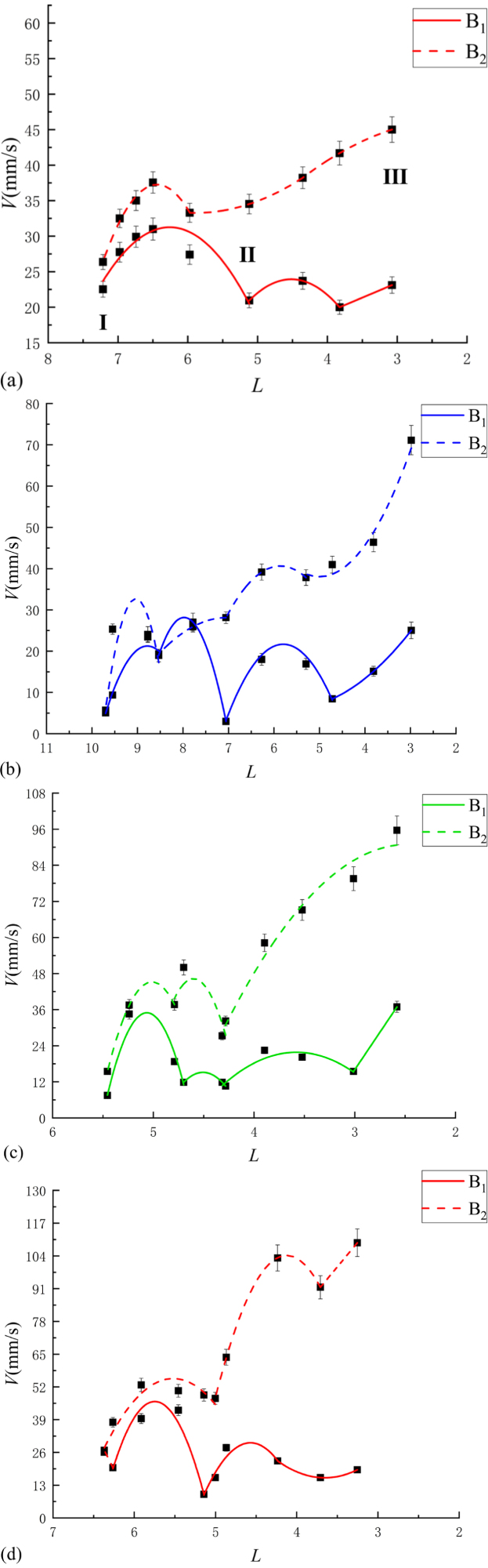
The dynamics of acoustic cavitation bubbles hold significant importance in ultrasonic cleaning, biomedicine, and chemistry. Utilizing an in-situ normal pressure bubble generation and observation system that was developed, this study examined the translational behavior of micrometer-scale normal pressure bubble pairs with initial radius ratio of 1:1 and 2:1 under ultrasonic field excitation. A velocity-distance curve was proposed to quantify the secondary Bjerknes forces during various interaction stages of the bubbles. The findings revealed that equal-sized bubbles underwent an acceleration phase, a deceleration phase, and a velocity jump phase during attraction in both strong and weak acoustic fields. In contrast, bubbles of unequal sizes, due to different oscillation frequencies, experienced multiple acceleration and deceleration phases, presenting asynchronous behaviors. The study further explored the effects of the initial bubble radius, shape oscillation, and volume oscillations on the attraction speed. Results showed that the velocity of the bubble's centroid decreased with an increase in the initial radius, while intensified volume oscillations increased the secondary Bjerknes force, thereby increasing the centroid's velocity. Moreover, strong acoustic fields were more likely to induce severe volume and shape oscillations in bubbles than weak fields. The irregular shape oscillations in twin bubbles resulted in shortened durations of acceleration and deceleration phases, reduced peak velocities of acceleration phase, and diminished acceleration during the velocity jump phase. The research provided some mechanical explanations for acoustic cavitation dynamics and its applications.
声空化气泡的动力学在超声清洗、生物医学和化学领域具有重要意义。本研究利用自行研制的原位常压气泡产生与观测系统,考察了初始半径比为1:1和2:1的微米级常压气泡对在超声场激发下的平移行为。提出了速度-距离曲线来量化气泡在不同相互作用阶段的二级 Bjerknes 力。研究结果表明,在强声场和弱声场中,等尺寸气泡在吸引过程中经历了加速阶段、减速阶段和速度跳跃阶段。相比之下,尺寸不等的气泡由于振荡频率不同,经历了多个加速和减速阶段,呈现出异步行为。该研究进一步探讨了初始气泡半径、形状振荡和体积振荡对吸引速度的影响。结果表明,气泡质心速度随初始半径的增加而降低,而增强的体积振荡增加了二级 Bjerknes 力,从而提高了质心速度。此外,强声场比弱声场更易引发气泡剧烈的体积和形状振荡。孪生气泡中不规则的形状振荡导致加速和减速阶段的持续时间缩短、加速阶段的峰值速度降低以及速度跳跃阶段的加速度减小。该研究为声空化动力学及其应用提供了一些力学解释。