• 文献检索
  • 文档翻译
  • 深度研究
  • 学术资讯
  • Suppr Zotero 插件Zotero 插件
  • 邀请有礼
  • 套餐&价格
  • 历史记录
应用&插件
Suppr Zotero 插件Zotero 插件浏览器插件Mac 客户端Windows 客户端微信小程序
定价
高级版会员购买积分包购买API积分包
服务
文献检索文档翻译深度研究API 文档MCP 服务
关于我们
关于 Suppr公司介绍联系我们用户协议隐私条款
关注我们

Suppr 超能文献

核心技术专利:CN118964589B侵权必究
粤ICP备2023148730 号-1Suppr @ 2026

文献检索

告别复杂PubMed语法,用中文像聊天一样搜索,搜遍4000万医学文献。AI智能推荐,让科研检索更轻松。

立即免费搜索

文件翻译

保留排版,准确专业,支持PDF/Word/PPT等文件格式,支持 12+语言互译。

免费翻译文档

深度研究

AI帮你快速写综述,25分钟生成高质量综述,智能提取关键信息,辅助科研写作。

立即免费体验

新型冠状病毒肺炎感染与灭活疫苗接种:对中国1型糖尿病儿童临床和免疫学特征的影响

COVID-19 infection and inactivated vaccination: Impacts on clinical and immunological profiles in Chinese children with type 1 diabetes.

作者信息

Xu Zhen-Ran, Xi Li, Wu Jing, Ni Jin-Wen, Luo Fei-Hong, Zhang Miao-Ying

机构信息

Department of Pediatric Endocrinology and Inherited Metabolic Diseases, National Children's Medical Center, Children's Hospital of Fudan University, Shanghai 201102, China.

出版信息

World J Diabetes. 2024 Dec 15;15(12):2276-2284. doi: 10.4239/wjd.v15.i12.2276.

DOI:10.4239/wjd.v15.i12.2276
PMID:39676798
原文链接:https://pmc.ncbi.nlm.nih.gov/articles/PMC11580597/
Abstract

BACKGROUND

The coronavirus disease 2019 (COVID-19) pandemic has been linked to an increased incidence of diabetes and diabetic ketoacidosis (DKA). However, the relationship between COVID-19 infection and progression to type 1 diabetes (T1D) in children has not been well defined.

AIM

To evaluate the influence of COVID-19 infection and inactivated vaccine administration on the progression of T1D among Chinese children.

METHODS

A total of 197 newly diagnosed patients with T1D were retrospectively enrolled from Children's Hospital of Fudan University between September 2020 and December 2023. The patients were divided into three groups based on their history of COVID-19 infection and vaccination: the infection group, the vaccination-only group, and the non-infection/non-vaccination group. Comprehensive clinical assessments and detailed immunological evaluations were performed to delineate the characteristics and immune responses of these groups.

RESULTS

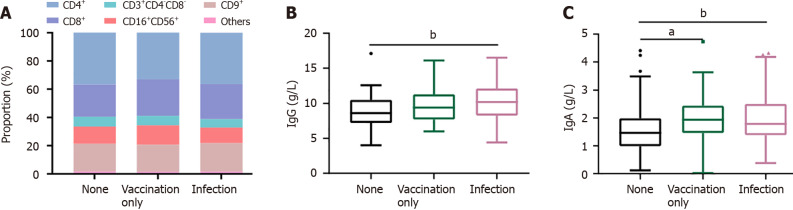
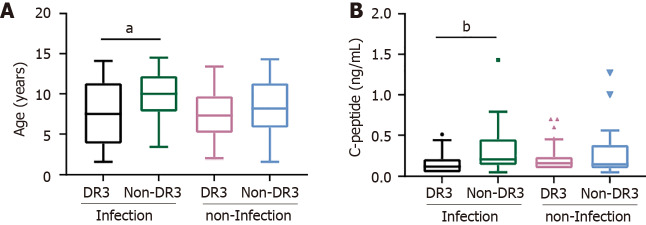
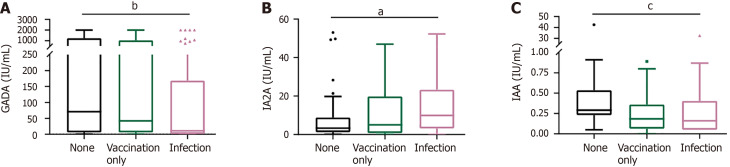
The incidence of DKA was significantly higher in the COVID-19 infection group (70.2%) compared to the non-infection/non-vaccination group (62.5%) and vacscination-only group (45.6%; = 0.015). Prior COVID-19 infection was correlated with increased DKA risk (OR: 1.981, 95%CI: 1.026-3.825, = 0.042), while vaccination was associated with a reduced risk (OR: 0.558, 95%CI: 0.312-0.998, = 0.049). COVID-19 infection mildly altered immune profiles, with modest differences in autoantibody positivity, lymphocyte distribution, and immunoglobulin levels. Notably, positive children with a history of COVID-19 infection had an earlier T1D onset and lower fasting C-peptide levels than the negative children with a history of infection (both < 0.05).

CONCLUSION

COVID-19 infection predisposes children to severe T1D, characterized by enhanced DKA risk. Inactivated vaccination significantly lowers DKA incidence at T1D onset. These findings are valuable for guiding future vaccination and T1D risk surveillance strategies in epidemic scenarios in the general pediatric population.

摘要

背景

2019年冠状病毒病(COVID-19)大流行与糖尿病和糖尿病酮症酸中毒(DKA)发病率增加有关。然而,COVID-19感染与儿童1型糖尿病(T1D)进展之间的关系尚未明确。

目的

评估COVID-19感染和灭活疫苗接种对中国儿童T1D进展的影响。

方法

2020年9月至2023年12月,从复旦大学附属儿科医院回顾性纳入197例新诊断的T1D患者。根据COVID-19感染和疫苗接种史将患者分为三组:感染组、仅接种疫苗组和未感染/未接种疫苗组。进行了全面的临床评估和详细的免疫学评估,以描述这些组的特征和免疫反应。

结果

COVID-19感染组的DKA发病率(70.2%)显著高于未感染/未接种疫苗组(62.5%)和仅接种疫苗组(45.6%;P = 0.015)。既往COVID-19感染与DKA风险增加相关(OR:1.981,95%CI:1.026 - 3.825,P = 0.042),而接种疫苗与风险降低相关(OR:0.558,95%CI:0.312 - 0.998,P = 0.049)。COVID-19感染轻微改变了免疫谱,自身抗体阳性、淋巴细胞分布和免疫球蛋白水平存在适度差异。值得注意的是,有COVID-19感染史的阳性儿童比有感染史的阴性儿童T1D发病更早且空腹C肽水平更低(均P < 0.05)。

结论

COVID-19感染使儿童易患严重T1D,其特征为DKA风险增加。灭活疫苗接种显著降低T1D发病时的DKA发病率。这些发现对于指导普通儿科人群在流行情况下的未来疫苗接种和T1D风险监测策略具有重要价值。
https://cdn.ncbi.nlm.nih.gov/pmc/blobs/7cd0/11580597/dc93d8b3bc6e/WJD-15-2276-g003.jpg
https://cdn.ncbi.nlm.nih.gov/pmc/blobs/7cd0/11580597/f938dfd57322/WJD-15-2276-g001.jpg
https://cdn.ncbi.nlm.nih.gov/pmc/blobs/7cd0/11580597/036df8088f6b/WJD-15-2276-g002.jpg
https://cdn.ncbi.nlm.nih.gov/pmc/blobs/7cd0/11580597/dc93d8b3bc6e/WJD-15-2276-g003.jpg
https://cdn.ncbi.nlm.nih.gov/pmc/blobs/7cd0/11580597/f938dfd57322/WJD-15-2276-g001.jpg
https://cdn.ncbi.nlm.nih.gov/pmc/blobs/7cd0/11580597/036df8088f6b/WJD-15-2276-g002.jpg
https://cdn.ncbi.nlm.nih.gov/pmc/blobs/7cd0/11580597/dc93d8b3bc6e/WJD-15-2276-g003.jpg

相似文献

1
COVID-19 infection and inactivated vaccination: Impacts on clinical and immunological profiles in Chinese children with type 1 diabetes.新型冠状病毒肺炎感染与灭活疫苗接种:对中国1型糖尿病儿童临床和免疫学特征的影响
World J Diabetes. 2024 Dec 15;15(12):2276-2284. doi: 10.4239/wjd.v15.i12.2276.
2
The global impact of COVID-19 pandemic on the incidence of pediatric new-onset type 1 diabetes and ketoacidosis: A systematic review and meta-analysis.COVID-19 大流行对儿童新发 1 型糖尿病和酮症酸中毒发病率的全球影响:系统评价和荟萃分析。
J Med Virol. 2022 Nov;94(11):5112-5127. doi: 10.1002/jmv.27996. Epub 2022 Jul 22.
3
Diabetic ketoacidosis incidence among children with new-onset type 1 diabetes in Poland and its association with COVID-19 outbreak-Two-year cross-sectional national observation by PolPeDiab Study Group.波兰新发 1 型糖尿病儿童中糖尿病酮症酸中毒的发生率及其与 COVID-19 爆发的关系——波兰儿科糖尿病研究组进行的为期两年的全国横断面观察
Pediatr Diabetes. 2022 Nov;23(7):944-955. doi: 10.1111/pedi.13379. Epub 2022 Jul 4.
4
Epidemiologic Characteristics of Children with Diabetic Ketoacidosis Treated in a Pediatric Intensive Care Unit in a 10-Year-Period: Single Centre Experience in Croatia.10 年间在儿科重症监护病房治疗的儿童糖尿病酮症酸中毒的流行病学特征:克罗地亚单中心经验。
Medicina (Kaunas). 2022 May 5;58(5):638. doi: 10.3390/medicina58050638.
5
Increased frequency of severe diabetic ketoacidosis at type 1 diabetes onset among children during COVID-19 pandemic lockdown: an observational cohort study.在 COVID-19 大流行封锁期间,1 型糖尿病发病时严重糖尿病酮症酸中毒的频率增加:一项观察性队列研究。
Pediatr Endocrinol Diabetes Metab. 2020;26(4):167-175. doi: 10.5114/pedm.2020.101003.
6
Increase in newly diagnosed type 1 diabetes and serological evidence of recent SARS-CoV-2 infection: Is there a connection?新诊断1型糖尿病的增加与近期感染严重急性呼吸综合征冠状病毒2(SARS-CoV-2)的血清学证据:二者有关联吗?
Front Med (Lausanne). 2022 Jul 28;9:927099. doi: 10.3389/fmed.2022.927099. eCollection 2022.
7
DKA and new-onset type 1 diabetes in Brazilian children and adolescents during the COVID-19 pandemic.巴西儿童和青少年在 COVID-19 大流行期间的 DKA 和新发 1 型糖尿病。
Arch Endocrinol Metab. 2022 Mar 8;66(1):88-91. doi: 10.20945/2359-3997000000433. Epub 2022 Jan 13.
8
Higher rates of diabetic ketoacidosis and admission to the paediatric intensive care unit among newly diagnosed children with type 1 diabetes in Kuwait during the COVID-19 pandemic.在 COVID-19 大流行期间,科威特新诊断为 1 型糖尿病的儿童中,糖尿病酮症酸中毒和入住儿科重症监护病房的比率较高。
Diabetes Metab Res Rev. 2022 Mar;38(3):e3506. doi: 10.1002/dmrr.3506. Epub 2021 Oct 25.
9
Factors Associated With Diabetic Ketoacidosis at Onset of Type 1 Diabetes Among Pediatric Patients: A Systematic Review.与儿童 1 型糖尿病发病时糖尿病酮症酸中毒相关的因素:系统综述。
JAMA Pediatr. 2022 Dec 1;176(12):1248-1259. doi: 10.1001/jamapediatrics.2022.3586.
10
10-Year Incidence of Diabetic Ketoacidosis at Type 1 Diabetes Diagnosis in Children Aged Less Than 16 Years From a Large Regional Center (Hangzhou, China).中国杭州大型区域中心 16 岁以下儿童 1 型糖尿病诊断时糖尿病酮症酸中毒的 10 年发生率。
Front Endocrinol (Lausanne). 2021 Apr 27;12:653519. doi: 10.3389/fendo.2021.653519. eCollection 2021.

本文引用的文献

1
Immunological and virological triggers of type 1 diabetes: insights and implications.1 型糖尿病的免疫和病毒学触发因素:见解与意义。
Front Immunol. 2024 Jan 4;14:1326711. doi: 10.3389/fimmu.2023.1326711. eCollection 2023.
2
Pleconaril and ribavirin in new-onset type 1 diabetes: a phase 2 randomized trial.普乐可复和利巴韦林治疗初发 1 型糖尿病:一项 2 期随机试验。
Nat Med. 2023 Nov;29(11):2902-2908. doi: 10.1038/s41591-023-02576-1. Epub 2023 Oct 4.
3
Diabetic Ketoacidosis in Children Before and During COVID-19 Pandemic: A Cross-sectional Study.
新冠疫情之前及期间儿童糖尿病酮症酸中毒:一项横断面研究
Int J Endocrinol Metab. 2023 Apr 3;21(2):e132809. doi: 10.5812/ijem-132809. eCollection 2023 Apr.
4
The unreversible reduced but persistent activated NK and CD8 T cells in severe/critical COVID-19 during omicron pandemic in China.中国奥密克戎流行期间,重症/危重症 COVID-19 患者体内持续存在但不可逆转减少的活化 NK 和 CD8 T 细胞。
Emerg Microbes Infect. 2023 Dec;12(1):2208679. doi: 10.1080/22221751.2023.2208679.
5
Risk of Type 1 Diabetes in Children Is Not Increased After SARS-CoV-2 Infection: A Nationwide Prospective Study in Denmark.儿童感染 SARS-CoV-2 后不会增加 1 型糖尿病的风险:丹麦全国性前瞻性研究。
Diabetes Care. 2023 Jun 1;46(6):1261-1264. doi: 10.2337/dc22-2351.
6
COVID-19 as a Trigger for Type 1 Diabetes.COVID-19 作为 1 型糖尿病的诱因。
J Clin Endocrinol Metab. 2023 Aug 18;108(9):2176-2183. doi: 10.1210/clinem/dgad165.
7
Coxsackievirus and Type 1 Diabetes: Diabetogenic Mechanisms and Implications for Prevention.柯萨奇病毒与 1 型糖尿病:致糖尿病机制及预防意义。
Endocr Rev. 2023 Jul 11;44(4):737-751. doi: 10.1210/endrev/bnad007.
8
COVID-19 and diabetes mellitus: a review of the incidence, pathophysiology and management of diabetes during the pandemic.2019冠状病毒病与糖尿病:大流行期间糖尿病的发病率、病理生理学及管理综述
Expert Rev Endocrinol Metab. 2023 Mar;18(2):167-179. doi: 10.1080/17446651.2023.2176300. Epub 2023 Feb 16.
9
The Association between SARS-CoV-2 Infection and Diabetic Ketoacidosis in Patients with New-Onset Diabetes: A Retrospective Study from a Diabetic Center in Saudi Arabia.新发糖尿病患者中新冠病毒感染与糖尿病酮症酸中毒的关联:沙特阿拉伯一家糖尿病中心的回顾性研究
Pediatr Rep. 2022 Nov 29;14(4):519-527. doi: 10.3390/pediatric14040060.
10
ISPAD Clinical Practice Consensus Guidelines 2022: Definition, epidemiology, and classification of diabetes in children and adolescents.《国际儿童青少年糖尿病研究学会(ISPAD)2022临床实践共识指南:儿童和青少年糖尿病的定义、流行病学及分类》
Pediatr Diabetes. 2022 Dec;23(8):1160-1174. doi: 10.1111/pedi.13454.