Narozna Maria, Latham Megan C, Gorbsky Gary J
Program in Cell Cycle and Cancer Biology, Oklahoma Medical Research Foundation, Oklahoma City, OK 73104, USA.
Department of Cell Biology, University of Oklahoma Health Sciences Center, Oklahoma City, OK 73104, USA.
bioRxiv. 2025 Jan 23:2024.12.02.626470. doi: 10.1101/2024.12.02.626470.
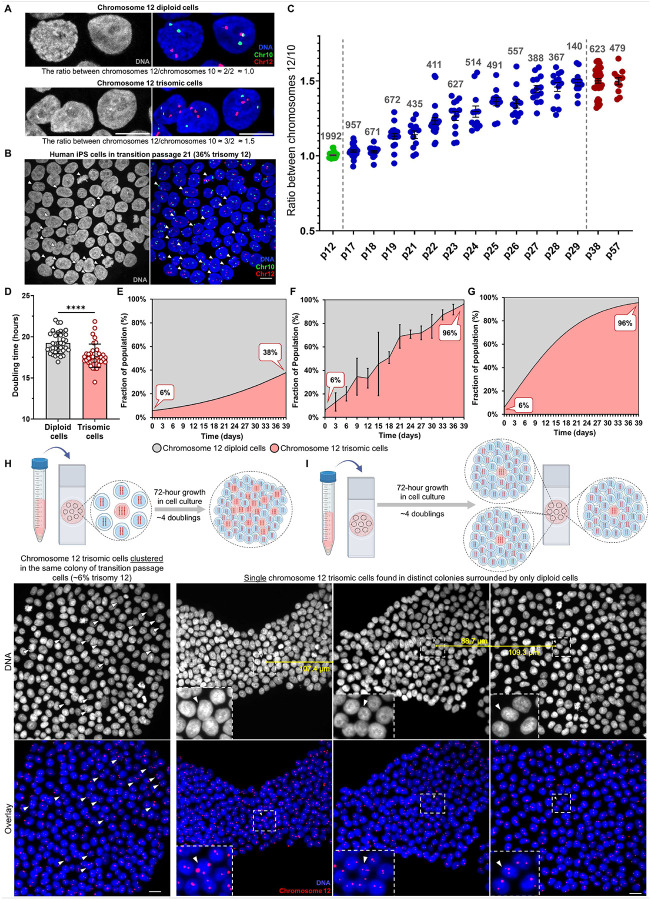
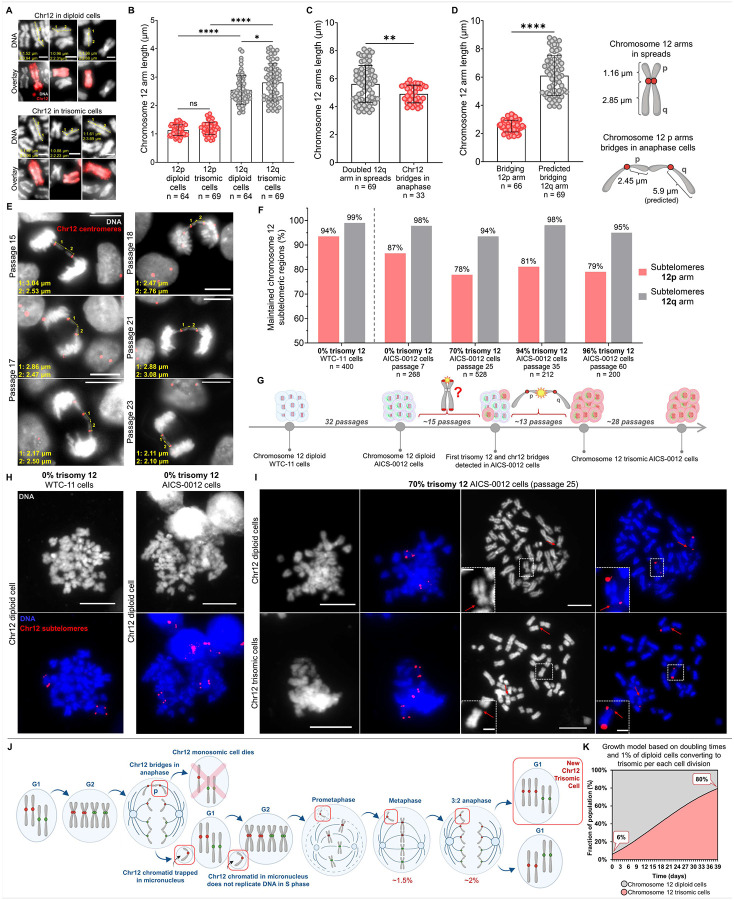
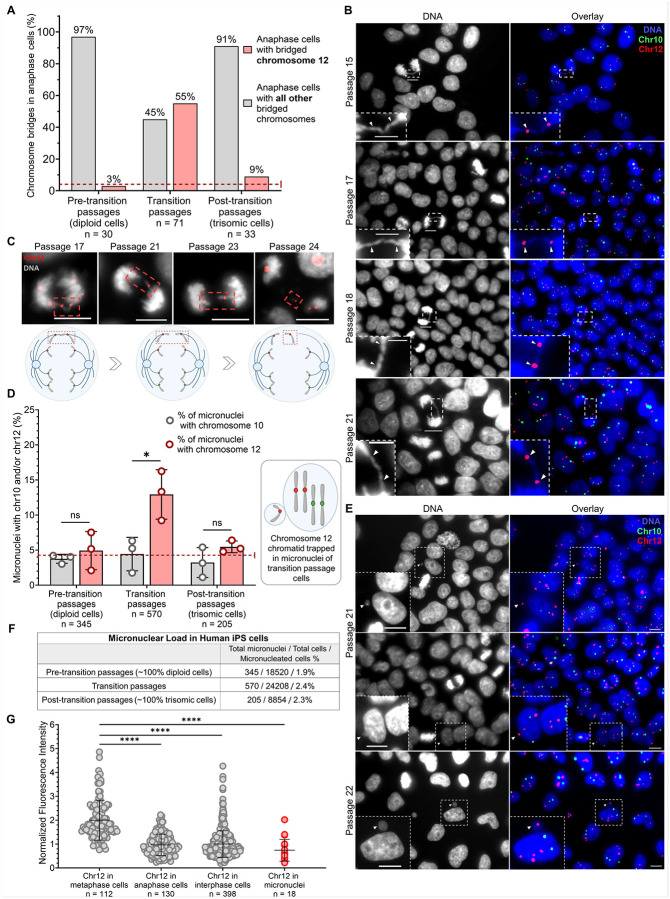
Cultured pluripotent stem cells are unique in being the only fully diploid immortal human cell lines. However, during continued culture, they acquire significant chromosome abnormalities. Chromosome 12 trisomy is the most common whole-chromosome abnormality found during culture of human induced pluripotent stem cells (iPSCs). The conventional paradigm is that trisomy 12 occurs very rarely but provides a proliferative advantage, enabling these cells to outcompete the diploid. Here, we challenge this prevailing model by demonstrating that trisomy 12 arises simultaneously in a very high percentage of diploid cells. Using a single cell line that reproducibly undergoes transition from diploid to trisomy 12, we found that proliferation differences alone do not account for the rapid dominance of trisomic cells. Through careful mapping by fluorescent in-situ hybridization, we identified critical transition passages where trisomic cells first appeared and swiftly gained dominance. Remarkably, single trisomic cells repeatedly emerged de novo from diploid parents. Delving deeper, we discovered an extremely high incidence of chromosome 12 anaphase bridging exclusively during transition passages, along with overrepresentation of chromosome 12 chromatids in micronuclei. These micronuclei fail to replicate during S phase. Subsequently, when these micronucleated cells enter mitosis they contain an unreplicated chromosome 12 chromatids. We also found that nearly 20% of the shorter p arms of chromosome 12 but not the longer q arms exhibited loss of subtelomeric repeats during transition passages. Chromosome 12p arms were exclusively responsible for the bridging observed in anaphase cells. Our findings unveil a novel mechanism of whole-chromosome instability in human stem cells, where chromosome 12p arm-specific segregation errors occur simultaneously in a high percentage of cells. The slight yet significant growth advantage of trisomy 12 cells allows them to persist and eventually dominate the population. Our findings detailing this novel interpretation of the origin of chromosome instability in cultured of human stem cells may have broad implications for understanding the genesis of aneuploidy across diverse biological systems.
培养的多能干细胞是唯一完全二倍体的不朽人类细胞系,具有独特性。然而,在持续培养过程中,它们会出现显著的染色体异常。12号染色体三体是在人类诱导多能干细胞(iPSC)培养过程中发现的最常见的整条染色体异常。传统模式认为12号染色体三体很少发生,但具有增殖优势,使这些细胞能够胜过二倍体细胞。在这里,我们通过证明12号染色体三体在非常高比例的二倍体细胞中同时出现,对这一普遍模型提出了挑战。使用一个可重复地从二倍体转变为12号染色体三体的单细胞系,我们发现仅增殖差异并不能解释三体细胞的快速主导地位。通过荧光原位杂交的仔细定位,我们确定了三体细胞首次出现并迅速占据主导地位的关键转变阶段。值得注意的是,单个三体细胞反复从二倍体亲本中新生出现。深入研究后,我们发现仅在转变阶段出现极高频率的12号染色体后期桥接,以及微核中12号染色体染色单体的过度存在。这些微核在S期无法复制。随后,当这些微核化细胞进入有丝分裂时,它们含有未复制的12号染色体染色单体。我们还发现,在转变阶段,近20%的12号染色体较短的p臂而非较长的q臂表现出亚端粒重复序列的缺失。12号染色体p臂是后期细胞中观察到的桥接的唯一原因。我们的发现揭示了人类干细胞中整条染色体不稳定性的一种新机制,即12号染色体p臂特异性分离错误在高比例细胞中同时发生。12号染色体三体细胞轻微但显著的生长优势使其能够持续存在并最终主导群体。我们对人类干细胞培养中染色体不稳定性起源的这一新解释的详细发现,可能对理解不同生物系统中aneuploidy的发生具有广泛影响。