Zhang Qian, Yan Lei, Bao Yujie, Yuan Xiaoling, Yin Donglin, Xu Jie
Department of Infectious Disease, Shanghai Ninth People's Hospital, Shanghai Jiao Tong University School of Medicine, Shanghai, People's Republic of China.
Onco Targets Ther. 2024 Dec 11;17:1189-1193. doi: 10.2147/OTT.S486860. eCollection 2024.
Alectinib is a second generation of anaplastic lymphoma kinase (ALK) inhibitor that has been approved for the treatment of advanced non-small-cell lung cancer (NSCLC) with ALK rearrangements. Hepatotoxicity is the most common adverse drug reaction. However, there is currently no published report on the pathologic findings of alectinib-induced hyperbilirubinemia.
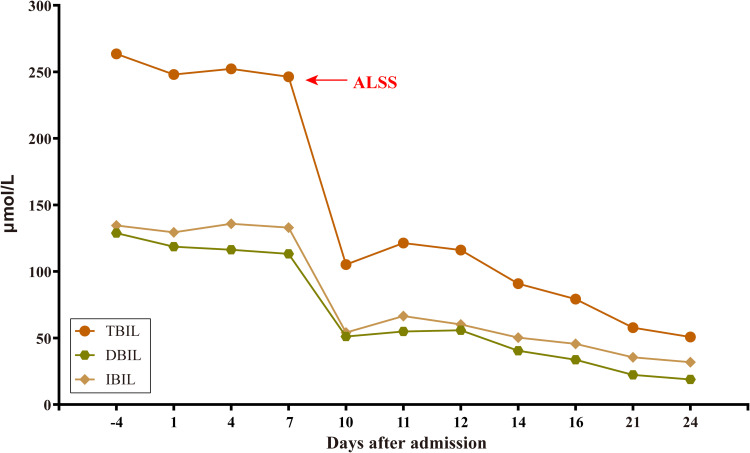
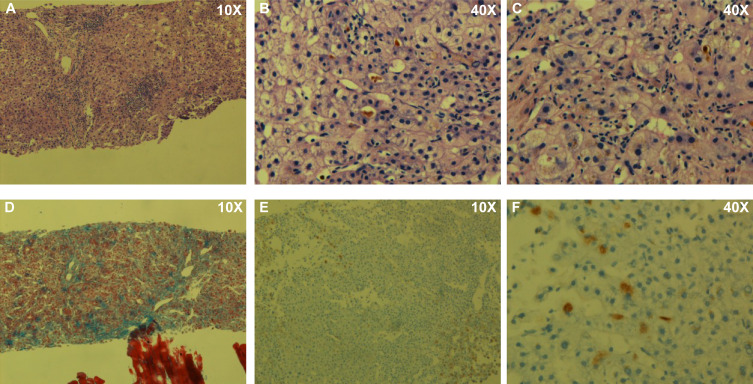
Here, we report a case of a patient with NSCLC and chronic hepatitis B (CHB) who was treated with alectinib and developed grade 4 hyperbilirubinemia after 3 years on therapy. Alectinib was discontinued, and an artificial liver support system (ALSS) was used to decline blood bilirubin levels. The pathological manifestations from a liver biopsy showed the hepatocytes with scattered focal necrosis, bile stasis, and vesicular steatosis, bile emboli in capillaries, and star-shaped fibers proliferation in the portal area.
This is the first report of alectinib-induced hyperbilirubinemia which was confirmed by liver histopathology and successfully relieved by ALSS treatment and drug discontinuation.
阿来替尼是第二代间变性淋巴瘤激酶(ALK)抑制剂,已被批准用于治疗ALK重排的晚期非小细胞肺癌(NSCLC)。肝毒性是最常见的药物不良反应。然而,目前尚无关于阿来替尼引起高胆红素血症病理表现的报道。
在此,我们报告1例NSCLC合并慢性乙型肝炎(CHB)患者,接受阿来替尼治疗3年后出现4级高胆红素血症。停用阿来替尼,并使用人工肝支持系统(ALSS)降低血胆红素水平。肝脏活检的病理表现显示肝细胞有散在局灶性坏死、胆汁淤积和小泡性脂肪变性,毛细血管内有胆栓,门管区有星状纤维增生。
这是首例经肝脏组织病理学证实的阿来替尼引起的高胆红素血症,经ALSS治疗和停药后成功缓解。