Xin Lun, Lan Lan, Mellal Mourad, McChesney Nathan, Vaughan Robert, Berdugo Claudia, Li Yunsong, Zhang Jingtao
Product Development, Catalent Pharma Solutions, 3770 W. Jonathan Dr., Bloomington, IN 47404, United States.
Product Development, Catalent Pharma Solutions, 14 School House Rd, Somerset, NJ 08873, United States.
Antib Ther. 2024 Oct 12;7(4):335-350. doi: 10.1093/abt/tbae028. eCollection 2024 Oct.
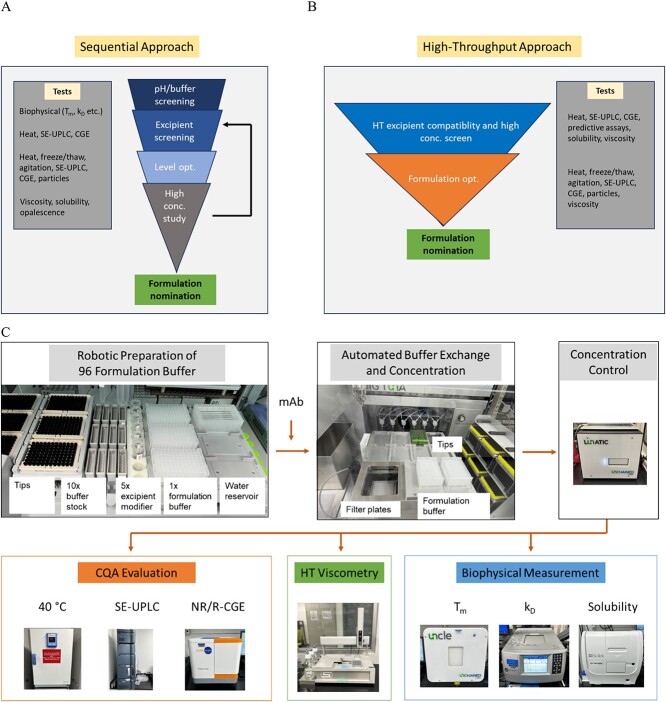
Formulation screening is essential to experimentally balance stability and viscosity in high-concentration mAb formulations. We developed a high-throughput approach with automated sample preparation and analytical workflows to enable the integrated assessment of excipient compatibility and viscosity of mAb formulations.
Ninety-six formulations of a trastuzumab biosimilar were screened by combining 8 types of excipient modifiers with 4 types of buffers across a pH range of 4.5 to 7.5. Key stability risks, including high molecular weight (HMW) aggregation and fragmentation, were thoroughly assessed along with viscosity at high concentrations. Additionally, several biophysical parameters were evaluated for their ability to predict stability or viscosity outcomes. Multiple linear regression was applied to fit the data and identify key factors.
The optimal pH range for the trastuzumab biosimilar was found to be 5.0 to 6.5, based on opposing pH dependencies for stability and viscosity. Buffer type had a minor effect on viscosity and fragmentation but played a significant role in influencing HMW aggregates, with Na-acetate and histidine-HCl being the best candidates. The impact of excipient modifiers on viscosity, HMW, and fragmentation depended on both pH and buffer type, showing strong interactions among factors. Arginine-HCl and lysine-HCl effectively lowered viscosity of the trastuzumab biosimilar at pH levels above 6.0, while glycine formulations were more effective at reducing viscosity below pH 6.0. Histidine-HCl, arginine-HCl, and lysine-HCl lowered the risk of HMW aggregation, whereas formulations containing Na-phosphate or NaCl showed higher HMW aggregation. Formulations with arginine-HCl, lysine-HCl, and NaCl demonstrated a rapid increase in fragmentation at pH levels below 5.0, while Na-aspartate formulations showed increased fragmentation at pH levels above 6.5.
Hence, it is important to optimize the levels of each chosen excipient in the formulation study to balance their benefits against potential incompatibilities. This study serves as a foundation for identifying high-concentration antibody formulations using a high-throughput approach, where minimal materials are required, and optimized formulation design spaces can be quickly identified.
在高浓度单克隆抗体制剂中,配方筛选对于通过实验平衡稳定性和粘度至关重要。我们开发了一种高通量方法,采用自动化样品制备和分析工作流程,以实现对单克隆抗体制剂中辅料兼容性和粘度的综合评估。
通过在4.5至7.5的pH范围内将8种辅料改性剂与4种缓冲液组合,筛选了96种曲妥珠单抗生物类似物配方。全面评估了包括高分子量(HMW)聚集和片段化在内的关键稳定性风险以及高浓度下的粘度。此外,还评估了几个生物物理参数预测稳定性或粘度结果的能力。应用多元线性回归来拟合数据并确定关键因素。
基于稳定性和粘度对pH的相反依赖性,发现曲妥珠单抗生物类似物的最佳pH范围为5.0至6.5。缓冲液类型对粘度和片段化影响较小,但在影响HMW聚集体方面起重要作用,醋酸钠和组氨酸盐酸盐是最佳选择。辅料改性剂对粘度、HMW和片段化的影响取决于pH和缓冲液类型,显示出各因素之间的强烈相互作用。盐酸精氨酸和盐酸赖氨酸在pH高于6.0时有效降低曲妥珠单抗生物类似物的粘度,而甘氨酸配方在pH低于6.0时降低粘度更有效。组氨酸盐酸盐、盐酸精氨酸和盐酸赖氨酸降低了HMW聚集的风险,而含有磷酸钠或氯化钠的配方显示出更高的HMW聚集。含有盐酸精氨酸、盐酸赖氨酸和氯化钠的配方在pH低于5.0时片段化迅速增加,而天冬氨酸钠配方在pH高于6.5时片段化增加。
因此,在配方研究中优化每种所选辅料的水平以平衡其益处与潜在的不相容性非常重要。本研究为使用高通量方法鉴定高浓度抗体制剂奠定了基础,该方法所需材料最少,并且可以快速确定优化的配方设计空间。