Dan Ashley, Ramachandran Rohit
Department of Chemical and Biochemical Engineering, Rutgers University, Piscataway, NJ 08854, USA.
Int J Pharm X. 2024 Sep 26;8:100287. doi: 10.1016/j.ijpx.2024.100287. eCollection 2024 Dec.
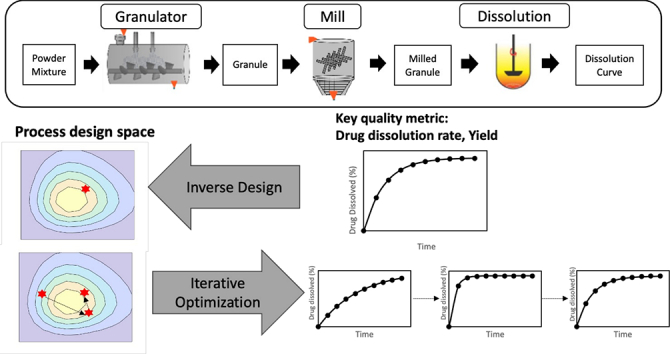
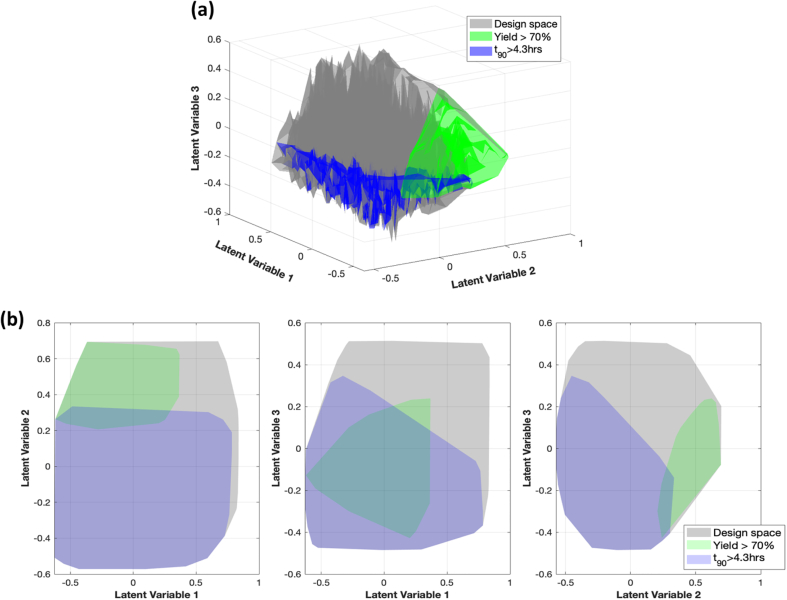
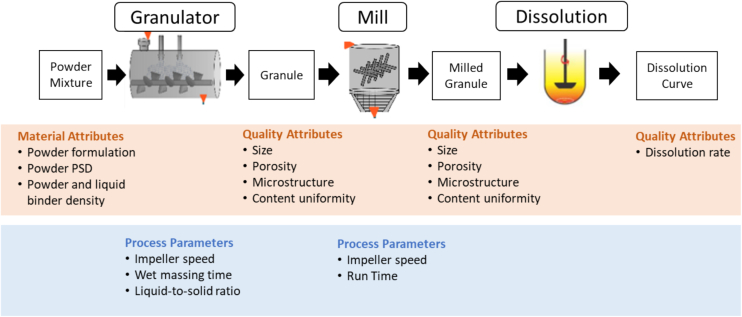
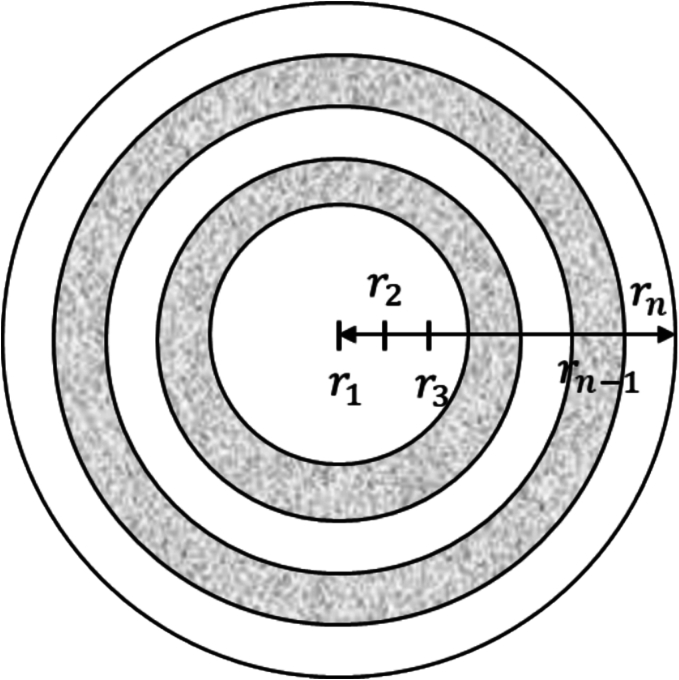
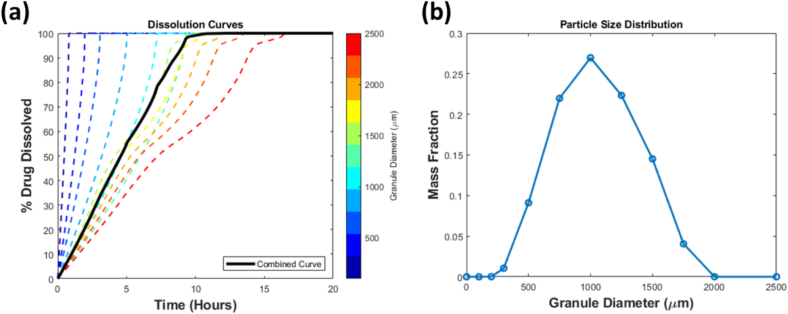
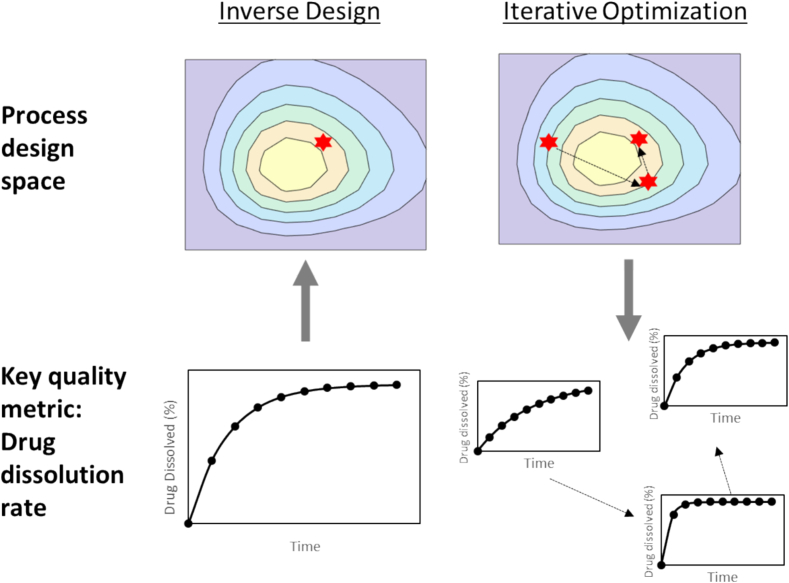
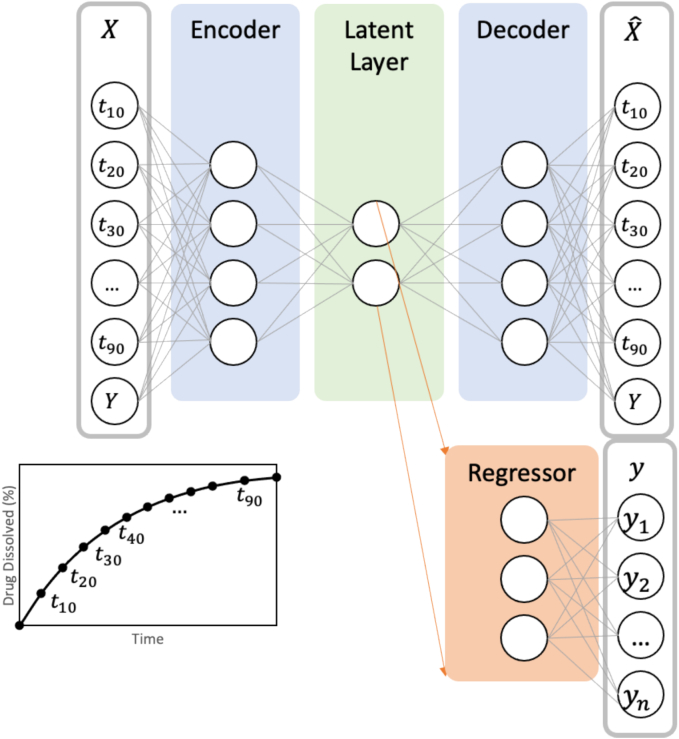
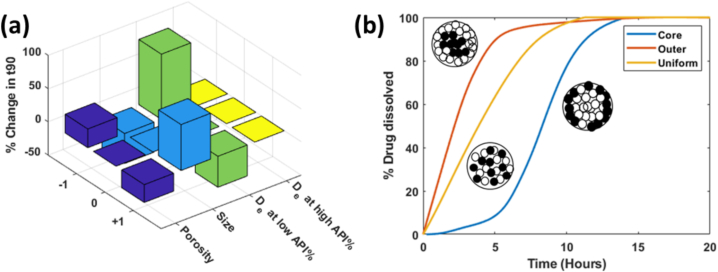
In pharmaceutical manufacturing, integrating model-based design and optimization can be beneficial for accelerating process development. This study explores the utilization of Machine Learning (ML) techniques as a surrogate model for the optimization of a three-unit wet-granulation based flowsheet model for solid dosage form manufacturing. First, a reduced representation of a wet granulation flowsheet model is developed, incorporating a granulation and milling process, along with a novel dissolution model that accounts for the effect of particle size, porosity, and microstructure on dissolution rate. Two optimization approaches are compared, including an autoencoder-based inverse design and a surrogate-based forward optimization. Both methods address the bi-objective problem of maximizing dissolution time and product yield by identifying the optimal granulation and mill process parameters. For this case study, both approaches were effective and incurred a similar computational cost, averaging under 4 s. However, the autoencoder approach offers an advantage through dimensionality reduction, a feature not available in surrogate-based optimization. Dimensional reduction is particularly beneficial for complex process designs with numerous inputs and outputs. The lower dimensional representation helps improve process understanding through enhanced visualization of the process design space and facilitates feasibility studies involving multiple constraints. The autoencoder-based inverse design introduced in this work showcases an implementation of AI and ML in pharmaceutical process development, demonstrating the potential to enhance process efficiency and product quality in complex manufacturing scenarios.
在制药生产中,整合基于模型的设计与优化有助于加速工艺开发。本研究探索利用机器学习(ML)技术作为替代模型,以优化用于固体剂型生产的基于三单元湿法制粒的流程图模型。首先,开发了一种湿法制粒流程图模型的简化表示,纳入了制粒和研磨过程,以及一个考虑了粒径、孔隙率和微观结构对溶解速率影响的新型溶解模型。比较了两种优化方法,包括基于自动编码器的逆向设计和基于替代模型的正向优化。两种方法都通过确定最佳制粒和研磨工艺参数来解决最大化溶解时间和产品收率的双目标问题。对于本案例研究,两种方法均有效且计算成本相近,平均在4秒以下。然而,自动编码器方法通过降维提供了一个优势,这是基于替代模型的优化所不具备的特征。降维对于具有大量输入和输出的复杂工艺设计特别有益。较低维度的表示有助于通过增强对工艺设计空间的可视化来提高对工艺的理解,并便于进行涉及多个约束的可行性研究。本文介绍的基于自动编码器的逆向设计展示了人工智能和机器学习在制药工艺开发中的应用,证明了在复杂制造场景中提高工艺效率和产品质量的潜力。