Li Shuai, Chen Xiaosong, Shen Kunwei
Department of General Surgery, Comprehensive Breast Health Center, Ruijin Hospital, Shanghai Jiao Tong University School of Medicine, Shanghai, China.
Front Oncol. 2024 Nov 29;14:1443467. doi: 10.3389/fonc.2024.1443467. eCollection 2024.
Non-metastatic breast cancer patients who had a medical history of skin or cervix cancers were presently eligible for clinical trials while few data were available regarding thyroid gland cancer. The study estimated the rate of prior thyroid gland cancer and evaluated its impact on survivals among breast cancer patients.
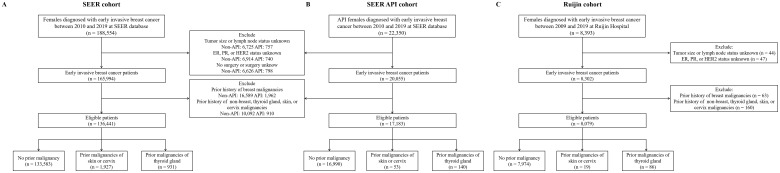
Non-metastatic invasive breast cancer patients from the SEER database (SEER cohort) between 2010 and 2019 and Ruijin Hospital (Ruijin cohort) during 2009 and 2019 were retrospectively analyzed. Ascian or Pacific Island patients in the SEER cohort (SEER API cohort) were analyzed separately. Chi-square test and multivariate logistic regression analysis were performed to describe the clinical features. Kaplan-Meier analysis and Cox proportional hazards model were used to compare the overall survival (OS) and breast cancer specific survival (BCSS).
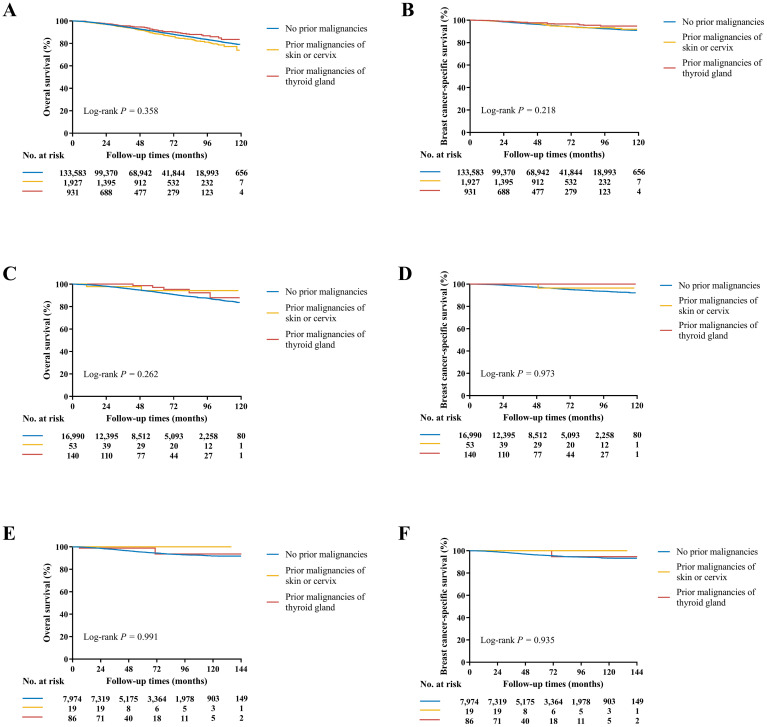
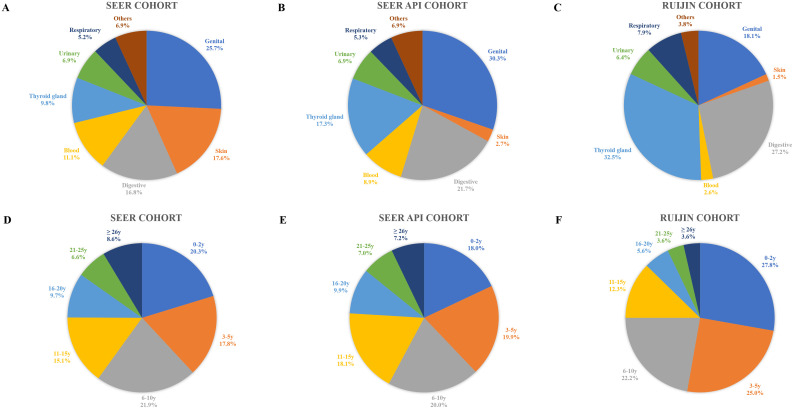
A total of 136,441 patients from the SEER cohort, 17,183 from the SEER API cohort, and 8,079 from the Ruijin cohort were enrolled, of whom 0.68%, 0.81%, and 1.06% had a medical history of thyroid gland cancer, respectively. Patients with prior thyroid gland cancers were significantly older (51-60 years: OR 1.84, 95% CI 1.46-2.30, < 0.001; 61-70 years: OR 2.00, 95% CI 1.61-2.50, < 0.001; > 70 years: OR 1.51, 95% CI 1.18-1.92, = 0.001) and more likely to be API (OR 1.23, 95% CI 1.03-1.48, = 0.026) versus other races. Multivariate analysis demonstrated that patients with a history of thyroid gland cancer had comparable OS (SEER: HR 0.87, 95% CI 0.68-1.11, = 0.257; SEER API: HR 0.53, 95% CI 0.22-1.28, = 0.159; Ruijin: HR 1.07, 95% CI 0.26-4.29, = 0.811) and BCSS (SEER: HR 0.72, 95% CI 0.49-1.08, = 0.117; SEER API: HR ∞, 95% CI ∞-∞, = 0.878; Ruijin: HR 0.70, 95% CI 0.10-4.98, = 0.750) versus those without primary malignancies in the three cohorts.
There were of a sizable of non-metastatic breast cancer patients with medical history of thyroid gland cancer, which was related with different races. Prior thyroid gland cancer had no adverse impact on clinical outcomes, indicating possible eligible in further clinical trials.
有皮肤癌或宫颈癌病史的非转移性乳腺癌患者目前有资格参加临床试验,而关于甲状腺癌的数据较少。本研究估计了既往甲状腺癌的发生率,并评估了其对乳腺癌患者生存率的影响。
对2010年至2019年期间来自监测、流行病学和最终结果(SEER)数据库(SEER队列)以及2009年至2019年期间来自瑞金医院(瑞金队列)的非转移性浸润性乳腺癌患者进行回顾性分析。对SEER队列中的亚洲或太平洋岛民患者(SEER API队列)进行单独分析。采用卡方检验和多因素逻辑回归分析来描述临床特征。采用Kaplan-Meier分析和Cox比例风险模型比较总生存期(OS)和乳腺癌特异性生存期(BCSS)。
共纳入136441例SEER队列患者、17183例SEER API队列患者和8079例瑞金队列患者,其中分别有0.68%、0.81%和1.06%有甲状腺癌病史。与其他种族相比,有既往甲状腺癌的患者年龄显著更大(51 - 60岁:比值比[OR] 1.84,95%置信区间[CI] 1.46 - 2.30,P < 0.001;61 - 70岁:OR 2.00,95% CI 1.61 - 2.50,P < 0.001;> 70岁:OR 1.51,95% CI 1.18 - 1.92,P = 0.001),且更可能是亚洲或太平洋岛民(OR 1.23,95% CI 1.03 - 1.48,P = 0.026)。多因素分析表明,在这三个队列中,有甲状腺癌病史的患者与无原发性恶性肿瘤的患者相比,OS(SEER:风险比[HR] 0.87,95% CI 0.68 - 1.11,P = 0.257;SEER API:HR 0.53,95% CI 0.22 - 1.28,P = 0.159;瑞金:HR 1.07,95% CI 0.26 - 4.29,P = 0.811)和BCSS(SEER:HR 0.72,95% CI 0.49 - 1.08,P = 0.117;SEER API:HR ∞,95% CI ∞ - ∞,P = 0.878;瑞金:HR 0.70,95% CI 0.10 - 4.98,P = 0.750)相当。
有相当数量的非转移性乳腺癌患者有甲状腺癌病史,这与不同种族有关。既往甲状腺癌对临床结局无不良影响,表明可能适合进一步的临床试验。