Autorino Rosa, Rinaldi Raffaella Michela, Macchia Gabriella, Boccardi Mariangela, Mihoci Roshanian Inga, Sebastiani Rita, Santo Bianca, Russo Donatella, Ferioli Martina, Benini Anna, Perrucci Elisabetta, Raguso Arcangela, Cossa Sabrina, Matteucci Paolo, Talocco Claudia, Vicenzi Lisa, Trippa Fabio, Draghini Lorena, Augurio Antonietta, Di Guglielmo Fiorella Cristina, Cocuzza Paola, Pistis Francesca, De Felice Francesca, Meregalli Sofia, Bonetto Elisa Maria, Tamburo Maria, Bini Vittorio, Vavassori Andrea, Gambacorta Maria Antonietta, Aristei Cynthia
Department of Radiation Oncology, Fondazione Policlinico Universitario A. Gemelli IRCCS, Rome, Italy.
Responsible Research Hospital, Unità Operativa Di Radioterapia Oncologica 'Molise ART', Campobasso, Italy.
Radiol Med. 2025 Apr;130(4):463-473. doi: 10.1007/s11547-024-01940-6. Epub 2024 Dec 17.
To compare Italian use with current international guidelines and to evaluate oncological outcomes and toxicity patterns of adjuvant radiation therapy (RT) for endometrial cancer (EC) in Italian women.
To conduct a retrospective multicentre Italian study a large database was set up. Inclusion criteria were: accrual between 2010 and 2020, treatment with surgery, post-operative external beam RT (EBRT) and/or interventional radiotherapy (IRT) associated or not with adjuvant chemotherapy. Oncological outcomes, acute and late toxicities were analysed according to RT schedule and risk group.
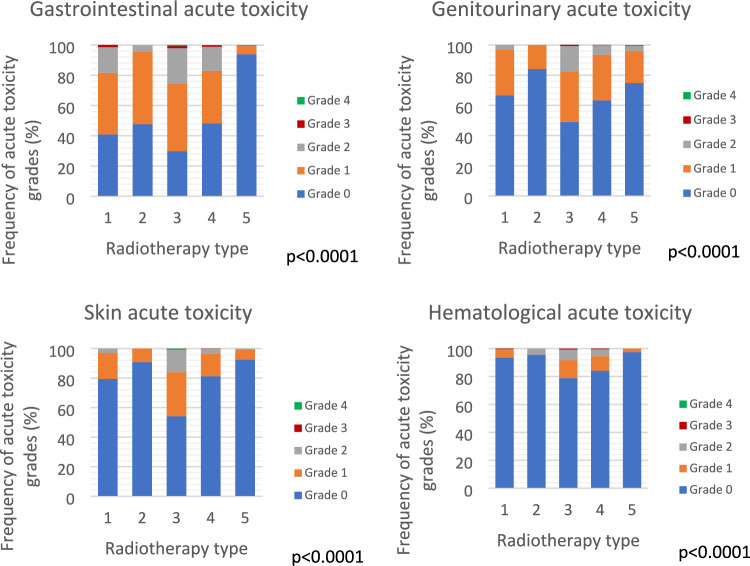
A total of 1848 patients, from 16 Italian RT centres were enrolled (median age 65 years, range 27-88). All patients received post-operative RT associated with chemotherapy in 31%. Patients were stratified on the basis of standard risk factors (Bosse et al. in Eur J Cancer 51:1742-50, 2015). After merging intermediate and high-intermediate risk classes into one intermediate group and including advanced and oligometastatic disease in the high-risk group, the low-risk group encompassed 124 patients, the intermediate-risk 1140, and the high risk 576. No low-risk patient developed local relapse (LR). Multivariate analysis showed that intermediate risk patients had a 2.5-fold increased risk of LR if treated with IRT alone vs EBRT-IRT boost. RT schedule did not impact significantly on LR in high risk patients. All acute toxicity parameters were highest in patients who received EBRT with simultaneous integrated boost (EBRT-SIB) and lowest in patients who received only IRT (p < 0.0001). Late toxicity was highest patients who received EBRT-SIB and lowest in those who were given EBRT with sequential boost (p < 0.0001).
This retrospective study showed that Italian administration of adjuvant RT for EC is in accordance with current international guidelines. IRT alone for low-risk patients and EBRT associated with vaginal IRT remain standard adjuvant approaches for EC.
比较意大利子宫内膜癌辅助放疗的应用情况与当前国际指南,并评估意大利女性子宫内膜癌(EC)辅助放疗的肿瘤学结局和毒性模式。
为开展一项回顾性多中心意大利研究,建立了一个大型数据库。纳入标准为:2010年至2020年期间入组,接受手术治疗,术后接受外照射放疗(EBRT)和/或介入放疗(IRT),联合或不联合辅助化疗。根据放疗方案和风险组分析肿瘤学结局、急性和晚期毒性。
共纳入来自16个意大利放疗中心的1848例患者(中位年龄65岁,范围27 - 88岁)。31%的患者接受了与化疗相关的术后放疗。根据标准风险因素对患者进行分层(博斯等人,《欧洲癌症杂志》51:1742 - 50,2015年)。将中风险和高中风险类别合并为一个中风险组,并将晚期和寡转移疾病纳入高风险组后,低风险组有124例患者,中风险组有1140例,高风险组有576例。低风险患者未发生局部复发(LR)。多因素分析显示,与EBRT - IRT推量相比,仅接受IRT治疗的中风险患者发生LR的风险增加2.5倍。放疗方案对高风险患者的LR没有显著影响。所有急性毒性参数在接受同步整合推量的EBRT(EBRT - SIB)患者中最高,在仅接受IRT的患者中最低(p < 0.0001)。晚期毒性在接受EBRT - SIB的患者中最高,在接受序贯推量的EBRT患者中最低(p < 0.0001)。
这项回顾性研究表明,意大利对EC的辅助放疗管理符合当前国际指南。低风险患者单独使用IRT以及EBRT联合阴道IRT仍然是EC的标准辅助治疗方法。