Goldberg Ori, Shmueli Einat, Levinsky Yoel, Vardi Yoav, Yaniv Noga, Bar-On Ophir, Levine Hagit, Berant Ron, Mei Zahav Meir, Prais Dario, Stafler Patrick
Pulmonary Institute, Schneider Children's Medical Center of Israel, Petach Tikva, Israel.
School of Medicine, Faculty of Medical and Health Sciences, Tel Aviv University, Tel Aviv, Israel.
Acta Paediatr. 2025 May;114(5):1015-1021. doi: 10.1111/apa.17531. Epub 2024 Dec 16.
Our aim was to examine how fever duration affected the ability of biomarkers to diagnose community-acquired pneumonia (CAP).
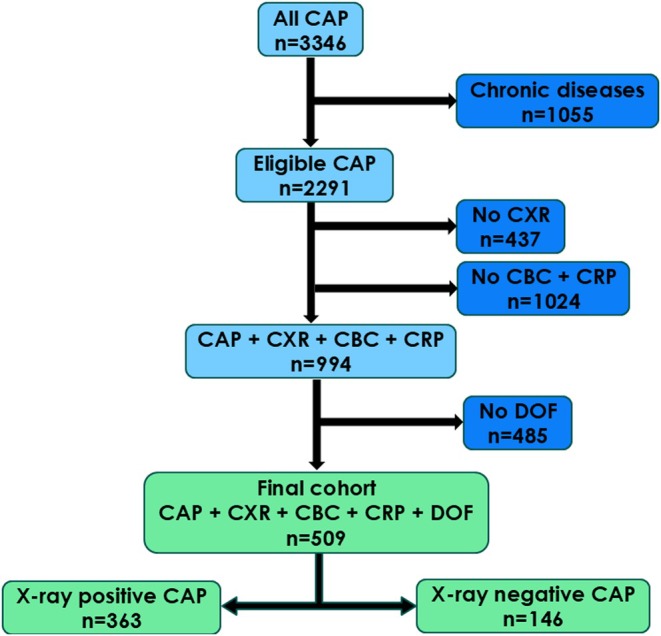
This was a retrospective cohort study of children aged 2-18 years who attended the emergency department at Schneider Children's Medical Centre of Israel with CAP from June 2015 to May 2020. The children underwent biomarker measurements and chest radiographs and optimal biomarker thresholds were identified. Biomarker predictions of x-ray positive CAP were analysed, using receiver operating characteristic curves and area under the curve calculations.
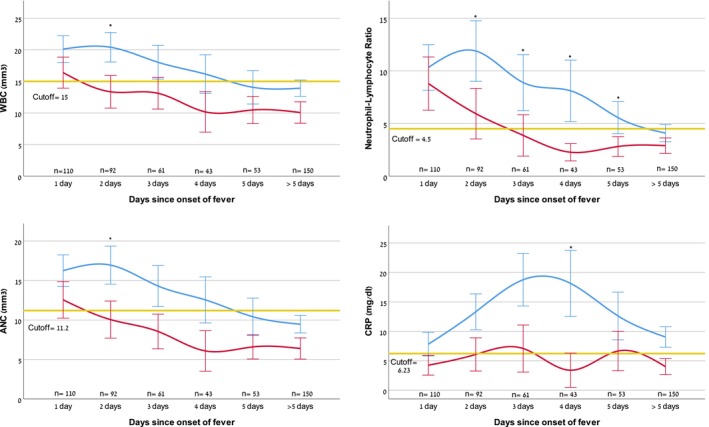
We screened 3346 children, 509 met the inclusion criteria and 363 of those had x-ray positive CAP. White blood counts of >15 000/mm and absolute neutrophil counts of >11 200/mm showed significant discriminatory power on day 2 of a fever. A neutrophil to lymphocyte ratio (NLR) of >4.5 displayed significant discriminatory power from days 2-5 and peaked on day 4. C-reactive protein of 6.23 mg/dL was discriminatory on day 4.
Fever duration affected how effectively biomarkers diagnosed x-ray positive CAP and all were unreliable on day 1. The NLR showed the most consistent reliability and may be suitable for clinical decision-making. Fever duration should be considered to optimise diagnostic accuracy.
我们的目的是研究发热持续时间如何影响生物标志物诊断社区获得性肺炎(CAP)的能力。
这是一项回顾性队列研究,研究对象为2015年6月至2020年5月在以色列施耐德儿童医疗中心急诊科就诊的2至18岁CAP患儿。对这些儿童进行生物标志物测量和胸部X光检查,并确定最佳生物标志物阈值。使用受试者工作特征曲线和曲线下面积计算分析生物标志物对X光阳性CAP的预测。
我们筛查了3346名儿童,509名符合纳入标准,其中363名X光检查显示为阳性CAP。发热第2天时,白细胞计数>15000/mm³和绝对中性粒细胞计数>11200/mm³显示出显著的鉴别能力。中性粒细胞与淋巴细胞比值(NLR)>4.5在发热第2至5天显示出显著的鉴别能力,并在第4天达到峰值。发热第4天时,C反应蛋白水平为6.23mg/dL具有鉴别意义。
发热持续时间影响生物标志物诊断X光阳性CAP的有效性,且所有生物标志物在第1天均不可靠。NLR显示出最一致的可靠性,可能适用于临床决策。应考虑发热持续时间以优化诊断准确性。