Haider Mohammad N, Deren Jule, Khaled Karim, Corrado Cathlyn, Chizuk Haley M, Miecznikowski Jeffrey C, Leddy John J
UBMD Orthopaedics and Sports Medicine, Jacobs School of Medicine and Biomedical Sciences, State University of New York at Buffalo, Buffalo, NY 14221, USA.
Department of Neurology, Jacobs School of Medicine and Biomedical Sciences, State University of New York at Buffalo, Buffalo, NY 14068, USA.
Diagnostics (Basel). 2024 Dec 5;14(23):2743. doi: 10.3390/diagnostics14232743.
BACKGROUND/OBJECTIVE: Assessing Orthostatic Intolerance (OI, symptoms upon standing from supine) is recommended in athletes with sport-related concussions (SRCs), as this is caused by impairments in the cardiovascular autonomic nervous system (cANS). Early Exercise Intolerance (Early EI, symptoms on light physical exertion) is also due to impairments in the cANS but is difficult to incorporate into outpatient clinical practice (cost of personnel, time, equipment). The purpose of this study was to determine if we could use OI to screen for Early EI, as well as understand differences between adolescents who do and do not report OI.
Retrospective chart review. Adolescents with physician-diagnosed SRC performed the 2 min supine to 1 min standing OI test and the Buffalo Concussion Treadmill Test (BCTT) during their first post-SRC visit. Early EI was defined as more-than-mild symptom exacerbation at a heart rate (HR) below 135 bpm on the BCTT; OI was defined as new or increased symptoms of dizziness or lightheadedness on postural change. The sensitivity, specificity and diagnostic accuracy were calculated. Participants with and without OI were compared.
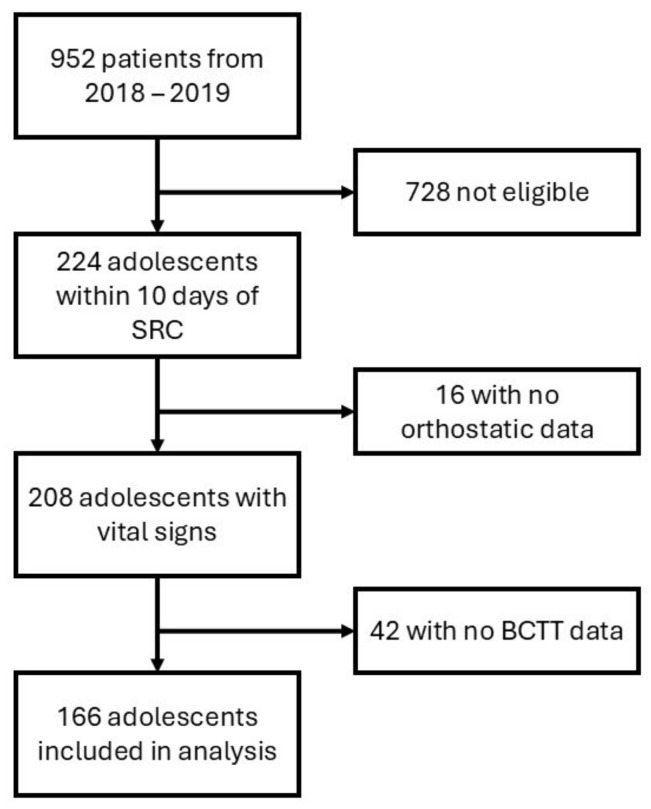
In total, 166 adolescents (mean 15.4 years, 58.8% male) were seen a mean of 5.5 days after injury; 48.2% had OI and 52.4% had Early EI, but there was no association between the two measures (Phi = 0.122, = 0.115). The sensitivity and specificity (with 95% confidence intervals) for OI to screen for Early EI were 54.0% (43.5, 64.3) and 58.2% (47.2, 68.7), respectively. Adolescents with OI had a higher incidence of delayed recovery (24% vs. 9%, = 0.012).
Although both measures seem to be related to impaired autonomic function after SRC, OI has limited accuracy in screening for Early EI, which suggests that their etiologies may be different. Nevertheless, the assessment of OI has clinical utility in the management of SRC.
背景/目的:对于患有运动相关性脑震荡(SRC)的运动员,建议评估直立不耐受(OI,即从仰卧位站立时出现的症状),因为这是由心血管自主神经系统(cANS)功能受损引起的。早期运动不耐受(早期EI,即轻度体力活动时出现的症状)同样归因于cANS功能受损,但难以纳入门诊临床实践(人力成本、时间、设备)。本研究的目的是确定是否可以用OI来筛查早期EI,以及了解报告有OI和未报告有OI的青少年之间的差异。
回顾性病历审查。经医生诊断为SRC的青少年在首次SRC后就诊时进行2分钟仰卧位到1分钟站立位的OI测试以及布法罗脑震荡跑步机测试(BCTT)。早期EI定义为在BCTT中,心率(HR)低于135次/分钟时症状加重超过轻度;OI定义为体位改变时出现新的或加重的头晕或眩晕症状。计算敏感性、特异性和诊断准确性。对有和没有OI的参与者进行比较。
总共166名青少年(平均年龄15.4岁,58.8%为男性)在受伤后平均5.5天就诊;48.2%有OI,52.4%有早期EI,但这两项指标之间无关联(Phi = 0.122,P = 0.115)。OI筛查早期EI的敏感性和特异性(95%置信区间)分别为54.0%(43.5,64.3)和58.2%(47.2,68.7)。有OI的青少年恢复延迟的发生率更高(24%对9%,P = 0.012)。
尽管这两项指标似乎都与SRC后自主神经功能受损有关,但OI在筛查早期EI方面准确性有限,这表明它们的病因可能不同。然而,OI评估在SRC的管理中具有临床实用性。