
通过乳酸发酵对水果副产品进行增值以用于创新饮料配方:微生物学和物理化学效应
Valorization of Fruit By-Products Through Lactic Acid Fermentation for Innovative Beverage Formulation: Microbiological and Physiochemical Effects.
作者信息
Chiarini Elisabetta, Alessandria Valentina, Buzzanca Davide, Giordano Manuela, Seif Zadeh Negin, Mancuso Francesco, Zeppa Giuseppe
机构信息
Department of Agricultural, Forest and Food Sciences (DISAFA), University of Turin, 10095 Grugliasco, TO, Italy.
出版信息
Foods. 2024 Nov 21;13(23):3715. doi: 10.3390/foods13233715.
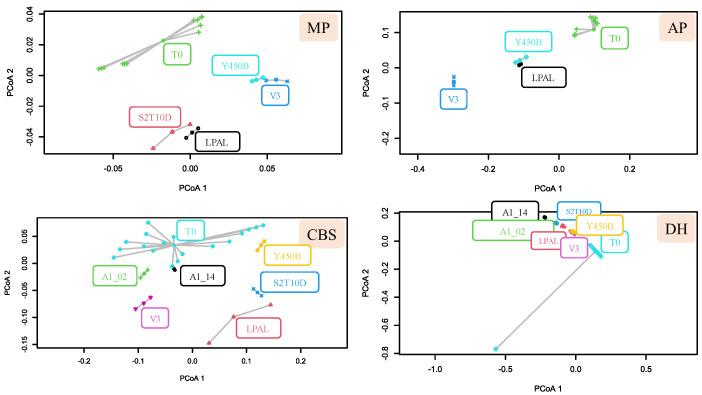
The increase in food production is accompanied by an increase in waste, particularly agricultural by-products from cultivation and processing. These residues are referred to as agricultural by-products. To address this issue, biotechnological processes can be used to create new applications for these by-products. This study explored the use of LAB strains (, subsp. , and ) on by-products such as white grape pomace, cocoa bean shells, apple pomace, and defatted roasted hazelnut to develop yoghurt-style fruit beverages. Microbial load and pH changes were monitored during a 24 h fermentation and 14-day shelf life at 5 °C. Concentrations of sugars, organic acids, and volatile organic compounds were also analyzed using HPLC and GC-qMS. The results showed that optimizing the matrix led to significant bacterial growth, with viable microbes remaining under refrigeration. In particular, the strain of tested on the cocoa bean shell yielded the most promising results. After 24 h of fermentation, the strain reached a charge of 9.3 Log CFU/mL, acidifying the substrate to 3.9 and producing 19.00 g/100 g of lactic acid. Aromatic compounds were produced in all trials, without off-flavours, and characteristic fermented food flavours developed. Additionally, secondary metabolites produced by lactic acid bacteria may enhance the health benefits of these beverages.
粮食产量的增加伴随着废弃物的增加,尤其是来自种植和加工的农业副产品。这些残留物被称为农业副产品。为了解决这个问题,可以利用生物技术工艺为这些副产品创造新的应用。本研究探索了使用乳酸菌菌株( 、 亚种 以及 )处理白葡萄果渣、可可豆壳、苹果果渣和脱脂烤榛子等副产品,以开发酸奶型水果饮料。在5℃下进行24小时发酵和14天保质期期间监测微生物负荷和pH值变化。还使用高效液相色谱法(HPLC)和气相色谱 - 四极杆质谱联用仪(GC - qMS)分析了糖、有机酸和挥发性有机化合物的浓度。结果表明,优化基质导致细菌显著生长,在冷藏条件下仍有存活微生物。特别是在可可豆壳上测试的 菌株产生了最有前景的结果。发酵24小时后,该菌株的菌数达到9.3 Log CFU/mL,将底物酸化至3.9,并产生19.00 g/100 g的乳酸。所有试验均产生了芳香化合物,没有异味,并形成了典型的发酵食品风味。此外,乳酸菌产生的次生代谢产物可能会增强这些饮料对健康的益处。



 Zotero 插件