Wang Lijun, Jing Siluo, Wang Shuang, Xing Zhikai, Qu Jiangyong, Wang Xumin
College of Life Science, Yantai University, Yantai 264005, China.
Plants (Basel). 2024 Nov 26;13(23):3315. doi: 10.3390/plants13233315.
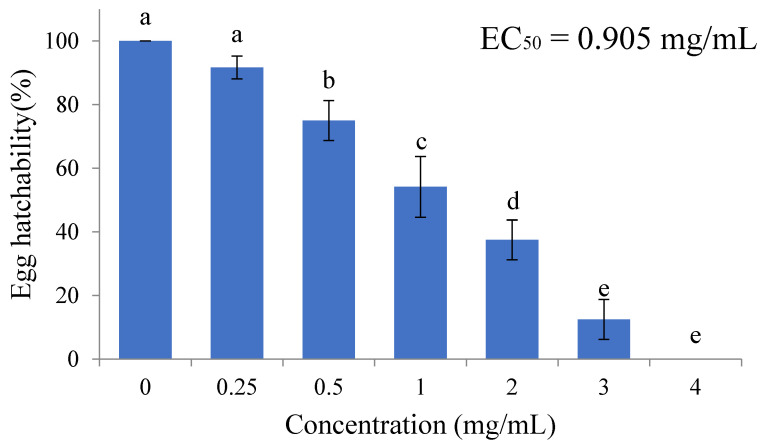
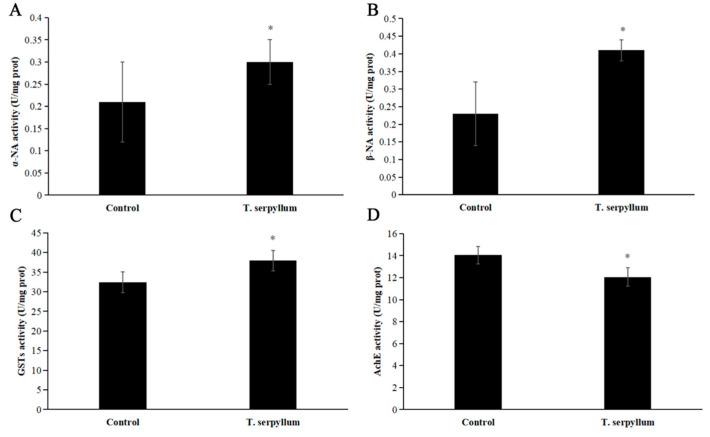
Due to their effectiveness at low doses and relative safety for non-target species, plant essential oils (EOs) are considered ideal alternatives to conventional pesticides for pest control. In this study, the chemical composition of () EO was construed by Gas Chromatography-Mass Spectrometry (GC-MS), and its larvicidal and ovicidal activity against omnivorous pests () was assessed. The effects of EO on the activities of antioxidant detoxification enzymes were also measured. GC-MS analysis revealed that the main constituents of EO were thymol (42.1%), p-cymene (22.4%), and γ-terpinene (18.6%). In the larvicidal toxicity experiment, the EO demonstrated LC50 values of 0.606 and 0.664 mg/mL against the second- and third-instar larvae of respectively, after 48 h exposure. Moreover, an EC value of 0.905 mg/mL was measured against eggs. In , EO treatment reduced the enzymatic activity of ESTs and GST and, conversely, increased the enzymatic activity of AChE. Overall, this study demonstrated that EO has the potential to be implemented as a novel eco-friendly insecticide against .
由于植物精油(EOs)在低剂量下具有有效性且对非目标物种相对安全,因此被认为是用于害虫防治的传统杀虫剂的理想替代品。在本研究中,通过气相色谱 - 质谱联用仪(GC - MS)分析了()EO的化学成分,并评估了其对杂食性害虫()的杀幼虫和杀卵活性。还测定了EO对抗氧化解毒酶活性的影响。GC - MS分析表明,EO的主要成分是百里香酚(42.1%)、对伞花烃(22.4%)和γ - 萜品烯(18.6%)。在杀幼虫毒性实验中,暴露48小时后,EO对()的二龄和三龄幼虫的LC50值分别为0.606和0.664 mg/mL。此外,测得对()卵的EC值为0.905 mg/mL。在()中,EO处理降低了酯酶(ESTs)和谷胱甘肽 - S - 转移酶(GST)的酶活性,相反,增加了乙酰胆碱酯酶(AChE)的酶活性。总体而言,本研究表明EO有潜力作为一种新型环保杀虫剂用于防治()。