Popescu Adrian Marcel, Vlăduțu Diana Elena, Ionescu Mihaela, Târtea Daniel Adrian, Popescu Sanda Mihaela, Mercuț Veronica
Department of Fixed Prosthodontics, University of Medicine and Pharmacy of Craiova, 200349 Craiova, Romania.
Department of Dental Prosthetics, University of Medicine and Pharmacy of Craiova, 200349 Craiova, Romania.
J Clin Med. 2024 Nov 27;13(23):7218. doi: 10.3390/jcm13237218.
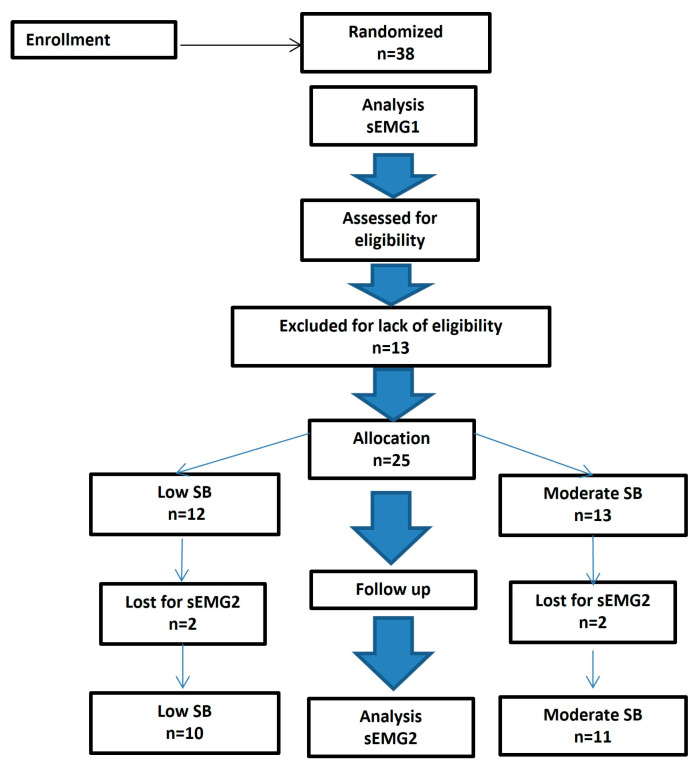
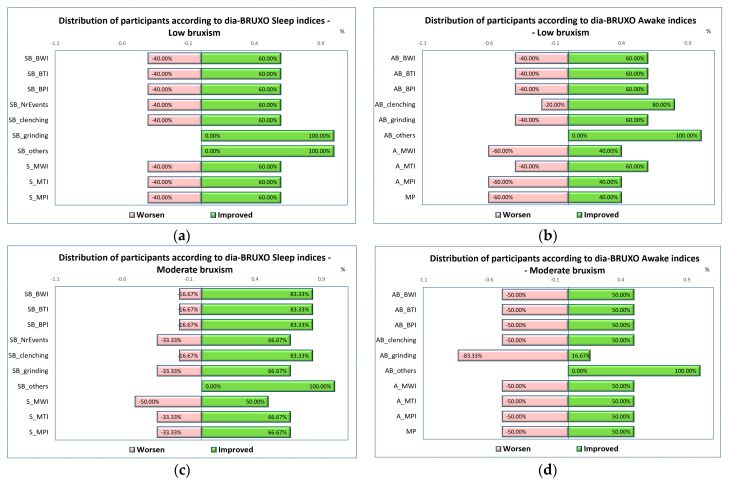
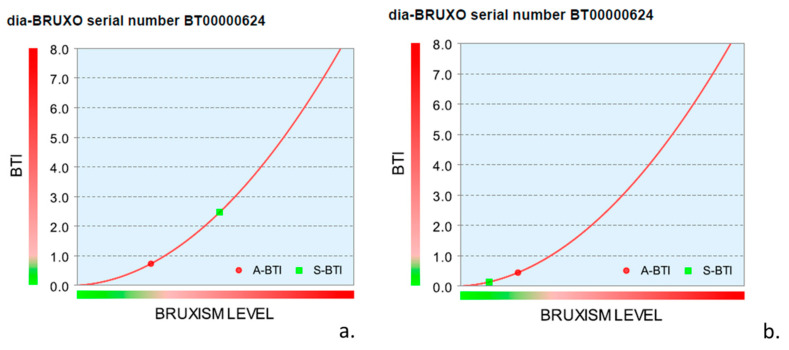
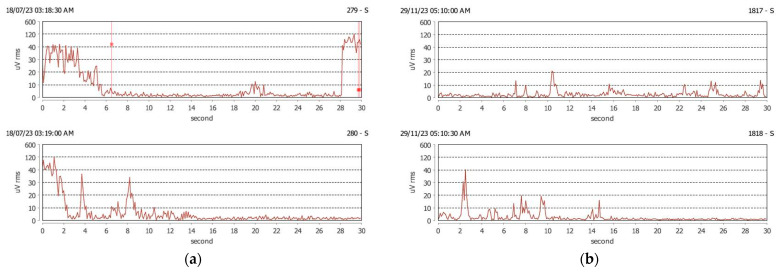
: Bruxism is a masticatory muscle activity, phasic or tonic, with/without teeth contact, that appears in sleep or an awake state. An instrumental technique used to measure the surface electromyographic (sEMG) activity of the masseter muscle is used to diagnose bruxism activity during sleep and while awake. The objective of this study was to compare the variation in bruxism (sleep and awake) indices and masseter activity indices in low sleep bruxism and moderate sleep bruxism before and after wearing an occlusal appliance (OA) for 3 months each night. : A clinical interventional study was designed in which subjects diagnosed with sleep bruxism were randomly selected to be included in the study. After the first sEMG recording, two groups were formed: a low sleep-bruxism group (number of sleep-bruxism events/h between 2 and 4) and a moderate sleep-bruxism group (number of sleep-bruxism events/h equal or higher than 4). All subjects received treatment with a 3D-printed occlusal appliance and wore it each night for 3 months, at which point the second sEMG recording was performed. For each participant of this study, a chart was created that included anamnestic data, clinical data, and sEMG data. The data were statistically analyzed with SPSS, using the Mann-Whitney U and Wilcoxon signed-rank tests. : A total of 21 participants were included in the final analysis, 18 women and 3 men, with a mean age of 24.5 ± 2.7 years. The OA lowered all bruxism indices in the whole group, but clusters analysis showed a significant reduction in sleep-bruxism indices in the moderate sleep-bruxism group, while in the low-bruxism group, the sleep and awake indices varied insignificantly, and the number of sleep-bruxism events/h remained constant. : The 3D-printed occlusal appliances significantly lowered the sleep-bruxism indices and sleep masseter activity indices recorded with a portable sEMG device in the moderate sleep-bruxism group. The OA lowered the awake-bruxism indices and awake masseter activity indices in the moderate sleep-bruxism group.
磨牙症是一种咀嚼肌活动,有相位性或紧张性,伴有或不伴有牙齿接触,出现在睡眠或清醒状态。一种用于测量咬肌表面肌电图(sEMG)活动的仪器技术被用于诊断睡眠期间和清醒时的磨牙症活动。本研究的目的是比较每晚佩戴咬合矫治器(OA)3个月前后,轻度睡眠磨牙症和中度睡眠磨牙症患者的磨牙症(睡眠和清醒时)指数及咬肌活动指数的变化。
设计了一项临床干预研究,将被诊断为睡眠磨牙症的受试者随机纳入研究。在首次进行sEMG记录后,形成了两组:轻度睡眠磨牙症组(每小时睡眠磨牙症事件数在2至4之间)和中度睡眠磨牙症组(每小时睡眠磨牙症事件数等于或高于4)。所有受试者均接受3D打印咬合矫治器治疗,并每晚佩戴3个月,此时进行第二次sEMG记录。为该研究的每位参与者创建了一份图表,其中包括记忆数据、临床数据和sEMG数据。使用SPSS软件,通过曼-惠特尼U检验和威尔科克森符号秩检验对数据进行统计学分析。
最终分析共纳入21名参与者,其中18名女性和3名男性,平均年龄为24.5±2.7岁。OA降低了整个组的所有磨牙症指数,但聚类分析显示,中度睡眠磨牙症组的睡眠磨牙症指数显著降低,而在轻度磨牙症组中,睡眠和清醒指数变化不显著,每小时睡眠磨牙症事件数保持不变。
3D打印咬合矫治器显著降低了中度睡眠磨牙症组中用便携式sEMG设备记录的睡眠磨牙症指数和睡眠咬肌活动指数。OA降低了中度睡眠磨牙症组的清醒磨牙症指数和清醒咬肌活动指数。