Hambleton Ian R, Jeyaseelan Selvi
The University of the West Indies at Cave Hill Bridgetown, Saint Michael Barbados The University of the West Indies at Cave Hill, Bridgetown, Saint Michael, Barbados.
Rev Panam Salud Publica. 2024 Dec 16;48:e64. doi: 10.26633/RPSP.2024.64. eCollection 2024.
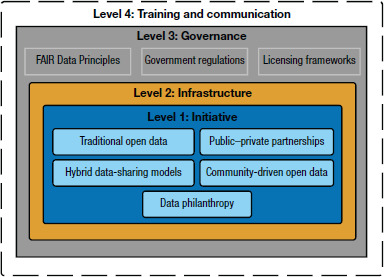
The widespread digitization of information, advances in data processing and the emergence of internet-connected devices have led to a proliferation of data, often loosely referred to as big data. With this digital transformation, offering open data - that is, data freely available for modification and reuse - has emerged as a key strategy for encouraging transparency and innovation. Data reuse holds particular importance in the small island developing states of the Caribbean, which have a limited resource pool from which to tackle the landscape of social priorities. Efforts made towards data-sharing must consider privacy, security and the ethical use of information, and the tension between data as a social good and data for commercial gain can be a determinant of data-sharing decisions. A multidisciplinary approach is needed to realize the potential of data-sharing. In this article, we describe techniques (or pathways) for growing the Caribbean's stock of open data, classifying these into four types. Initiative pathways are techniques to broaden the range of data producers that share data. Infrastructure pathways deal with the practicalities of making data publicly available. Governance pathways are regulations and frameworks that guide data producers, including in meeting their legal data obligations. Training and communication pathways are efforts to raise awareness and knowledge about the benefits and practices of data-sharing. Data-sharing can offer a cost-effective evidence base for the Caribbean's continuing digital transformation. Sustainable sharing is key, and it must include robust technical infrastructure and governance, and ongoing communication.
信息的广泛数字化、数据处理的进步以及联网设备的出现导致了数据的激增,这些数据通常被宽泛地称为大数据。随着这种数字转型,提供开放数据——即可自由用于修改和再利用的数据——已成为鼓励透明度和创新的关键策略。数据再利用在加勒比地区的小岛屿发展中国家尤为重要,这些国家用于应对社会优先事项的资源池有限。在进行数据共享时,必须考虑隐私、安全和信息的道德使用,而数据作为一种社会公益与用于商业利益之间的矛盾可能会成为数据共享决策的一个决定因素。需要采取多学科方法来实现数据共享的潜力。在本文中,我们描述了增加加勒比地区开放数据存量的技术(或途径),并将其分为四类。倡议途径是扩大共享数据的数据生产者范围的技术。基础设施途径涉及使数据公开可用的实际操作。治理途径是指导数据生产者的法规和框架,包括履行其法定数据义务。培训和沟通途径是提高对数据共享的好处和做法的认识与知识的努力。数据共享可为加勒比地区持续的数字转型提供具有成本效益的证据基础。可持续共享是关键,它必须包括强大的技术基础设施和治理以及持续的沟通。